In the United States, a dental hygienist is a licensed oral-health professional who focuses on prevention. Hygienists may assess the mouth, provide preventive services, remove plaque and tartar, and help patients care for their teeth and gums at home.
The short answer to “what does a dental hygienist do?” is: a hygienist provides preventive oral-health care and education, then shares relevant findings with the dental team. Exact duties and supervision rules vary by state, country, setting, and the person’s license.
They are not dental assistants, and they do not simply “help the dentist.” Hygienists have their own education, license, clinical responsibilities, and scope of practice. They also collaborate with dentists and other members of the dental team.
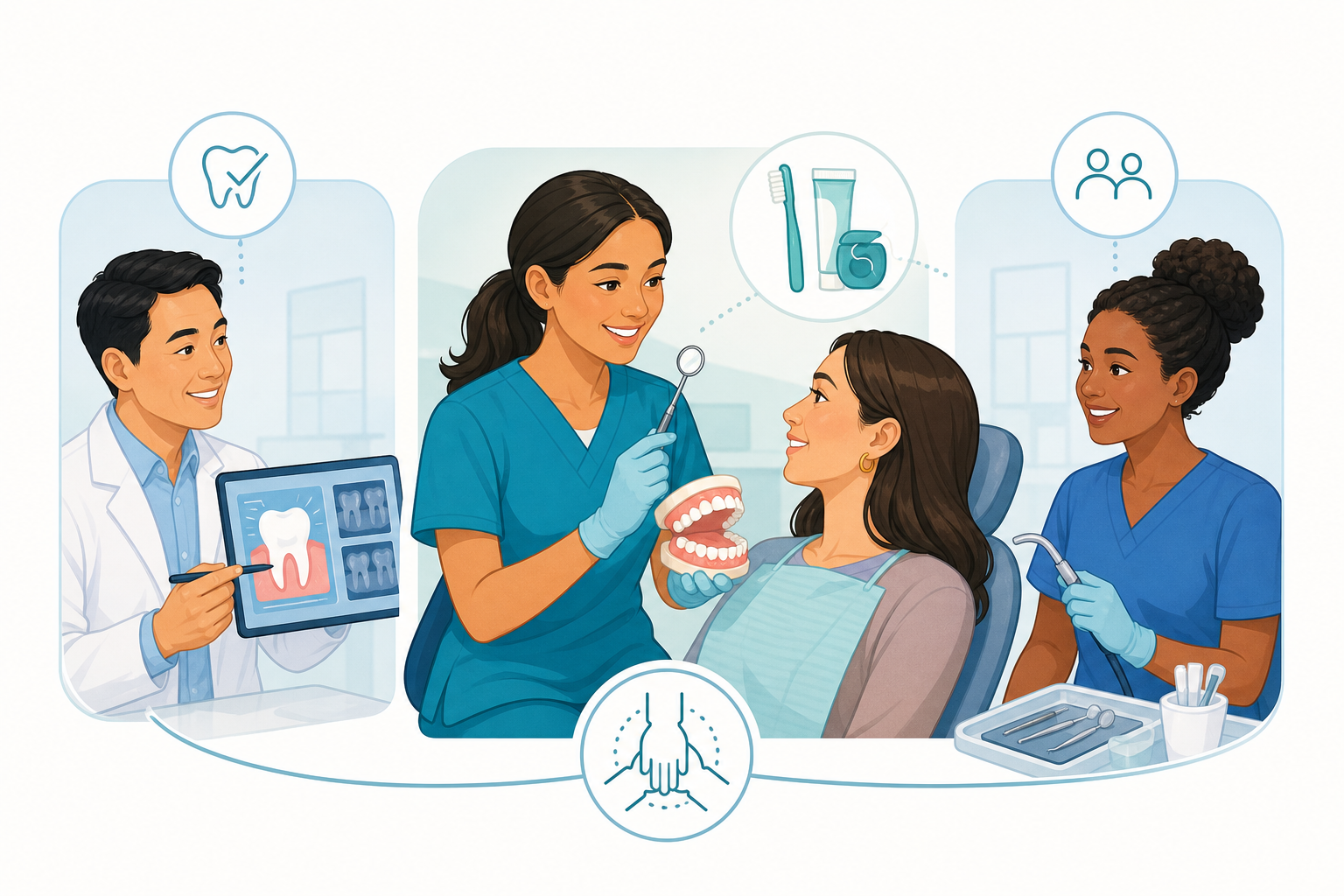
What does a dental hygienist do?
A hygiene appointment may begin with a review of your health history, medications, recent dental concerns, and changes since your last visit. That information can affect how the team plans safe care.
Depending on your needs, the practice, and local rules, a hygienist may:
- assess your teeth, gums, and other oral tissues
- measure around the gums and record findings
- remove soft plaque and hardened tartar, also called calculus
- polish teeth or help clean between them
- take dental X-rays when they are clinically needed and permitted
- apply fluoride or sealants when appropriate
- explain brushing, flossing, interdental cleaning, and other preventive habits
- document care and share important findings with the dentist
Not every appointment includes every item. For example, dental X-rays are not automatically needed at every visit, and sealants are used only in suitable situations.
For a closer look at the cleaning portion of a visit, see what happens during a dental cleaning. A cleaning is one service; the hygienist’s broader role can also include assessment, education, documentation, and preventive planning.
Why does the hygienist ask about your health?
Oral care is part of health care. A current health history helps the dental team understand relevant conditions, allergies, medications, past reactions, and changes that could affect an appointment.
The hygienist may also ask about bleeding, sensitivity, dry mouth, home care, tobacco use, or diet. These questions help build an accurate preventive-care picture; they are not a test of whether you have been a “good” patient.
What happens during the gum assessment?
The hygienist looks for signs that may need attention and may gently measure the spaces around the teeth. Those measurements, together with bleeding, buildup, and other findings, help the dental team track gum health over time.
The hygienist reports relevant findings and records the care provided. A dentist may then examine you, make diagnoses within the dentist’s role, and discuss treatment when needed. Dental-hygiene assessment and dental diagnosis are not interchangeable, and exact responsibilities vary by jurisdiction.
If you want to understand the whole appointment rather than only the hygiene portion, what happens at a dental checkup explains the common examination and discussion steps.
Is a hygienist the same as a dentist or dental assistant?
No. The roles overlap as a team, but they are different.
- Dental hygienists focus strongly on prevention, oral-health assessment, clinical hygiene services, and education.
- Dentists diagnose and manage dental conditions and provide services that can include restorations, procedures, and surgery.
- Dental assistants commonly support care at chairside, prepare rooms and materials, and help the practice run smoothly. Their permitted duties also vary.
A hygienist does not replace a dentist, and a dental assistant is not simply another name for a hygienist.
Why might two hygiene visits feel different?
Your oral health, the reason for the visit, available time, practice model, and local law all shape what happens. Scope-of-practice and supervision rules differ by state or country. Some hygienists also work in community clinics, schools, hospitals, long-term-care settings, education, or public health rather than a traditional dental office.
That is why one person’s hygiene visit may include a service that another person’s does not. If you are unsure who is providing a service or why it is recommended, it is reasonable to ask about the person’s role and what the visit will include.
Questions to ask a dental hygienist
You can ask:
- “What is included in today’s visit?”
- “What did you notice, and what should the dentist review?”
- “Is this service preventive, or is it part of treatment for a specific finding?”
- “Which home-care change would help most right now?”
- “Do local rules affect who can provide this service?”
These questions can clarify the care without asking the hygienist—or yourself—to make a diagnosis from symptoms or appearance alone.
The takeaway
A dental hygienist is a licensed preventive-care professional—not an assistant and not a replacement for a dentist. The hygienist helps assess oral health, remove plaque and tartar, provide permitted preventive services, and make daily care easier to understand. The exact services depend on your needs, the setting, and local rules.
Sources
- Dental Hygienists — U.S. Bureau of Labor Statistics
- Dental Hygienist — American Dental Association
- Frequently Asked Questions — American Dental Hygienists' Association
- Scope of Practice — American Dental Hygienists' Association