Why charcoal toothpaste claims can be confusing
Charcoal toothpaste is often promoted with simple promises: whiter teeth, a cleaner mouth, fewer stains, or a more natural routine. Those claims can sound reassuring because they are short and visual. A black paste also looks dramatic in videos, which can make the result feel more convincing than the evidence behind it.
The practical question is not whether every charcoal toothpaste is the same. Formulas vary. The better question is whether the specific claims being made are supported, and whether the tradeoffs make sense for your teeth and gums.
Whitening is not the same as proof
Some toothpaste ingredients can help remove surface stains. For a broader claim-literacy guide, see do viral whitening trends actually work?. That is different from proving that charcoal itself safely whitens teeth better than standard toothpaste or professional guidance.
Before-and-after photos can also be misleading. Lighting, wet teeth, camera settings, filters, and freshly cleaned surfaces can all change how tooth color looks. A photo may show that teeth looked brighter in one moment, but it does not prove that a product is safe, effective, or right for someone with sensitivity, gum recession, cavities, or dental work.
Be cautious with detox language
Words like “detox” can make a toothpaste sound like it is removing something dangerous from the mouth. For oral health, the better-supported basics are less dramatic: brush consistently, remove plaque, use appropriate fluoride toothpaste, clean between teeth, and get dental care when something changes.
Charcoal may be useful in other medical contexts, but that does not automatically prove a benefit when it is scrubbed on enamel and gums as toothpaste.
Abrasiveness matters
Toothpaste needs some cleaning ability, but harsh scrubbing can work against the goal. If a product is too abrasive for a person’s situation, or if someone scrubs harder because they are chasing a whitening result, enamel and exposed root surfaces may be at greater risk of wear.
That matters because enamel does not grow back after it is physically worn away. People who already have sensitivity, gum recession, exposed roots, thin enamel concerns, or visible wear should be especially careful about abrasive whitening claims.
Fluoride is part of the tradeoff
Some charcoal toothpastes are fluoride-free. That does not make them automatically harmful, but it does change the prevention conversation. Fluoride helps strengthen enamel against acid attacks during the tooth decay process, so replacing a fluoride toothpaste with a fluoride-free product can remove one evidence-supported part of daily cavity prevention.
If you are considering a charcoal toothpaste, check whether the formula includes fluoride and whether it has an ADA Seal. If you are not sure how that fits your own cavity risk, sensitivity, restorations, or gum recession, ask your dentist before changing your routine.
A calmer way to read the claim
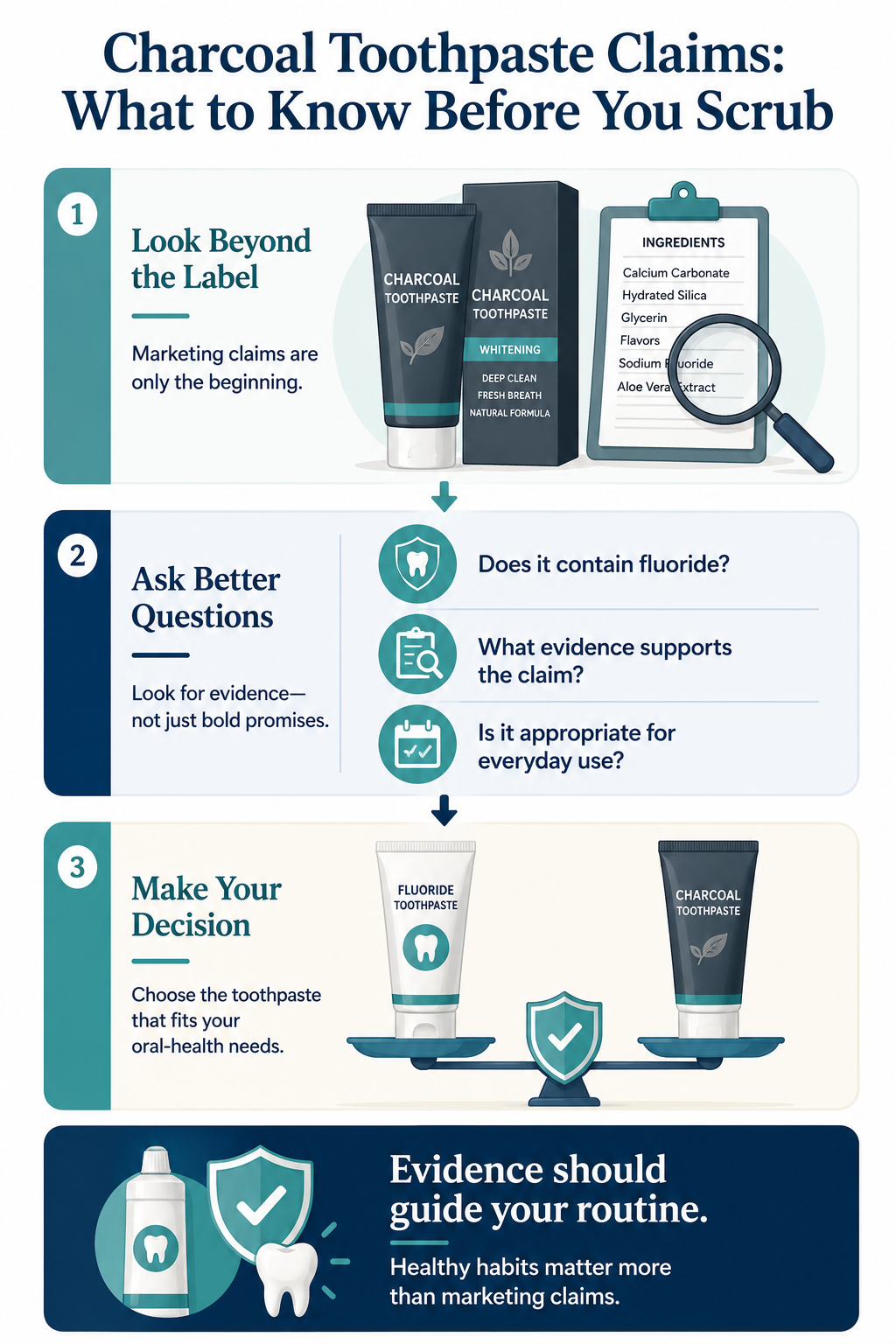
Instead of asking only, “Does this whiten?” ask a fuller set of questions:
- What exact claim is being made: whitening, stain removal, detox, cavity prevention, or gum health?
- Does the product include fluoride?
- Is the claim supported by dental evidence, or mostly by photos and testimonials?
- Could the product be too abrasive for my teeth, gums, exposed roots, or dental work?
- Am I replacing a routine that was already working?
Bottom line
Charcoal toothpaste claims often run ahead of the evidence. Some products may remove surface stains, but that is not the same as proving broad whitening, detox, or oral-health benefits. For most readers, the safest starting point is still a gentle routine with evidence-supported toothpaste and a dentist’s guidance when sensitivity, recession, restorations, or enamel concerns are present.
Sources
- Toothpastes — American Dental Association
- Toothpaste — MouthHealthy / American Dental Association
- Tooth Decay Process — National Institute of Dental and Craniofacial Research
- Charcoal and charcoal-based dentifrices: A literature review — PubMed / Journal of the American Dental Association