The short answer
Some whitening products can lighten natural teeth, and some products mainly remove stains from the tooth surface. But a dramatic social-media result does not show which effect occurred, how long it lasted, or whether the method was safe.
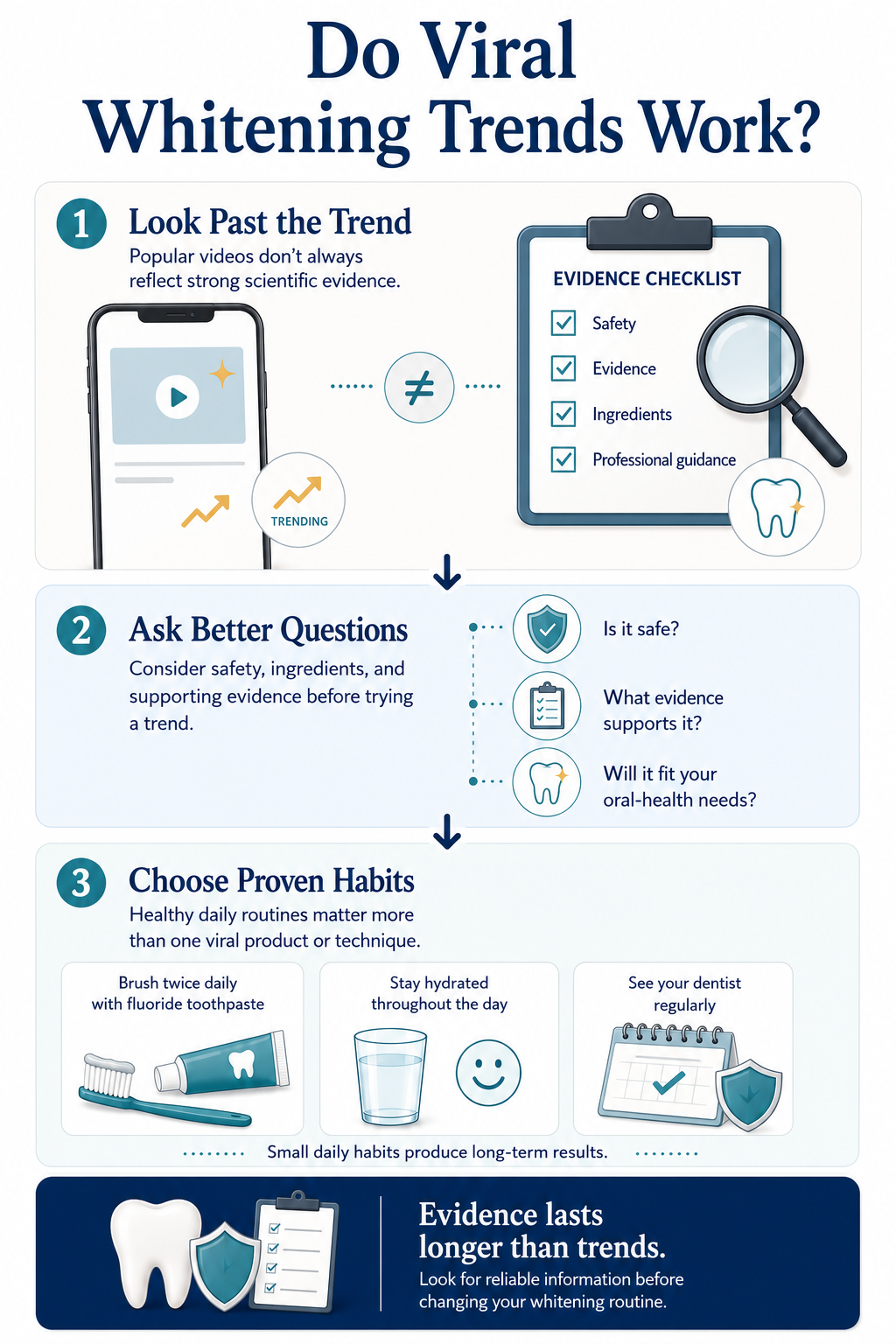
Viral trends are not one category. A labeled oral-care product used as directed is different from an improvised household mixture. The useful questions are: What is the product designed to do? Is the claim supported? What are the risks? And is there a dental reason to check the discoloration first?
Surface-stain removal is not the same as bleaching
Coffee, tea, tobacco, and some foods can leave extrinsic stains on the outside of teeth. Toothpastes may make teeth look brighter by cleaning or polishing away some of these surface stains. That does not necessarily change the tooth’s underlying color.
Whitening or bleaching agents such as hydrogen peroxide or carbamide peroxide work through a chemical reaction that can change the color of natural tooth structure. Results still vary with the cause and depth of discoloration, the product, and how it is used.
Crowns, veneers, fillings, and other tooth-colored restorations generally do not whiten along with natural teeth. That can leave a result looking uneven even when a product lightens some teeth.
Why household ingredients deserve caution
An ingredient being familiar, edible, or described as “natural” does not show that repeated contact with teeth and gums is safe. Viral mixtures may combine acidic liquids, abrasive powders, concentrated chemicals, or products that were never labeled for oral use.
Depending on the ingredient and exposure, possible harms include:
- wearing or roughening tooth structure through abrasion;
- irritating or chemically burning gums and other soft tissues;
- triggering or worsening tooth sensitivity; and
- creating patchy, temporary, or unpredictable color changes.
Evidence is limited for many DIY trends, so it would also be inaccurate to say that every trend causes harm in every person. The safer conclusion is narrower: popularity and household availability are not evidence of effectiveness or oral safety, and unsupported mixtures are a poor substitute for a product tested and labeled for use in the mouth.
Read the label, not only the post
For a packaged whitening product, check the intended use, ingredients, warnings, age limits, directions, and the exact claim on the label. Follow the label rather than an influencer’s altered schedule or combination of products. A claim such as “helps remove surface stains” is not the same as a claim that a product bleaches the tooth.
The ADA Seal of Acceptance is a voluntary program for over-the-counter oral-care products. When present, it means evidence was reviewed for the specific accepted claim and for safety when the product is used as directed. Its absence does not by itself prove that a product is unsafe, and a seal does not make a product suitable for every person.
Testimonials and photos have important limits
A testimonial is one person’s report, not a controlled comparison. Before-and-after images can change with lighting, camera exposure, filters, tooth dehydration, angle, cleaning, and editing. They also may not disclose side effects, existing dental work, how long the result lasted, or whether the person was paid or received a free product.
Health-product advertising claims—including claims conveyed by images, testimonials, and influencer marketing—should be truthful, not misleading, and supported by appropriate evidence. A striking post can be a reason to investigate a claim; it is not proof on its own.
When to ask a dentist before whitening
A dental evaluation is sensible before whitening if you have tooth pain, suspected or known decay, gum irritation or gum disease, significant sensitivity, cracks, exposed roots, crowns, veneers, fillings, or discoloration you cannot explain. A single tooth that has changed color also deserves evaluation rather than being covered up with a whitening attempt.
These findings can affect both safety and whether whitening is likely to create an even result. An online article cannot identify the cause of discoloration or choose an individualized whitening treatment.
Bottom line
Some evidence-supported whitening products work, while other products mainly remove surface stains. Viral DIY methods often leave out the distinction, the product-label context, and the possibility of abrasion, irritation, sensitivity, or uneven results. Treat testimonials and before-and-after images as marketing or personal experience—not as proof—and get dental guidance when symptoms, dental work, gum problems, decay, or unexplained discoloration are part of the picture.
Sources
- Whitening — American Dental Association
- Efficacy and adverse effects of whitening dentifrices compared with other products: A systematic review and meta-analysis — PubMed / Operative Dentistry
- Over-the-counter products in tooth bleaching: A scoping review — PubMed / Clinical Oral Investigations
- Health Products Compliance Guidance — Federal Trade Commission