The simple answer
Both electric and manual toothbrushes can clean teeth effectively. An electric toothbrush is not a requirement for a healthy mouth, and a manual toothbrush is not automatically a lesser choice.
Research reviews have found that powered brushes reduce plaque and gingivitis somewhat more on average than manual brushes. But that result does not mean every electric brush is better for every person, and the long-term importance of the difference is uncertain. The better everyday choice is the brush you can use gently, for about two minutes, on every tooth surface, twice a day with fluoride toothpaste.
Electric and manual toothbrushes at a glance
| Question | Manual toothbrush | Electric toothbrush |
|---|---|---|
| Can it clean effectively? | Yes, with complete and consistent technique. | Yes, with complete and consistent technique. |
| Who controls the motion? | You create the brushing motion. | The head supplies some or all of the brushing motion; you still guide it to every surface. |
| Built-in help | Usually few or no added features. | Some models include timers, quadrant prompts, or pressure alerts. |
| Cost | Usually lower upfront cost. | Usually higher upfront cost, plus replacement heads. |
| Power and travel | No charging or batteries. | Needs a battery or charge; travel setup varies. |
| Accessibility | Light, simple, and widely available. | A larger handle or powered motion may be easier for some people with limited dexterity or braces. |
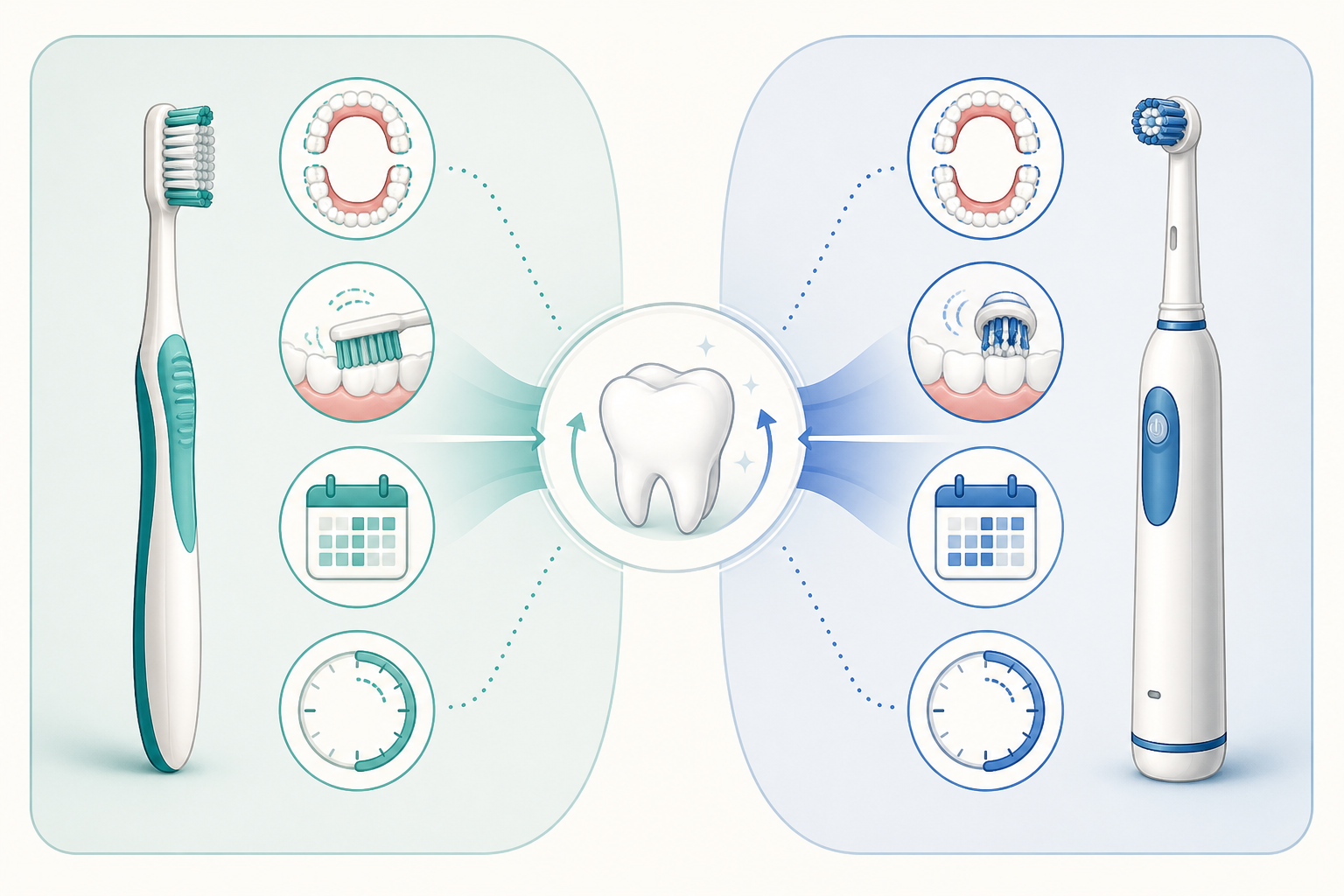
The table compares broad categories, not every model. A simple powered brush can differ from a premium one, and manual brush handles and heads also vary.
What the evidence actually says
The American Dental Association states that both manual and powered toothbrushes are effective at removing plaque. A Cochrane systematic review found moderate-quality evidence that powered brushes reduced plaque and gingivitis more than manual brushing in studies lasting one to three months and longer than three months.
That finding needs context. The review included many types of powered motion, the studies varied, and the authors said the importance for long-term dental health was unclear. Cost, reliability, and side effects were not reported consistently. The evidence supports a possible average cleaning advantage—not a promise that buying a powered brush will prevent cavities or gum disease.
Whichever brush you choose, coverage and routine still matter. A powered head cannot clean a tooth surface you never reach, and a manual brush can work well when you use it thoroughly.
When a manual toothbrush may be the better fit
A manual brush may make sense when you:
- Want the lowest-cost, simplest option.
- Prefer a light handle and full control of the motion.
- Travel often and do not want to manage charging or batteries.
- Already brush comfortably and cover every surface for about two minutes.
- Need a backup brush that is easy to replace locally.
Look for soft bristles and a head that you can move comfortably around your mouth. Price and elaborate bristle patterns do not replace gentle, complete technique.
When an electric toothbrush may help
A powered brush may be worth considering when you:
- Find it difficult to create a steady brushing motion by hand.
- Like a built-in timer or quadrant prompt that helps you reach two minutes.
- Prefer a larger handle that is easier to grip.
- Have braces or another dental appliance that makes brushing feel awkward.
- Find the powered routine easier to repeat consistently.
The ADA notes that some older adults, people with disabilities, children, people with dexterity difficulties, and people with dental appliances may find a powered brush easier to use. That is a possible usability benefit, not a universal product recommendation. A dentist or dental hygienist can help match a brush and technique to a specific physical need or appliance.
Which electric features are useful?
Features are helpful only when they solve a real problem.
- Two-minute timer: Useful if you tend to stop early.
- Quadrant prompt: Useful if you miss the same area or lose track of your path.
- Pressure alert: May help you notice when you are pressing harder than the brush is designed for.
- Comfortable handle and replaceable head: Important for daily use and ongoing cost.
- Available replacement heads: Worth checking before you commit to a handle.
You do not need an app, multiple modes, or a subscription to brush well. Marketing names such as “sonic” do not tell you whether the brush fits your hand, reaches your back teeth, or helps you maintain a complete routine.
Technique still changes with the tool
With a manual brush, you make gentle, controlled strokes. With a powered brush, follow that model’s instructions for positioning and movement; designs do not all work in exactly the same way.
For either type:
- Use soft bristles and gentle pressure.
- Brush for about two minutes, twice a day, with fluoride toothpaste.
- Reach the outer, inner, and chewing surfaces of every tooth.
- Clean along the gumline without aggressive scrubbing.
- Replace the brush or brush head when the bristles are worn.
The step-by-step brushing guide covers the shared goal without asking you to buy a particular device.
A practical way to choose
Start with the obstacle you are trying to solve.
If cost and simplicity matter most, a soft-bristled manual toothbrush is a sound choice. If hand movement, grip, timing, braces, or motivation makes brushing difficult, a powered brush may make the routine easier. If you are unsure, ask your dental team to watch how you brush with the tool you already own before assuming a more expensive one is necessary.
For help comparing head size, bristle softness, handle comfort, and replacement needs, use the toothbrush selection guide.
Takeaway
Electric toothbrushes may reduce plaque and gingivitis somewhat more on average, but both electric and manual brushes can work. Choose based on technique, comfort, accessibility, useful features, replacement cost, and the routine you can sustain—not on the idea that a higher price guarantees a healthier mouth.
Sources
- Toothbrushes — American Dental Association
- Home Oral Care — American Dental Association
- Powered/electric toothbrushes compared to manual toothbrushes for maintaining oral health — Cochrane