A simple way to brush well
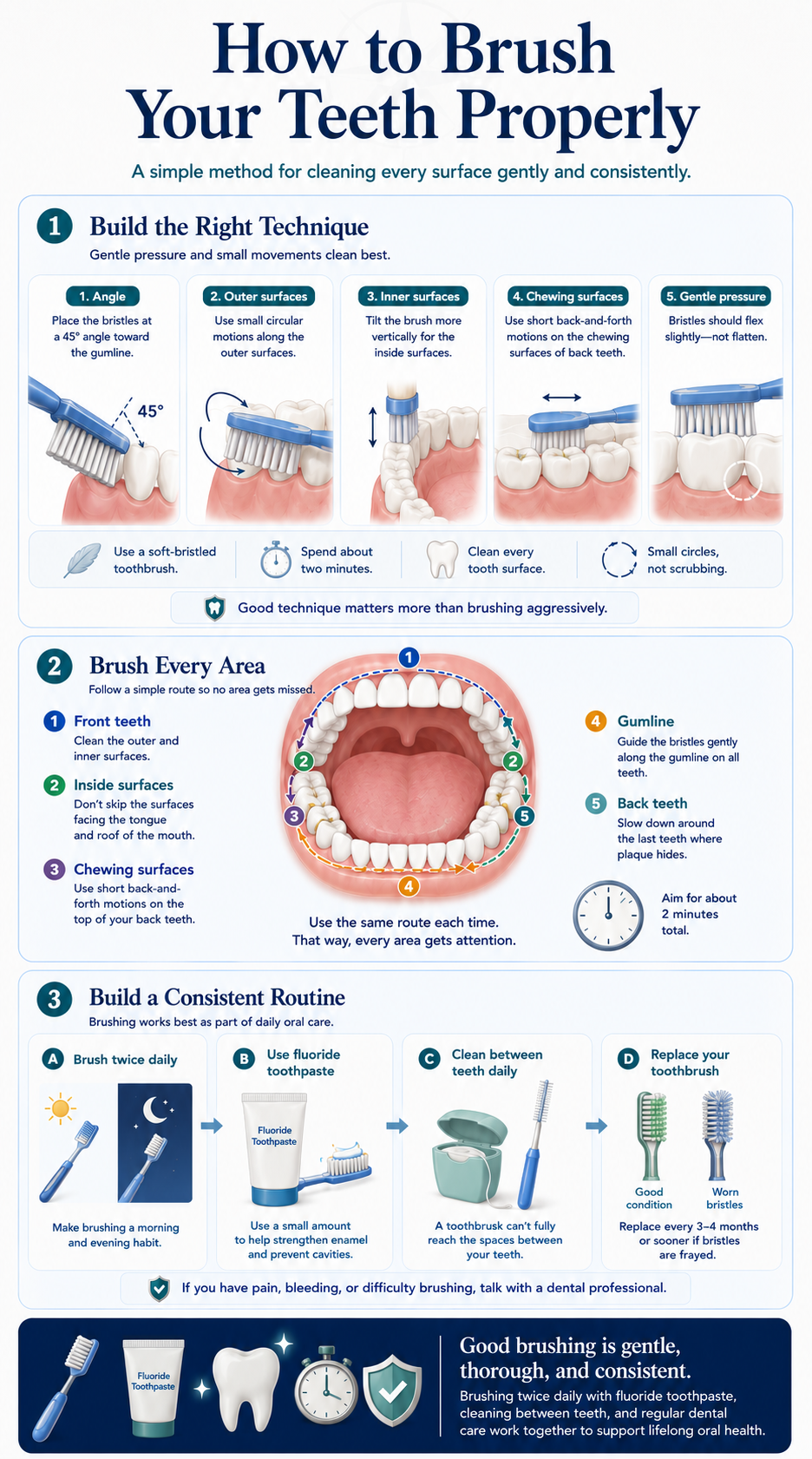
It is easy to wonder whether you are brushing the right way, especially when a quick routine becomes automatic. The basics are straightforward: use a soft-bristled toothbrush, fluoride toothpaste, gentle pressure, and enough time to clean every surface.
You do not need to scrub hard or use a complicated technique. A calm, repeatable routine is the goal.
What proper brushing is meant to do
Brushing removes plaque, a sticky film that builds up on teeth throughout the day. It also places fluoride toothpaste across the tooth surfaces.
For most people, the basic routine is:
- Brush twice a day.
- Brush for about two minutes each time.
- Use fluoride toothpaste.
- Use a soft-bristled toothbrush.
- Clean gently rather than scrubbing hard.
Step-by-step brushing technique
Start at the gumline
Place the bristles at about a 45-degree angle where the teeth meet the gums. This helps you clean the edge of the teeth near the gumline without forcing the bristles into the gums.
Use short, gentle strokes
Move the toothbrush back and forth in short strokes, about the width of one tooth. Gentle pressure is enough. Large, forceful scrubbing motions can make it harder to control where the bristles are cleaning.
Clean every tooth surface
Work around your mouth in the same order each time. This makes it less likely that you will miss an area.
Brush:
- The outer surfaces of your teeth.
- The inner surfaces of your teeth.
- The chewing surfaces of your back teeth.
- The inner surfaces of your front teeth.
For the inner surfaces of the front teeth, turn the toothbrush vertically and use gentle up-and-down strokes.
Give yourself the full two minutes
Two minutes is longer than it sounds. One practical approach is to divide your mouth into four sections: upper right, upper left, lower right, and lower left. Spend roughly 30 seconds on each section.
A timer or the built-in timer on some powered toothbrushes can make this easier.
Spit after brushing
After brushing, spit out the excess toothpaste. Avoid rinsing immediately with water, because this can wash away fluoride left on the teeth. The guide to rinsing after brushing explains what to do if mouthwash is also part of your routine.
Common mistakes to avoid
Brushing too quickly
A rushed brush can miss the inside surfaces of teeth, the chewing surfaces of back teeth, and the gumline.
Using too much pressure
Brushing should feel controlled, not aggressive. More pressure does not automatically mean a better clean.
Missing the inside surfaces
The tongue-side surfaces of teeth are easy to forget, particularly behind the lower front teeth and around the upper back teeth.
Replacing your toothbrush too late
Replace a toothbrush or powered-brush head about every three to four months, or sooner when the bristles look frayed or flattened. See when to replace your toothbrush for the signs that matter more than the calendar.
Brushing is one part of daily oral care
A toothbrush does not fully clean between teeth. Cleaning between teeth once a day with floss or another interdental cleaner helps reach those spaces. If floss is the tool you use, follow a gentle step-by-step flossing technique.
When to contact a dentist
Contact a dentist if tooth pain lasts more than two days, your gums bleed regularly or concern you, your cheek or jaw is swollen, or an adult tooth feels loose. These signs can have different causes, and a dental professional can assess them in context.
Seek emergency care now if swelling around your mouth or neck makes it difficult to breathe, swallow, or speak.
Takeaway
Proper brushing is mostly about consistency and gentle technique: brush twice a day for about two minutes, use fluoride toothpaste and a soft-bristled toothbrush, angle the bristles toward the gumline, and clean every surface of every tooth.
Sources
- Brushing Your Teeth — MouthHealthy / American Dental Association
- Toothbrushes — American Dental Association
- Home Oral Care — American Dental Association
- How to keep your teeth clean — NHS
- Dental Floss/Interdental Cleaners — American Dental Association
- Toothache — NHS
- Bleeding Gums — MouthHealthy / American Dental Association
- Gum disease — NHS