The simple goal of flossing
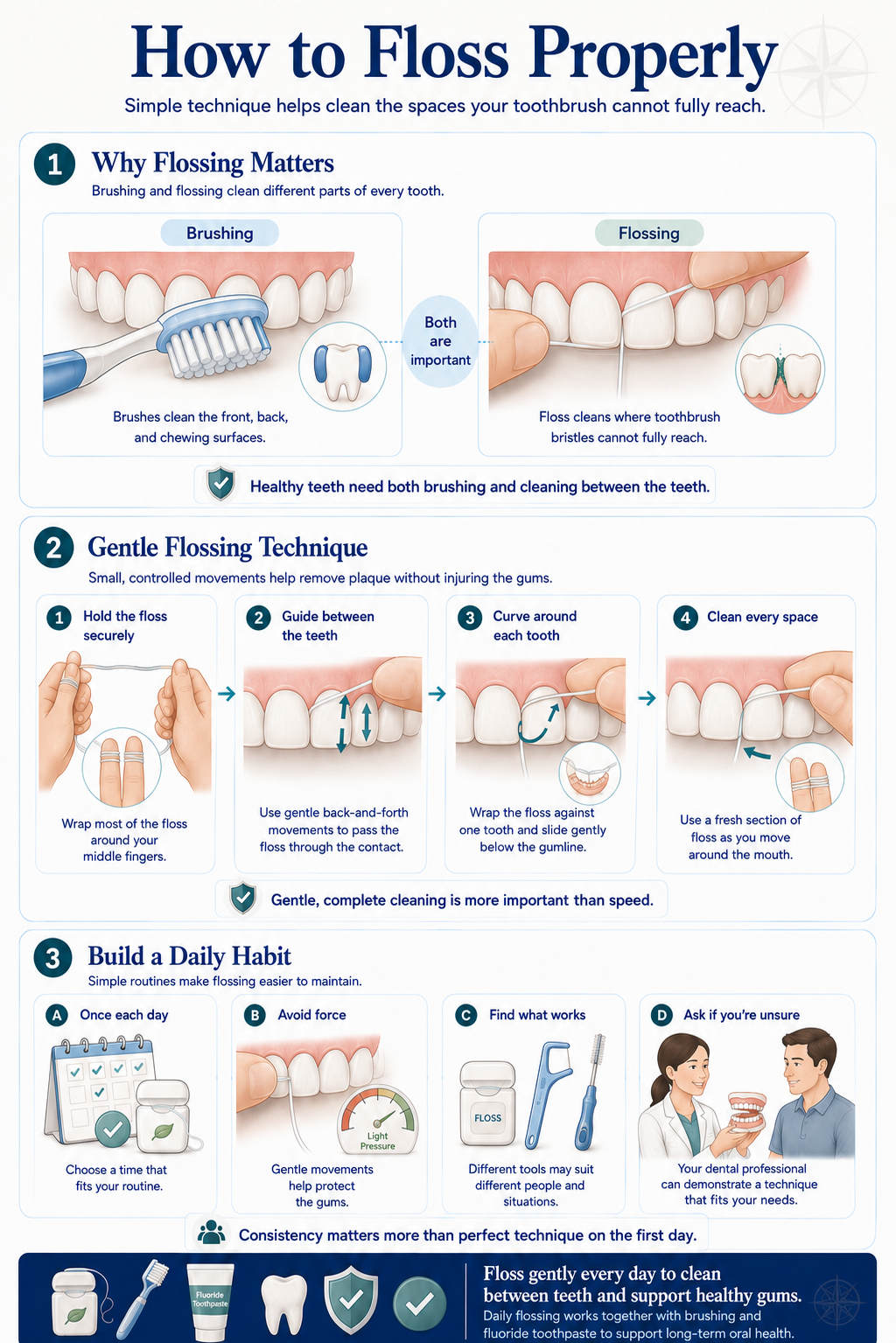
Flossing is meant to clean the spaces between teeth that a toothbrush cannot fully reach. The goal is not to force floss through every contact or make your gums sore. It is to gently clean both sides of each space between your teeth as part of a regular routine.
For many people, the most useful approach is to clean between the teeth once a day and focus on a technique they can repeat comfortably.
A simple step-by-step technique
Start with enough floss
Break off a piece of floss long enough to wrap around your middle fingers, leaving a short working section between your hands.
Use your thumbs and index fingers to guide that working section. Move to a clean area of floss as you go from one space to the next.
Guide floss gently between the teeth
Ease the floss between two teeth using a gentle back-and-forth motion. Do not snap it down into the gums.
If a contact feels tight, slow down and use a smaller sawing motion. Forcing floss can make it harder to control and may irritate the gums.
Make a C shape around one tooth
Once the floss is between the teeth, curve it into a C shape against one tooth.
Move the floss gently up and down along the side of that tooth, including just below the gumline. Then curve the floss around the neighboring tooth and repeat.
This matters because each space has two tooth surfaces to clean.
Work all the way around
Continue through each space between your teeth. Remember the back sides of the last molars if you can reach them comfortably.
A consistent order can help: start on one side of the upper teeth, work around, then repeat on the lower teeth.
Common flossing problems
“My floss gets stuck”
Tight contacts can make flossing frustrating. Try using a slower, gentler back-and-forth motion rather than pulling forcefully.
If floss consistently shreds, catches, or cannot pass through a particular area, mention it at your next dental visit or contact the office sooner if it is causing concern.
“I cannot reach the back teeth”
Reaching back teeth can take practice. Try changing your hand position, using a shorter working section of floss, or asking your dental team to demonstrate a technique that fits your mouth.
An interdental cleaner may be another option for some spaces. A water flosser works differently from string floss, and the best tool depends on the spaces between your teeth and your individual needs.
“My gums bleed when I floss”
Bleeding gums can have different causes. If your gums bleed regularly, are painful or swollen, or you are worried about what you are noticing, contact a dentist for guidance.
Do not assume that bleeding is something you should ignore. A dental professional can help you understand the pattern and whether your routine needs adjustment. The guide to why gums may bleed explains the concern without assuming a single cause.
How to make flossing easier to keep up
Keep floss where you already brush your teeth. Build it into the same part of your day, rather than waiting for a perfect time.
You can also start small. A consistent once-daily routine is more useful than trying to do everything perfectly from the first day.
When to contact a dentist
Contact a dentist if floss consistently gets stuck or shreds in one area, if you have regular bleeding gums, or if you notice pain, swelling, a loose tooth, or another concern in your mouth.
These signs can have different causes. A dental professional can examine the area and help determine the appropriate next step.
Takeaway
Proper flossing is gentle and methodical: guide the floss between teeth, curve it around one tooth at a time, clean both sides of each space, and work through your mouth in a repeatable order. It complements—not replaces—thorough toothbrushing.
The best routine is the one you can do consistently without turning it into a stressful task.
Sources
- Flossing — MouthHealthy / American Dental Association
- Dental Floss/Interdental Cleaners — American Dental Association
- How to keep your teeth clean — NHS
- Bleeding Gums — MouthHealthy / American Dental Association