The simple answer
For most people, cleaning between the teeth once a day is the standard recommendation. That can mean dental floss or another interdental cleaner that works for your mouth and routine.
Daily flossing does not need to become a perfect ritual. The useful goal is simple: clean between your teeth consistently enough that it becomes part of everyday care, just like brushing.
Why brushing alone is not enough
A toothbrush cleans the front, back, and chewing surfaces of teeth well. It does not fully reach the tight spaces between teeth or just under the gumline.
Flossing helps remove plaque and food particles from those areas. Cleaning between teeth once a day is meant to complement brushing, not replace it.
How often should you floss?
A practical standard is once a day.
You do not need to floss after every meal for it to count. One thorough session each day is a realistic target for most people.
Consistency matters more than choosing a perfect time of day. A routine that happens most days is more useful than a complicated plan that is hard to maintain.
Is there a best time to floss?
There is no single best time for everyone.
Many people prefer to floss in the evening, before bed, so they can clean between their teeth as part of their nighttime routine. Others do it after lunch or in the morning.
The best time to floss is the time you are most likely to keep doing it.
A few low-friction options:
- Keep floss where you already brush your teeth.
- Add it before or after a routine you do every evening.
- Keep a floss pick in a travel bag, desk drawer, or car for backup.
- Use a phone reminder until the habit becomes automatic.
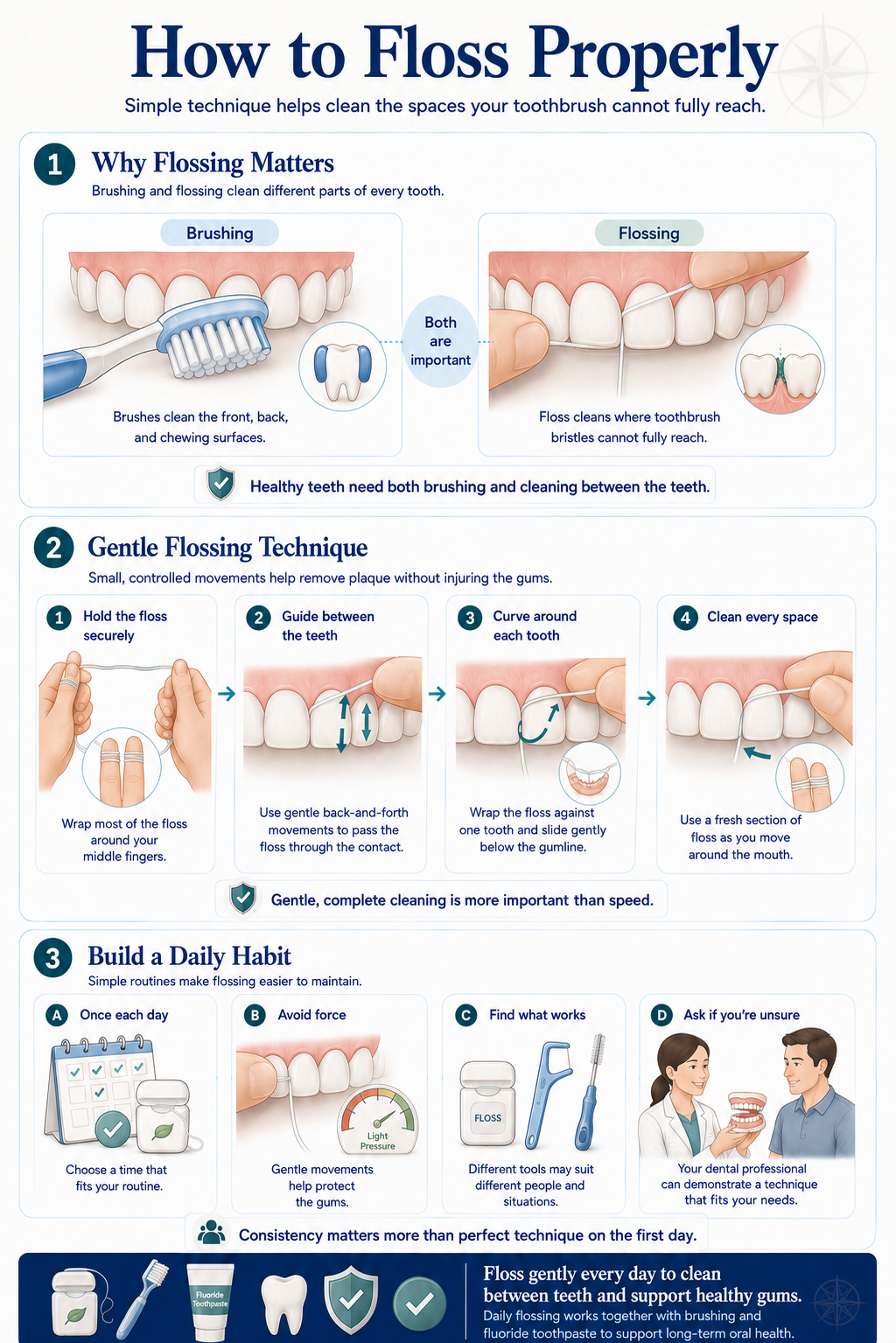
A realistic daily flossing routine
Keep the goal small
Start with once a day. You do not need to make up for missed days by flossing repeatedly.
Choose a tool you will use
Traditional string floss works for many people. Other options, such as floss picks, dental tape, or interdental brushes, may be easier for some people to handle.
The right tool depends on the spaces between your teeth, your dexterity, and what your dental team recommends for you.
Use a gentle technique
Guide the floss between two teeth without forcing it down. Curve it gently against one tooth, move it up and down, then repeat against the neighboring tooth.
Use a fresh section of floss as you move to the next space.
For a complete step-by-step guide, see how to floss properly.
What if your gums bleed when you floss?
Bleeding gums can have different causes. If your gums bleed regularly, are painful or swollen, or you are concerned about what you are noticing, contact a dentist for guidance.
Avoid assuming that bleeding is something to ignore or simply push through. A dental professional can help you understand what is happening and whether your cleaning method or routine needs adjustment.
For more context, why gums may bleed when you brush explains why regular bleeding deserves attention without pointing to one cause.
When to contact a dentist
Consider contacting a dental office if you have gums that bleed regularly, painful or swollen gums, persistent bad breath, or loose teeth.
These signs can have different causes, and a dentist can evaluate them in context.
Takeaway
For most people, cleaning between the teeth once a day is the standard recommendation. Pick a time that fits your life, use a tool you can handle comfortably, and focus on making the habit consistent rather than perfect.
Sources
- Flossing — MouthHealthy / American Dental Association
- Dental Floss/Interdental Cleaners — American Dental Association
- Take care of your teeth and gums — NHS
- Gum disease — NHS