A water flosser is a powered interdental-cleaning device, also called an oral irrigator. It sends a controlled, often pulsating stream of water around teeth and along the gumline. It may be a practical way to supplement toothbrushing, especially when other tools are difficult to maneuver.
It is not a miniature pressure washer for teeth, and stronger pressure is not automatically better. A water flosser also works differently from string floss: water moves around tooth and gum contours, while floss contacts and rubs against the sides of teeth.
How a water flosser works
Most water flossers have a water reservoir, a small motor or pump, a handle, and a narrow tip. The device directs water through the tip in a steady or pulsating jet. Many models offer multiple pressure settings and interchangeable tips.
The user guides the stream along the gumline and between teeth. The moving water can flush out loose food and debris and may help disrupt plaque around areas that are harder to reach with a toothbrush.
Technique still matters. Pointing the stream randomly around the mouth, using an uncomfortable setting, or using the device only occasionally may not provide the same result as careful, regular use.
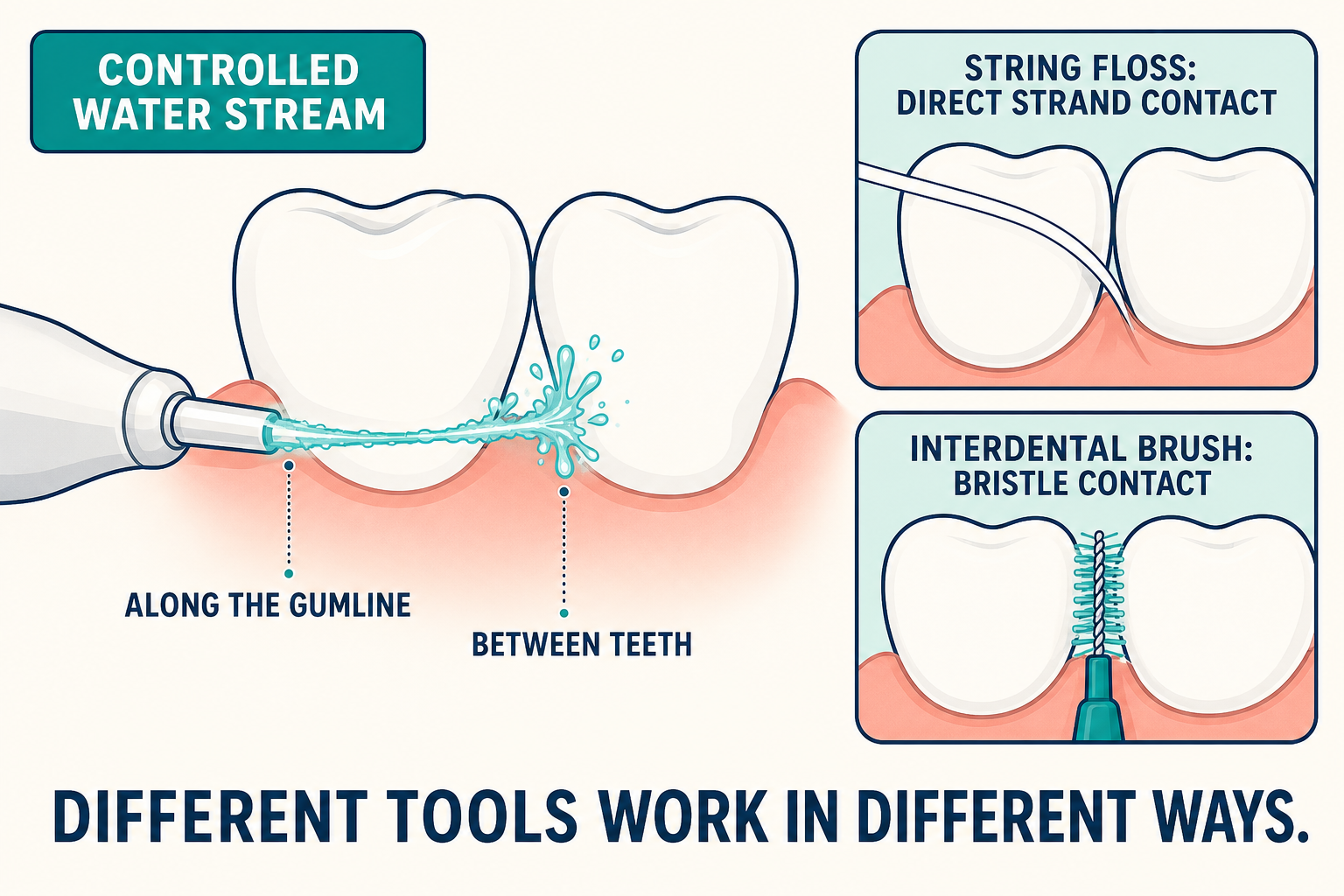
How it differs from floss and interdental brushes
These tools reach between teeth in different ways:
- String floss slides through a contact and curves against each tooth surface, creating direct wiping contact.
- Interdental brushes use small bristles to clean spaces that can accommodate the brush.
- Water flossers use pressurized or pulsating water rather than a strand or bristles.
Those mechanical differences matter. A water flosser should not be described as scraping tooth surfaces in exactly the same way as string floss. It is one category of interdental cleaner, not a universal upgrade over every other tool.
Who may find one practical?
Some people find a water flosser easier to handle than string floss. It may be worth discussing as an option when cleaning is awkward because of:
- braces or other orthodontic hardware;
- bridges or some types of dental prostheses;
- implants or restorations that create access challenges; or
- limited hand dexterity.
The best tool can depend on the spaces between your teeth, your dental work, your comfort, and whether you can use it consistently. A dentist or hygienist can show how a device may fit around specific dental work without assuming that everyone needs one.
What does the evidence show?
The evidence is mixed and should be described carefully.
The American Dental Association summarizes the evidence for oral irrigators as limited and inconsistent, with many studies short-term and the overall certainty low to very low. A 2019 Cochrane review found that oral irrigators might improve some short-term measures of gingivitis compared with flossing, but results for plaque were very uncertain and evidence for bleeding compared with brushing alone did not show a clear benefit.
A newer systematic review of regular and orthodontic patients found small improvements in some bleeding and gingival-inflammation measures, especially for orthodontic patients, while plaque results were inconsistent and water flossing did not clearly add more plaque improvement than flossing in regular patients.
In plain language: a water flosser may help some people maintain gum health, particularly if it makes between-teeth care more manageable. The research does not support promising that it is best for everyone, that it removes all plaque, or that it prevents or treats gum disease on its own.
Practical features without the product hype
You may see countertop and cordless devices, several pressure levels, and tips marketed for braces, implants, or general use. These features affect convenience and access, but they do not guarantee a health outcome.
Start with the manufacturer’s directions and a comfortable pressure setting. Guide the tip carefully rather than forcing it into the gums. If you have implants, bridges, orthodontic appliances, sensitive areas, or recent dental work, ask your dental team whether a particular technique or tip is appropriate for that area.
How to use one without overdoing it
Follow the device instructions, begin at a comfortable setting, and guide the tip slowly around the gumline and between teeth. Water may splash, so leaning over the sink can make the routine easier. The goal is controlled cleaning, not force: stop if the stream causes pain, persistent irritation, or bleeding that does not settle.
If you have braces, implants, bridges, periodontal concerns, or recent dental work, ask your dental team whether the device and technique fit the area. Do not add medication, antiseptic, or other substances to the reservoir unless a dental professional specifically tells you to.
What if your gums bleed?
Gums may bleed when inflamed areas are cleaned, but bleeding can have more than one explanation. A device cannot diagnose or cure the cause.
If bleeding, soreness, or discomfort is persistent, worsening, or focused around dental work, schedule a dental evaluation. A professional can check the tissues and help determine whether technique, inflammation, a restoration, or another issue needs attention. For broader context, see Why Do My Gums Bleed When I Brush?.
Where it fits in a routine
Toothbrushing remains essential, and some form of interdental cleaning helps reach areas that brush bristles do not clean well. A water flosser can be one way to do that work. It does not replace professional cleanings, and it is not a cure for existing gum disease.
If you use string floss, see How to Floss Properly and How Often Should You Floss? for the separate questions of technique and frequency.
Common questions
Is a water flosser the same as string floss?
No. Both are interdental-cleaning options, but string floss cleans by direct contact with tooth surfaces while a water flosser uses a stream of water. Neither is automatically the best choice for every mouth.
Can a water flosser replace brushing?
No. It is an adjunct for cleaning between teeth and along the gumline; it does not replace toothbrushing or professional dental care.
Is a water flosser better than floss?
Research does not establish a universal winner. Results vary by the device, comparison, outcome measured, dental anatomy, dental work, technique, and consistency of use.
Should I use one if cleaning hurts or my gums keep bleeding?
Do not use discomfort as a reason to increase pressure. Persistent, worsening, or focal bleeding or soreness deserves a dental evaluation so the cause can be checked rather than self-treated with a device.
The bottom line
A water flosser uses a controlled stream of water to clean around teeth and along the gumline. It works differently from floss and interdental brushes, and some people—especially those managing hardware or access challenges—may find it easier to use. Evidence suggests possible benefits for some gum-health measures, but it is not universally superior and results still depend on careful, regular use.
Sources
- Dental Floss/Interdental Cleaners — American Dental Association
- Home use of interdental cleaning devices, in addition to toothbrushing, for preventing and controlling periodontal diseases and dental caries — Cochrane Database of Systematic Reviews (PubMed record)
- Alleviation of Plaque and Gingivitis with Dental Water Jet in Regular and Orthodontic Patients: A Systematic Review and Meta-Analysis — Healthcare (PubMed record)
- The effectiveness of oral irrigators on periodontal health status and oral hygiene of orthodontic patients: a systematic review and meta-analysis — PubMed