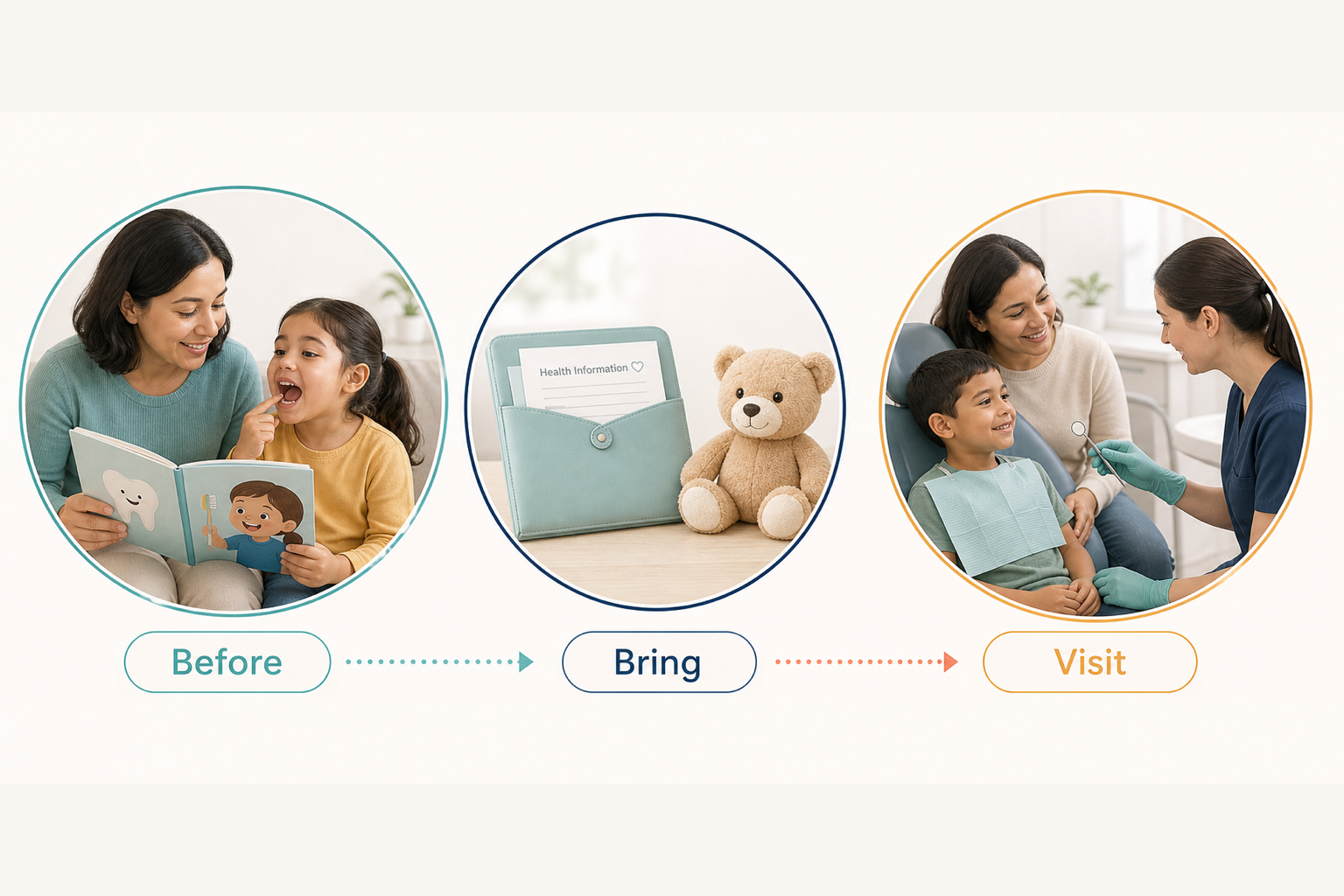
Preparing a child for a first dental visit does not require a perfect script. Keep the explanation short, positive, and honest: the dental team will look at and count their teeth and help keep their mouth healthy. Avoid promising that nothing will feel strange or that a particular procedure definitely will—or will not—happen.
The visit can vary with the child’s age, comfort, health history, and dental needs. For many young children, it is a brief preventive introduction. If a child is nervous, crying or needing a slower pace does not mean the visit has failed.
Before the appointment: make the unfamiliar more predictable
A few low-pressure steps can help:
- Use a children’s book, a short age-appropriate video, or pretend play to show what a dental visit is like.
- Let the child practice opening their mouth while you count their teeth.
- Describe the visit calmly and briefly instead of giving a detailed play-by-play days in advance.
- If possible, choose a time when the child is usually rested rather than hungry or due for a nap.
- Ask the office in advance what its first visits usually include and whether forms can be completed at home.
Some children want to ask questions; others do better with only the basic plan. Follow the child’s cues instead of repeatedly checking whether they are scared.
Use positive language without making promises
Try phrases such as:
- “The dentist helps us take care of your teeth.”
- “They may count your teeth and look inside your mouth.”
- “You can tell us if you need a pause.”
- “I will be nearby, and we will listen to the dental team.”
Avoid using a dental visit as a threat or punishment. Also avoid introducing frightening details while trying to reassure—for example, “It won’t hurt” can raise a concern the child had not considered and makes a promise you cannot guarantee.
If the child asks whether something will hurt, a realistic answer is: “Some things may feel new or funny. The dental team will explain what they are doing, and you can tell them how you feel.”
What parents should bring
The office can confirm its own requirements. Commonly useful items include:
- Completed forms, insurance information, and identification requested by the office.
- The child’s medical history, allergies, current medicines, and relevant health-care contacts.
- Details about previous mouth injuries, dental pain, feeding concerns, or other oral-health issues.
- A short list of questions and information about brushing, fluoride, bottles or cups, pacifier use, or thumb sucking when relevant.
- A familiar comfort item if the office permits it.
Tell the office ahead of time about developmental, communication, mobility, sensory, medical, or behavioral needs. This gives the team a chance to discuss accommodations, a quieter time, a gradual introduction, or other individualized supports. For home routines, the guide to sensory-friendly toothbrushing uses the same calm, gradual approach without assuming one strategy fits every child.
What may happen during a first visit
There is no single first-visit routine. Depending on the child’s age and needs, the dentist or hygienist may:
- Talk with the parent about health history, home care, eating and drinking patterns, fluoride, and habits.
- Let the child explore the chair or instruments in an age-appropriate way.
- Look at the teeth, gums, bite, and other parts of the mouth.
- Count the teeth and check for injuries, tooth decay, or other concerns.
- Clean the teeth or provide preventive care when appropriate.
- Discuss findings, answer questions, and recommend follow-up.
A very young child may sit on a parent’s lap, while another child may sit in the chair alone. X-rays, a cleaning, fluoride varnish, or other care are not automatic at every first visit. The dental team decides what is appropriate after considering the child’s needs and ability to participate.
For more on timing and the general purpose of early care, read what parents can expect from a child’s first dental visit.
If your child becomes nervous
Stay calm and let the dental team lead the visit. Pediatric behavior guidance can include showing a child an instrument before using it, explaining a step in simple language, offering choices when possible, praising specific cooperative behavior, distraction, or taking a gradual approach. The best combination differs by child, and evidence for individual non-drug techniques varies.
Parents can help by:
- Using a steady voice and brief reassurance.
- Acknowledging the feeling without shame: “This is new, and I am here with you.”
- Avoiding bargaining, threats, or apologizing for the child’s behavior.
- Following the team’s guidance about where to sit and how to support the child.
- Sharing what usually helps the child cope with unfamiliar settings.
If the visit cannot be completed, ask what the team learned and what the next step is. A shorter introduction, another appointment, or a different behavior-support plan may be reasonable depending on the child’s dental needs. Do not assume one difficult visit predicts every future visit.
Will treatment happen at the first visit?
Sometimes a first appointment is mainly an examination, prevention discussion, and chance to build familiarity. In other situations—especially when pain, injury, infection, or an urgent dental problem is involved—the team may need to discuss or provide care sooner.
Whether treatment occurs that day depends on what the dentist finds, how urgent the need is, the child’s health and comfort, the planned procedure, informed consent, and the office’s approach. If treatment is recommended, ask what needs to happen now, what can safely wait, what options exist, and how the team plans to support the child.
A calm first step
The goal is not to make a child perform perfectly. It is to give them a truthful, manageable introduction to dental care and help the dental team understand what support they need. Calm preparation, realistic expectations, and good communication give the visit room to unfold at the child’s pace while building care around why baby teeth matter.
Sources
- Your Baby's First Dental Visit — MouthHealthy / American Dental Association
- Behavior Guidance for the Pediatric Dental Patient — American Academy of Pediatric Dentistry
- Nonpharmacological Behavior Guidance for the Pediatric Dental Patient — American Academy of Pediatric Dentistry