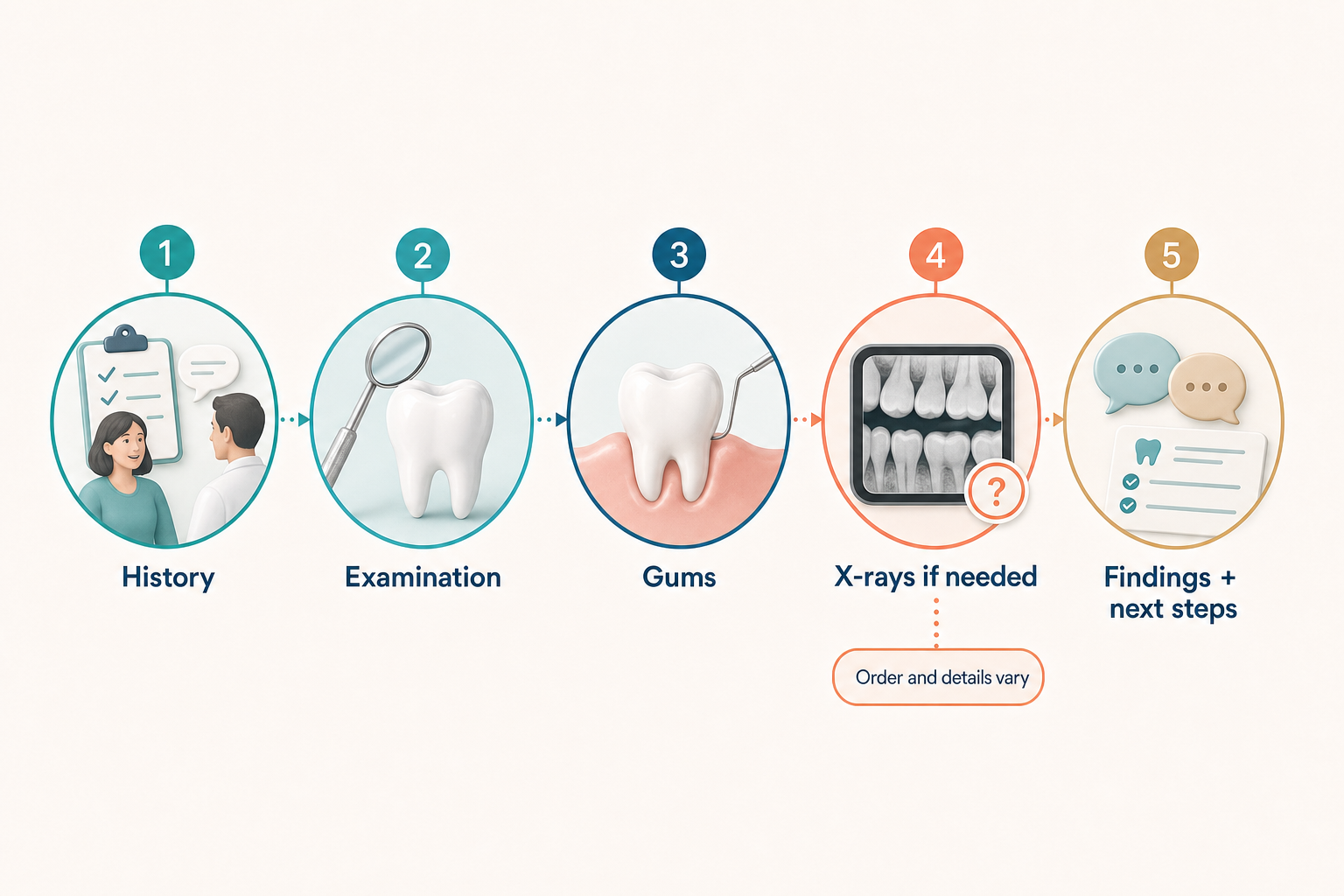
A routine dental checkup is mainly an evaluation. The dental team reviews relevant health information, examines your mouth, and explains what they find. X-rays may be recommended when they are likely to add useful information, but they are not automatically needed at every visit. The exact steps depend on your history, concerns, examination, and the practice.
The exact order and details vary by office, age, symptoms, dental history, and individual risk. A cleaning may happen at the same appointment, but the examination and the cleaning are different parts of care.
First, the team updates your history
You may be asked about changes in your health, medications, allergies, pregnancy status, recent diagnoses, or past reactions to dental care. These details can affect oral health and how care is planned, so update the team even if your last visit was recent.
This is also a good time to mention pain, sensitivity, bleeding, dry mouth, jaw symptoms, changes you have noticed, or concerns about a previous treatment. Even if a symptom seems minor, telling the team gives the examination useful context.
The oral examination
The dentist examines your teeth and the surrounding tissues. This commonly includes looking for signs of tooth decay, cracks, wear, and other changes. The dentist may use a small mirror, light, air, and dental instruments to see and gently assess different surfaces.
The examination is not limited to finding cavities. It can also include your bite, jaw movement, and the soft tissues of the mouth when appropriate.
Gum assessment
The dental team looks at the gums for signs such as redness, swelling, bleeding, recession, and buildup around the teeth. Periodontal measurements may be taken with a small probe to assess the spaces around teeth and track gum health.
Not every office performs every gum measurement in the same way at every visit. Age, prior findings, symptoms, and the practice’s clinical process can affect what is recorded.
X-rays when appropriate
Dental X-rays can show areas that are not visible during a direct examination, including some decay between teeth, bone levels, roots, and developing teeth. The type and timing should be based on clinical need rather than a fixed one-size-fits-all schedule. Our guide to dental X-rays explains the purpose-and-safety questions you can ask.
A dentist may consider your age, current examination, symptoms, cavity history, gum health, past images, and other risk factors before recommending new images. You can ask what the proposed X-rays are meant to show and how they may affect the plan.
Oral cancer screening
A routine examination may include looking and feeling for changes in the lips, cheeks, tongue, floor and roof of the mouth, throat area, jaw, or neck. This is often called an oral cancer screening, although the examination cannot by itself confirm that a change is cancer.
An unusual area does not establish cancer by itself. Depending on what the clinician sees and how long it has been present, the next step may be monitoring it, arranging follow-up, or referring for further assessment.
Existing fillings, crowns, and other dental work
The dentist may check fillings, crowns, bridges, implants, dentures, sealants, and other restorations for wear, damage, fit, or changes around their edges. Dental work does not last forever, but a finding does not automatically mean it must be replaced immediately.
Ask what the dentist sees, whether it is stable or changing, and what choices are reasonable. The goal is to understand the finding and its context—not to assume that every change needs immediate replacement.
Discussion of findings and recommendations
At the end of the examination, the dentist should explain the main findings in understandable language. The conversation may cover:
- What appears healthy or stable
- What needs attention now, if anything
- What can be monitored
- Whether additional records or testing would be useful
- Home-care changes that may help
- Possible treatment options, benefits, limits, timing, and alternatives
- When the next examination may be appropriate
A recommendation is the start of an informed conversation. Unless a situation is urgent, you can usually take time to understand what was found and why a particular next step is being discussed. Questions Before Dental Treatment can help if the visit leads to a proposed procedure.
Questions are part of the appointment
You can ask the dental team to show you an area in a mirror or on an X-ray and explain unfamiliar terms. Useful questions include:
- What did you find, and where is it?
- Is this new, stable, or getting worse?
- What happens if we monitor it?
- What are the options and tradeoffs?
- Is there anything I should change at home?
- When should I contact the office sooner?
If dental visits make you anxious, say so early. The team may be able to explain each step before doing it, agree on a pause signal, or make other reasonable adjustments.
A checkup is not the same as a cleaning
A checkup evaluates oral health and helps guide decisions. A professional cleaning focuses on removing plaque and hardened buildup and may include polishing and home-care guidance. They often happen together, which is why the terms can blur, but one does not define the other.
Visit timing also varies. How Often Should You See a Dentist? explains why recall schedules are individualized.
The takeaway
Most dental checkups follow a familiar pattern: update the history, examine the teeth and gums, use X-rays only when appropriate, screen the mouth’s soft tissues, and discuss findings and next steps. Your appointment may differ, and you should have room to ask what is being done and why.
Sources
- Dental check-ups — NHS
- What happens when you visit an NHS dentist — NHS
- Medical/Dental Health History — American Dental Association
- X-Rays/Radiographs — American Dental Association
- Cancer (Head and Neck) — American Dental Association
- Oral Cancer — National Institute of Dental and Craniofacial Research