The simple answer
There is no single dental-checkup schedule that fits everyone. Six months may be right for some people, while others may be advised to return sooner or later.
As one concrete example, current NHS and UK guideline recommendations allow routine recall intervals from 3 months to 2 years for adults, based on oral health and risk. For people younger than 18, the same guidance recommends no longer than 12 months between routine reviews. These are guideline boundaries, not a schedule to choose on your own, and recommendations can differ by person and healthcare setting.
The most useful answer is the interval recommended after your own examination, along with an explanation of what the dental team plans to monitor. A routine appointment can still matter even when nothing hurts. If you want to know what the visit may include, see what happens at a dental checkup.
Why the “every six months” rule is not universal
Many people grew up hearing that everyone should see a dentist every six months. That timing may be appropriate for some people, but it is not a universal rule.
Risk-based recall is supported by current guidance. The American Dental Association notes that evidence has not established one optimal frequency for preventing cavities or gum disease and supports tailoring recall to individual need and assessed disease risk.
A 2020 Cochrane review found little to no difference in several measured outcomes over four years when adults in primary care had risk-based rather than fixed six-month recalls. Among adults considered suitable for a 24-month interval, the review also found little to no difference in those outcomes compared with six-month or risk-based recall. The evidence for children and adolescents was uncertain. This does not show that every adult can safely wait two years; it supports choosing the interval from the person’s risk and clinical context rather than habit alone.
What can affect how often you need a checkup
A dentist may consider several factors when recommending when to return, including:
- Your history of cavities or gum problems.
- Current signs of tooth decay, gum inflammation, or other active disease.
- Whether you have ongoing dental treatment or restorative work that needs monitoring.
- Dry mouth or other factors that may affect your risk of tooth decay.
- How well your at-home routine is working for you.
- Changes in your overall health that may affect oral health.
- Whether the previous interval still fits what has changed since your last review.
These factors do not mean that something is necessarily wrong. They are part of deciding what level of follow-up makes sense for you.
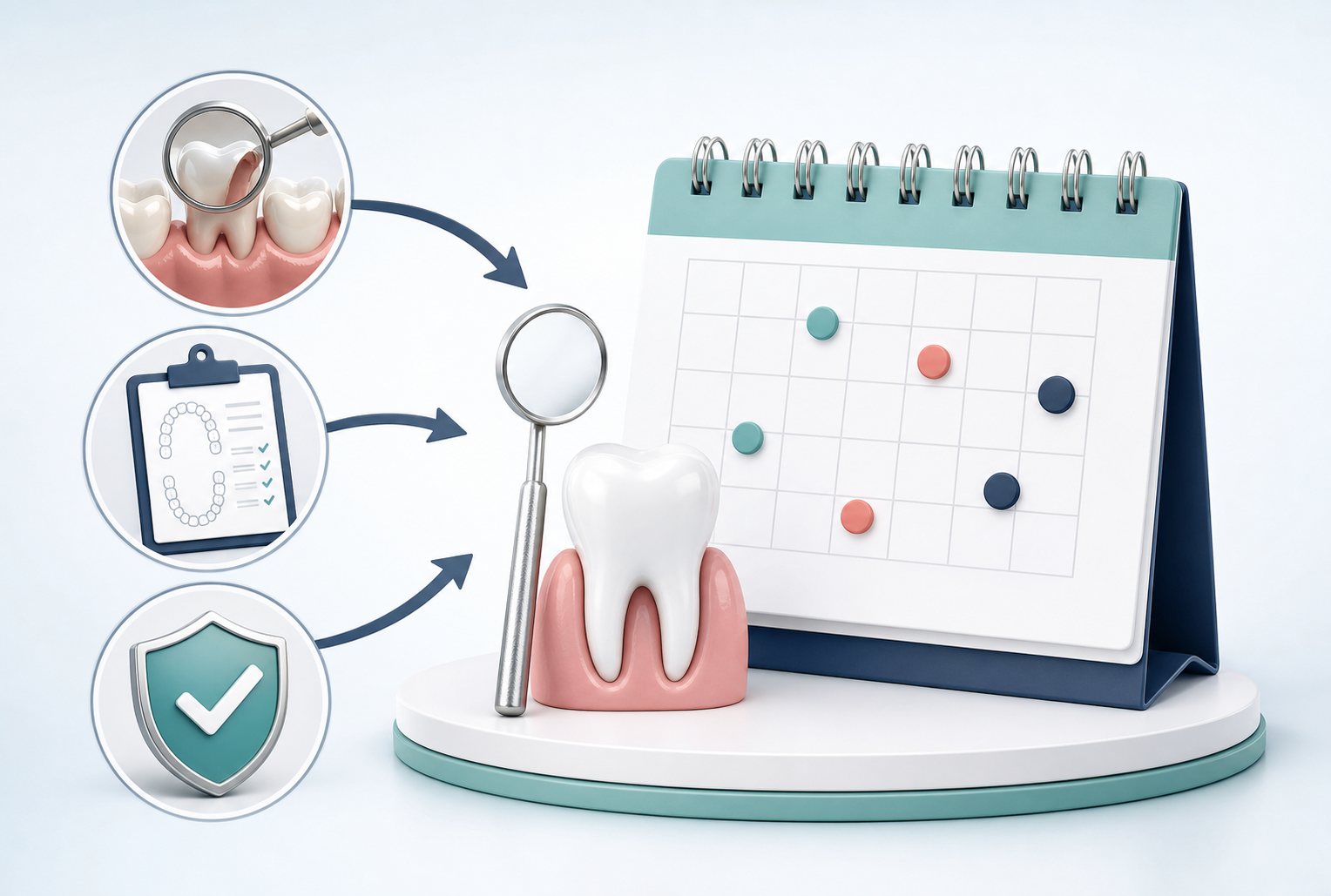
What happens at a routine dental checkup
A routine appointment can look different from one dental office to another. It may include a review of your health history, an examination of your teeth and gums, an assessment of your oral-hygiene routine, and a discussion of concerns you may have noticed.
Your dental team may also recommend preventive care, imaging, or other follow-up based on your individual situation. A recommendation is a chance to ask questions and understand the reason for it.
A checkup schedule is not every dental schedule
A routine recall interval tells you when to return for another oral-health review. It does not automatically set the timing for cleanings, X-rays, unfinished treatment, gum-disease maintenance, specialist care, or follow-up of a specific finding.
Those appointments may follow different plans. For example, a dental cleaning and a checkup often happen at the same visit, but they are not the same service. Ask which appointment the recommended interval refers to so that a longer routine recall is not mistaken for permission to delay active treatment or monitoring.
Questions you can ask about your recall schedule
If you are not sure why your dentist wants to see you again at a certain time, it is reasonable to ask:
- What are you monitoring between visits?
- Is this schedule based on my current oral-health risk?
- Has anything changed since my last visit?
- Does this timing apply to my checkup, cleaning, or both?
- What can I do at home to support my oral health before the next appointment?
- When should I contact the office sooner?
Clear answers can help you understand the plan instead of feeling like you are simply following an unexplained rule.
When to contact a dentist sooner
Do not wait for a routine checkup if you have tooth pain, swelling in or around your mouth, a broken or loose tooth, or bleeding gums that are regular or concerning. Contact a dental office for guidance about the timing that fits the concern.
These symptoms can have different causes. A dental professional can assess them in context and advise you on the appropriate next step.
If dental visits make you anxious
Dental anxiety is common. Let the office know before or when you arrive if appointments are difficult for you.
You can ask what the visit will involve, request that the team explain each step, or discuss ways to make the appointment feel more manageable. Bringing up the concern can help the dental team plan a calmer visit with you.
Takeaway
The right dental-checkup schedule is personal. Six months is not a universal rule, and a longer interval is not right for everyone. Use the recommendation made after your examination, ask what it is based on and which type of appointment it covers, and contact the office sooner when you notice a new concern.
Sources
- Dental check-ups — NHS
- Dental checks: intervals between oral health reviews — National Institute for Health and Care Excellence
- How often should you see your dentist for a check-up? — Cochrane
- Home Oral Care — American Dental Association
- Anxiety — MouthHealthy / American Dental Association