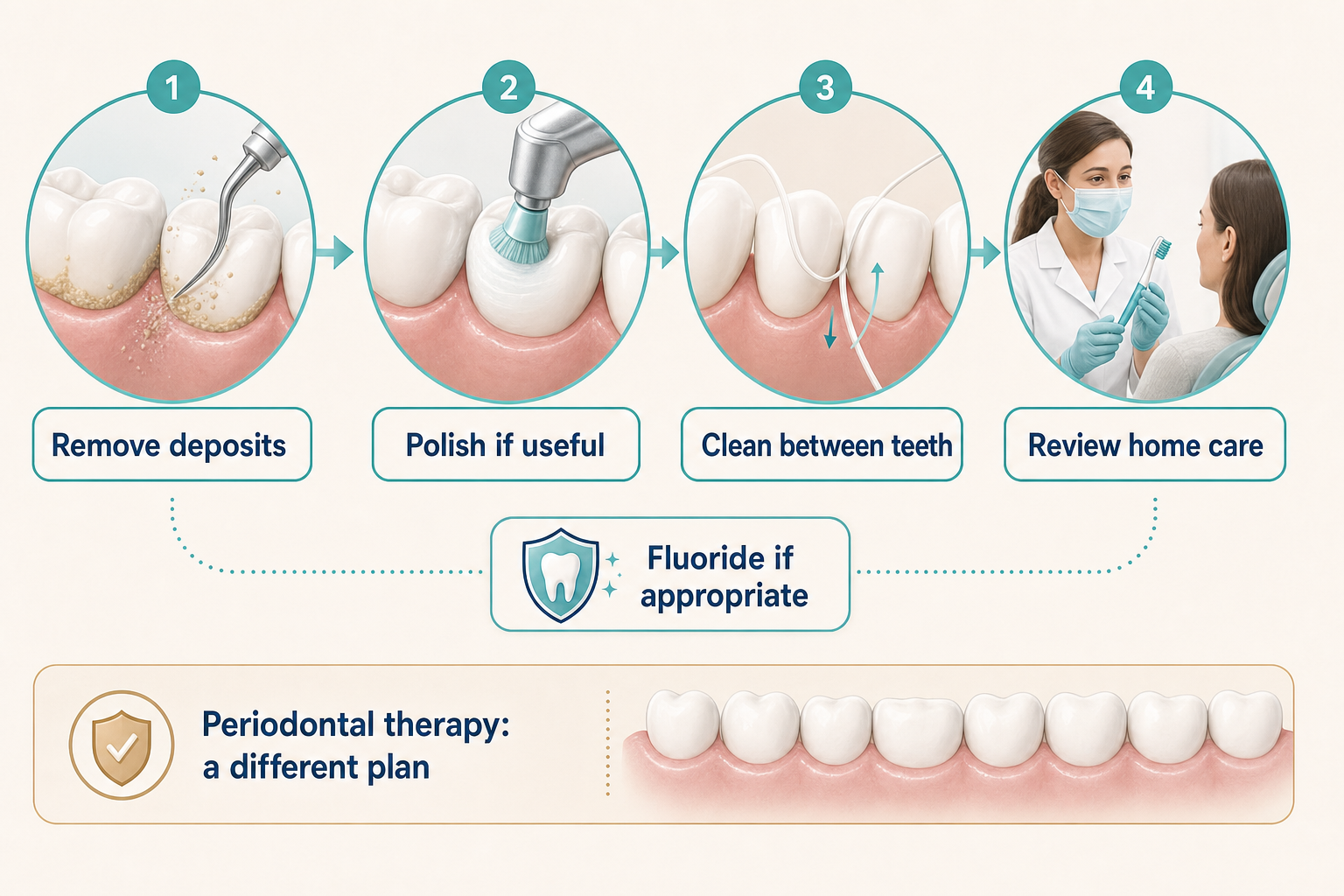
A routine dental cleaning is preventive care that removes plaque, hardened tartar, and some surface stains from the teeth. A dental hygienist or dentist usually performs it with hand instruments, powered instruments, or both. Polishing, flossing, fluoride, and home-care guidance may also be included when appropriate.
A routine cleaning is not automatically a “deep cleaning.” Periodontal therapy is a different service used when disease extends below the gumline and requires a different plan.
What a routine cleaning is designed to do
Plaque is a sticky film of bacteria that forms on teeth. Daily brushing and cleaning between teeth can disrupt it, but some areas are easy to miss. Plaque that remains can harden into tartar, also called calculus. Once it has hardened, a toothbrush and floss are not designed to remove it.
A professional cleaning removes deposits from accessible tooth surfaces and gives the dental team a chance to help you improve the areas that are difficult to clean at home. What Is Plaque? and Plaque at the Gumline explain how buildup develops and why location matters.
Plaque and tartar removal
The main step is scaling. The clinician uses small hand instruments, a powered ultrasonic scaler, or a combination to remove plaque and tartar from the teeth. Powered instruments may make a humming sound and release water; hand instruments may feel like gentle scraping.
The amount of time this takes varies with the amount and location of buildup, sensitivity, gum condition, and access around dental work. You can ask for a pause if you need one and tell the clinician if an area feels uncomfortable.
Polishing
Polishing uses a small rotating cup or another polishing method to remove some soft deposits and surface stains. Teeth may feel smoother afterward.
Polishing is not the same as whitening. It does not change the natural color inside the tooth, and it cannot remove every type of discoloration. Some clinicians polish selectively rather than treating every tooth the same way.
Flossing or cleaning between teeth
The clinician may floss or use another interdental tool to clear loosened material and assess areas between teeth. This can also help identify places where home cleaning is difficult.
If your gums bleed, it is reasonable to ask what the clinician is seeing. Bleeding can have more than one cause, including inflammation and irritation, so it should not be used as a stand-alone diagnosis. Why Do My Gums Bleed When I Brush? offers more context.
Fluoride when appropriate
Some cleanings are followed by a professional fluoride treatment, such as a varnish or gel. Fluoride can help strengthen tooth surfaces and reduce cavity risk. Whether it is recommended depends on factors such as age, cavity risk, oral-health history, and the dental professional’s assessment.
Fluoride is not an automatic part of every cleaning, and its use does not replace brushing with fluoride toothpaste or other preventive care.
Home-care review
A cleaning appointment can reveal a pattern of buildup, such as along the gumline, behind certain teeth, or around braces, retainers, implants, bridges, or other dental work. The clinician may show you these areas and suggest ways to reach them more effectively.
Useful advice should fit your mouth and abilities. You can ask the clinician to demonstrate a technique or explain why a particular brush or between-teeth tool is being suggested.
Routine cleaning versus periodontal therapy
A routine cleaning, sometimes called prophylaxis, focuses on preventive removal of plaque and tartar in a generally healthy or stable mouth. Scaling and root planing is nonsurgical periodontal treatment for gum disease. It involves cleaning below the gumline and along root surfaces, often by section of the mouth and sometimes with local anesthetic.
The terms should not be used interchangeably. The appropriate service depends on examination findings, including gum inflammation, attachment and bone support, pocketing, and the location of deposits. A dental professional should explain the diagnosis, the proposed procedure, and why routine cleaning would or would not be enough.
Why cleaning frequency varies
There is no schedule that fits every person. The interval may depend on gum health, history of gum disease or cavities, how quickly tartar accumulates, dry mouth, smoking or tobacco exposure, health conditions, home care, and other individual risks.
A person receiving periodontal maintenance after gum-disease treatment may follow a different plan from someone receiving routine preventive cleanings. Ask what interval is being recommended and what finding or risk it is meant to address. How Often Should You See a Dentist? explains individualized recall in more detail.
What a cleaning cannot promise
A cleaning can remove plaque, tartar, and some external stains, but it does not guarantee that cavities or gum disease will not develop. It does not permanently whiten teeth, repair lost enamel, or replace daily home care.
It is also distinct from the dental examination. The checkup evaluates the teeth, gums, and other oral tissues and helps determine what care is appropriate; the cleaning performs preventive deposit removal. The two services often happen during one visit, but not always.
The takeaway
A routine dental cleaning centers on removing plaque and tartar. Polishing, flossing, fluoride, and tailored home-care guidance may be added when useful. If your dental team recommends a “deep cleaning” or a schedule that differs from someone else’s, ask what findings led to that recommendation and how the proposed care differs from routine cleaning.
Sources
- Periodontal (Gum) Disease — National Institute of Dental and Craniofacial Research
- Fluoride: Topical and Systemic Supplements — American Dental Association
- Dental check-ups — NHS