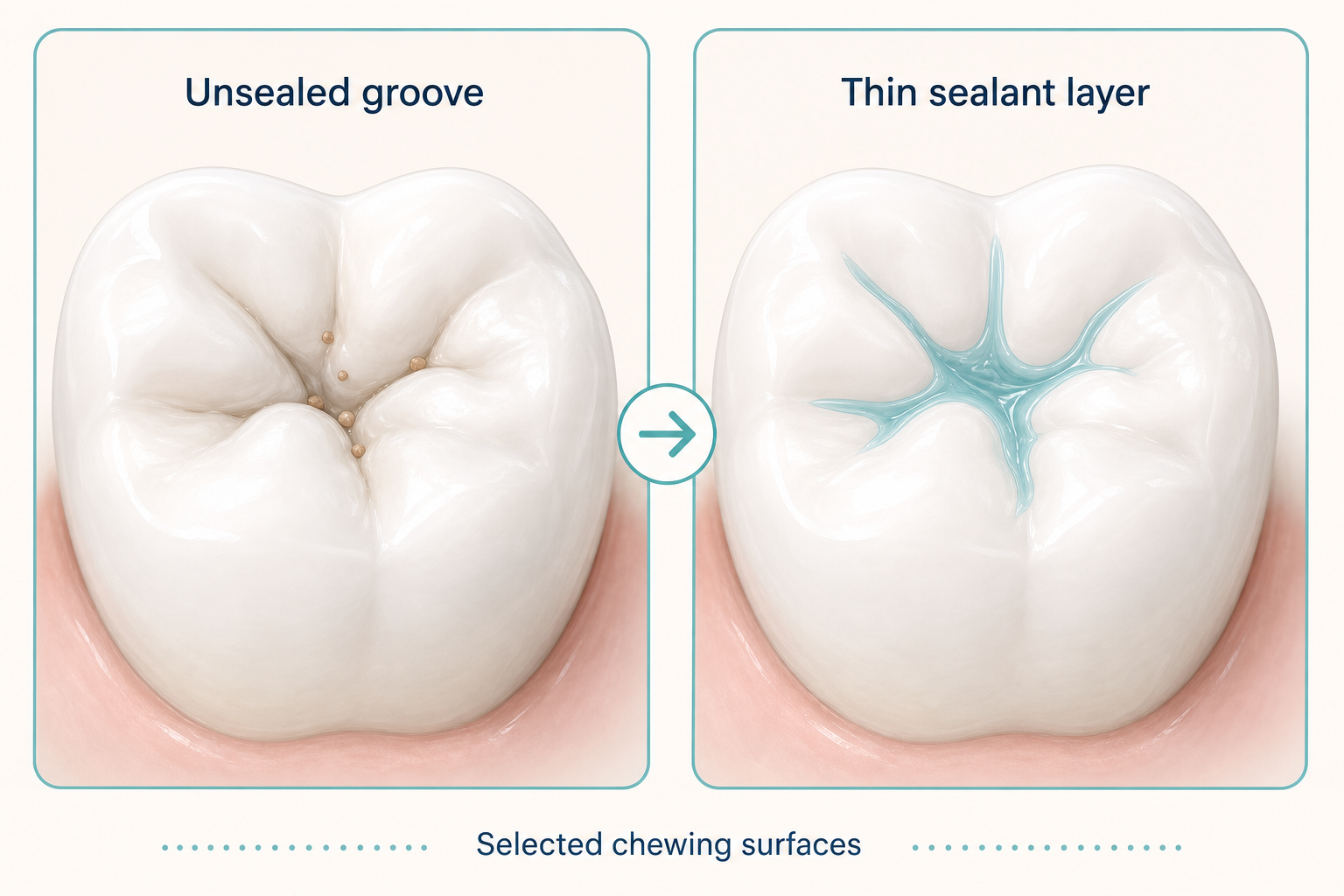
Dental sealants are thin coatings placed over the pits and grooves on the chewing surfaces of back teeth. They create a physical barrier that makes those hard-to-clean areas less likely to trap food and cavity-causing bacteria.
Sealants are used most often on children’s and adolescents’ molars, but age alone does not determine who needs them. A dental professional considers the tooth’s shape, whether it is fully erupted, its current condition, cavity risk, and whether a sealant can be kept dry during placement.
Why molars can be difficult to protect
Molars have grooves that help grind food. Some grooves are narrow or deep enough that toothbrush bristles cannot clean them well. Plaque and food can remain in these areas even when someone brushes regularly.
A sealant flows into the grooves and hardens into a protective layer. It does not strengthen the entire tooth or cover every surface. Its main job is to protect the sealed pits and fissures on the chewing surface.
Who commonly benefits from sealants
Children and adolescents are the groups most often considered because newly erupted permanent molars can be vulnerable to decay. First permanent molars commonly appear around age 6 and second permanent molars around age 12, although timing varies.
Sealants may be especially useful when a person has:
- Deep pits and grooves in molars
- A history or elevated risk of cavities
- Difficulty keeping back teeth clean
- Newly erupted permanent molars that can be isolated well enough for placement
- Barriers to consistent preventive dental care
Primary, or baby, molars may also be considered when their anatomy and a child’s cavity risk make protection useful. Not every child needs every molar sealed.
Can adults get sealants?
Yes. An adult with an unfilled molar that has deep grooves and is at risk for decay may be a candidate. The expected benefit depends on the individual tooth and the person’s risk.
A tooth with a filling, established decay, or a surface that cannot be cleaned and isolated may need a different approach. A dentist or other qualified dental professional must assess the tooth rather than deciding from age alone.
What happens during application
Sealant placement is usually a short, noninvasive procedure. The exact materials and steps vary, but the process generally includes:
- The tooth is cleaned.
- It is kept dry and separated from saliva.
- The chewing surface is prepared so the sealant can bond.
- The liquid sealant is placed into the pits and grooves.
- The material sets on its own or is hardened with a curing light.
- The dental professional checks the coating and the way the teeth come together.
Placement usually does not require removing healthy tooth structure. Keeping the tooth dry is important because moisture can interfere with bonding.
Sealants are not fillings
A sealant is primarily preventive: it covers vulnerable grooves to reduce the chance that decay will begin there. It does not treat established decay. A filling replaces tooth structure that has been removed because of a cavity or damage.
Professional guidelines also support sealing some early, noncavitated lesions when a clinician determines that the surface can be appropriately sealed and monitored. That is not the same as covering a large or clearly cavitated area without evaluation. The tooth must first be assessed.
How long do sealants last?
Sealants can protect teeth for years, but they are not permanent. They can wear, chip, or partially detach. How long one lasts depends on the material, placement, bite, tooth, and follow-up.
At routine visits, the dental team can check whether a sealant is intact. A worn or missing area may be repaired or replaced when appropriate. A sealant that needs maintenance has not necessarily “failed”; ongoing checks are part of using it as a preventive tool.
What sealants can and cannot do
Sealants lower the risk of cavities on the surfaces they cover, but they do not guarantee that a tooth will remain cavity-free. They do not protect the smooth sides of teeth or the areas between teeth, and they do not replace:
- Brushing twice daily with fluoride toothpaste
- Cleaning between teeth
- A tooth-supportive eating pattern
- Regular dental assessment based on individual needs
- Other preventive care recommended for a person’s risk
Sealants and fluoride have different roles. Fluoride helps make tooth enamel more resistant to acid attacks across exposed surfaces, while sealants provide a physical barrier in selected grooves. They can be used together as parts of a broader cavity-prevention plan.
Are sealants safe?
Dental sealants have a long history of use. Some resin-based materials can produce a very low, brief exposure to bisphenol A, or BPA, around placement. The ADA states that current evidence does not identify a health concern from BPA exposure from dental materials. Dental professionals can also follow material-handling steps that reduce residual exposure.
If you have a known material allergy or a concern about a product’s ingredients, tell the dental team before placement. They can identify the proposed material and discuss reasonable options.
Questions to ask
If sealants are recommended, you can ask:
- Which teeth would be sealed, and why?
- Are the grooves healthy, or is there an early area being monitored?
- How will the sealants be checked over time?
- What happens if part of a sealant wears away?
- Are there other cavity-risk factors we should address?
The takeaway
Dental sealants are protective coatings for cavity-prone grooves, most often on molars. They commonly help children and adolescents as permanent molars erupt, and selected adults may benefit too. They can reduce risk for years, but they require follow-up and do not replace fluoride toothpaste, brushing, cleaning between teeth, or regular dental care.
For the broader picture, read What Causes Cavities? and How to Prevent Cavities.
Sources
- Dental Sealants — American Dental Association
- About Dental Sealants — Centers for Disease Control and Prevention
- Evidence-based Clinical Practice Guideline for the Use of Pit-and-Fissure Sealants — American Academy of Pediatric Dentistry
- Dental Sealants — National Institute of Dental and Craniofacial Research