The simple answer
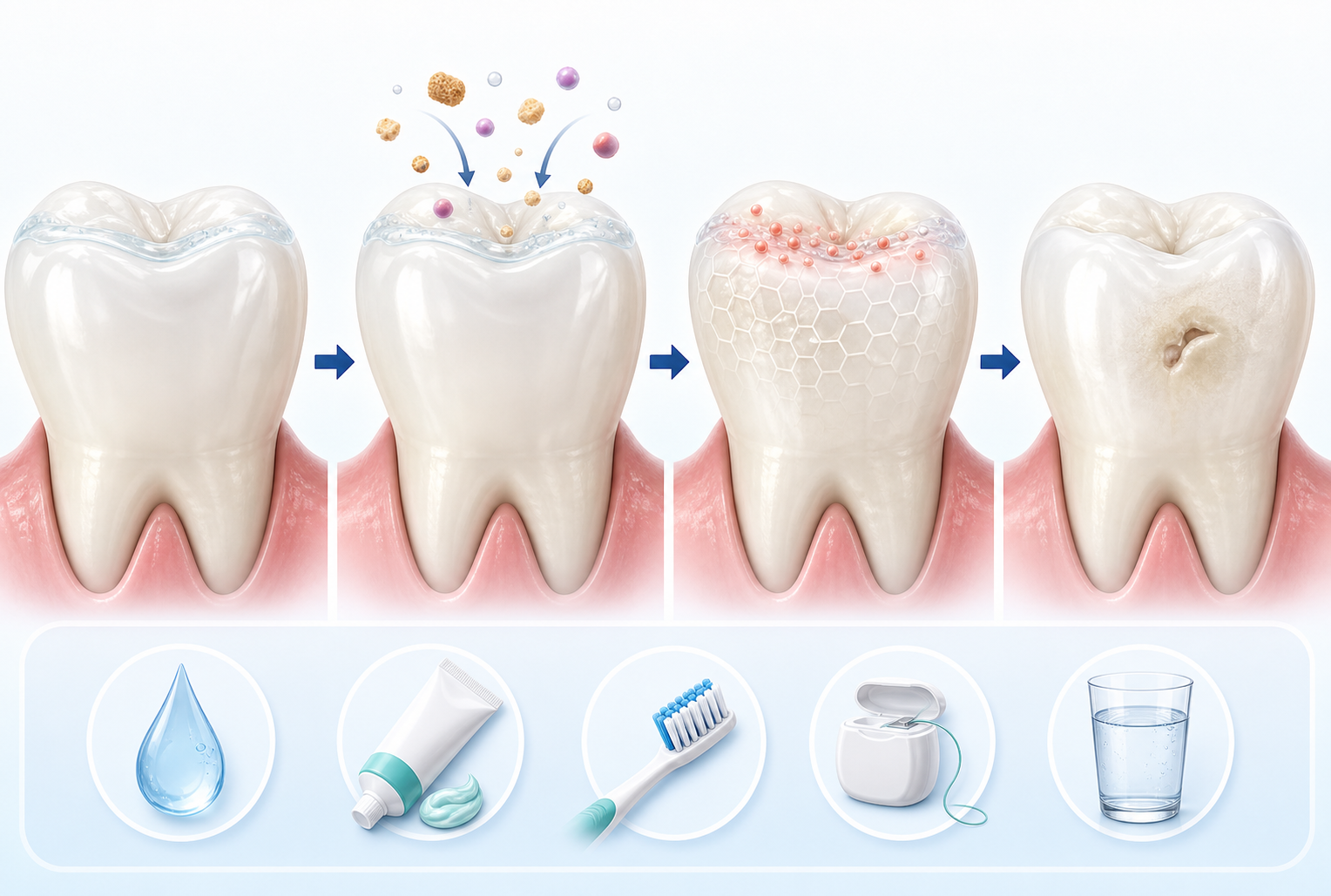
Cavities form when bacteria in dental plaque use sugars and starches from food and drinks to make acids. Repeated acid attacks can remove minerals from enamel faster than saliva and fluoride can replace them. If the decay process continues, the weakened tooth can develop a cavity.
This is why someone can brush regularly and still get a cavity. Brushing is important, but risk is influenced by several factors at once, including plaque, how often teeth are exposed to sugars or starches, fluoride, saliva, tooth anatomy, and time. A cavity is not proof that someone was careless.
What a cavity is
A cavity is a damaged area of a tooth caused by tooth decay. It may begin as an early change in the tooth’s mineral surface and can progress if the decay process continues.
Cavities do not always cause obvious symptoms at first. That is one reason dental examinations can matter even when nothing hurts.
The plaque–acid–time process
A useful way to understand cavities is to think about three connected parts:
- Plaque: A sticky film of bacteria that forms on teeth.
- Acid: Bacteria in plaque use sugars and starches and produce acids.
- Time: Repeated acid attacks can gradually weaken the tooth surface.
Your teeth are not permanently “under attack” after every bite. Saliva helps clear acids and supplies minerals, while fluoride helps protect enamel and support mineral replacement. The balance can shift toward decay when acid exposure happens often enough, plaque remains in place, saliva protection is reduced, or fluoride exposure is limited.
Early mineral loss is not the same as a formed hole. Early decay may be stopped or reversed in some circumstances, but a formed cavity is permanent damage that needs a dentist to assess and may need repair.
Why sugar and starch matter, but are not the whole story
Sugary foods and drinks can contribute to cavities because plaque bacteria can use sugars to make acid. Starchy foods can also matter because they break down into sugars in the mouth.
How often teeth are exposed can matter. For example, sipping a sweet drink over a long period or having frequent sugary snacks can create repeated acid exposures. The relationship between the amount and frequency of sugar is not simple, so an online rule cannot calculate one person’s cavity risk.
That does not mean one food or drink automatically causes a cavity. Cavities usually develop through a pattern over time, not from one imperfect day.
Why brushing does not prevent every cavity
Brushing twice a day with fluoride toothpaste is a strong foundation for oral health. It removes plaque from many tooth surfaces and helps expose teeth to fluoride. See how to brush your teeth properly for a practical technique.
But brushing is only one part of the picture. Cavities can still be more likely when:
- Plaque remains in hard-to-clean areas, including between teeth or in deep grooves.
- Teeth are exposed to sugars or starches frequently.
- Fluoride exposure is limited.
- Saliva flow is reduced.
- A person has other individual risk factors that affect their teeth or mouth.
This is not a reason to blame yourself. It is a reason to think of cavity prevention as a system rather than a test you either pass or fail.
Where fluoride and saliva fit in
Fluoride helps protect enamel from acid and can help replace minerals lost during early decay. It is commonly found in toothpaste and, in many communities, drinking water. Saliva also helps clear acids and provide minerals; reduced saliva flow and persistent dry mouth can increase cavity risk.
The right fluoride plan can vary by person. A dentist or other clinician can help with questions about a child’s fluoride needs, cavity history, dry mouth, medicines, or other individual concerns. Do not add concentrated fluoride products or supplements based only on an online article.
What can help lower cavity risk
General habits that support cavity prevention include:
- Brushing twice a day with fluoride toothpaste.
- Cleaning between teeth regularly; flossing properly or using another suitable interdental cleaner helps reach areas a toothbrush may miss.
- Limiting how often teeth are exposed to sugary foods and drinks.
- Choosing water more often between meals.
- Keeping up with dental visits recommended for your situation.
For children and people at higher risk, a dentist may also discuss options such as sealants or additional fluoride. Whether those options fit depends on the teeth, age, history, and examination.
Small, repeatable changes are more useful than trying to create a perfect routine overnight.
Can you tell if you have a cavity at home?
Not reliably. Cavities may have no symptoms at first, and a white, brown, or dark area can have more than one possible explanation. A dentist uses an examination and, when appropriate, other tests to decide what a finding means. Do not use the absence of pain to rule out decay.
When to contact a dentist
Arrange a dental visit if you notice tooth pain, sensitivity that does not improve, a visible hole or new white, brown, or dark area, swelling, or a broken tooth. Seek urgent dental or medical help for facial swelling, fever, trouble breathing or swallowing, or rapidly worsening symptoms.
A dentist can determine what is causing the problem and discuss the appropriate next step. For a broader routine, see how to prevent cavities.
Common questions
Can brushing alone prevent cavities?
Brushing with fluoride toothpaste is important, but it cannot remove every risk. Between-teeth plaque, frequent acid exposure, reduced saliva, tooth anatomy, and individual history can all matter.
Do cavities come from sugar only?
No. Sugars and starches provide fuel for acid production, but cavities develop through the interaction of plaque, acid, tooth susceptibility, saliva, fluoride, exposure patterns, and time.
Can an early cavity heal?
Early mineral loss may be stopped or reversed in some circumstances. A formed hole is permanent tooth damage and cannot be brushed away; a dentist needs to assess it.
Takeaway
Cavities are not caused by one mistake. They form through a process involving plaque, acid, repeated food and drink exposures, time, and the protections available to your teeth.
Brushing matters. Fluoride, saliva, food and drink patterns, cleaning between teeth, and dental care matter too. The most useful goal is a realistic routine that gives your teeth more protection over time.
Sources
- Cavities — MouthHealthy / American Dental Association
- Tooth decay — NHS
- The Tooth Decay Process: How to Reverse It and Avoid a Cavity — National Institute of Dental and Craniofacial Research
- Tooth Decay — Centers for Disease Control and Prevention
- Nutrition and Oral Health — American Dental Association