Using mouthwash correctly starts with the product label. Different rinses have different purposes, ingredients, amounts, rinse times, and age limits. There is no single routine that is right for every mouthwash.
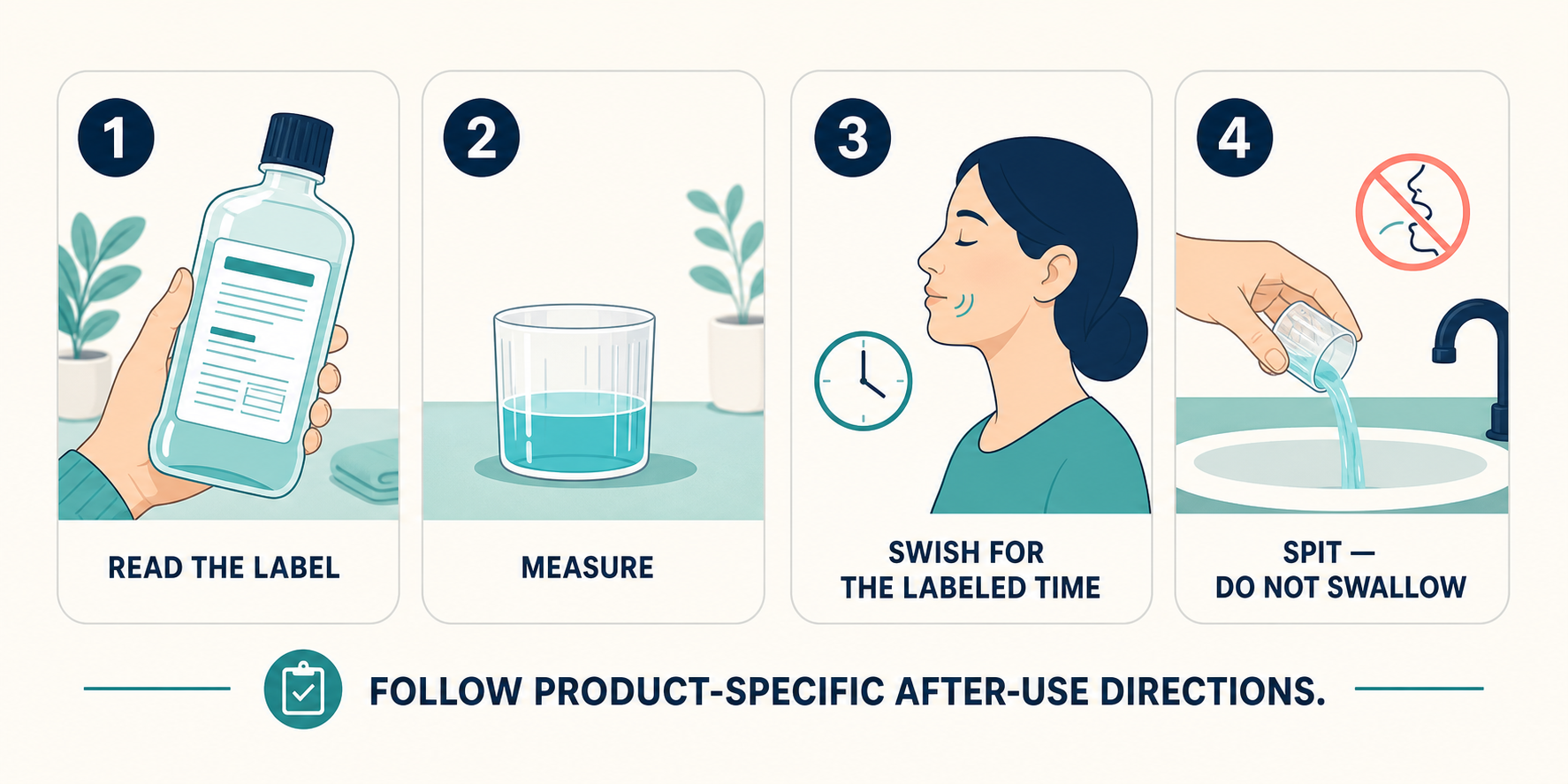
For most over-the-counter products, the basic pattern is simple: measure the labeled amount, swish for the labeled time, and spit it out. Do not swallow mouthwash, and do not assume that using more or rinsing longer will work better.
First, know what the mouthwash is meant to do
Mouthrinses generally fall into two broad groups:
- Cosmetic rinses mainly freshen breath or leave a pleasant taste for a short time.
- Therapeutic rinses contain active ingredients intended to provide a health benefit, such as helping prevent cavities or control plaque and gingivitis.
Some therapeutic rinses are sold over the counter. Others are prescribed. The words on the front of the bottle are not enough to tell you how a rinse works; check its active ingredients, intended use, and directions.
If alcohol is the part of the label you are comparing, Does Alcohol-Free Mouthwash Work? explains why the active ingredients and intended purpose matter more than that one feature.
A practical way to use an over-the-counter mouthwash
- Read the directions and warnings. Check the amount, rinse time, frequency, age guidance, and whether the label says to avoid food, drinks, or water afterward.
- Measure the stated amount. Use the supplied cap or another suitable measure if the directions call for one.
- Swish for the stated time. Do not extend the rinse time on the assumption that longer is better.
- Spit it out. Mouthwash is not meant to be swallowed.
- Follow the after-use directions. Whether to rinse with water, eat, or drink afterward depends on the product.
If a dental professional prescribed the rinse, follow the instructions provided for that specific product. Prescription rinses can have directions that differ from store-bought mouthwash.
Should mouthwash come before or after brushing?
It depends on the rinse and its ingredients. The American Dental Association notes that manufacturers may recommend a particular order because ingredients in one product can affect another.
There is also a practical reason not to make mouthwash an automatic final step after brushing. The NHS advises using fluoride mouthwash at a different time, such as after lunch, because rinsing immediately after brushing can wash away the more concentrated fluoride left by toothpaste. For more context, see Should You Rinse After Brushing?.
The safest general rule is to follow the mouthwash label and any instructions from your dentist rather than applying one sequence to every product.
Mouthwash adds to cleaning; it does not do all of it
Mouthwash can be useful for a particular purpose, but it does not replace brushing or cleaning between teeth. A toothbrush cleans accessible tooth surfaces, while floss or another interdental cleaner helps remove plaque from areas a brush may miss. Mouthwash and flossing do different jobs.
Keep brushing and interdental cleaning as the foundation of your routine. If floss is part of your plan, How to Floss Properly explains a gentle technique.
Children need extra caution
The American Dental Association advises that children younger than 6 generally should not use mouthrinse unless a dentist directs it. Young children may not yet reliably spit out the liquid and may swallow too much. For any child, check the product’s age restrictions and supervise use as appropriate.
Anyone who cannot reliably swish and spit should not use a mouthwash unless a dental or medical professional has provided suitable guidance.
What if mouthwash burns or irritates your mouth?
A strong sensation does not prove that a rinse is working better. Some formulations can feel uncomfortable, and certain ingredients may contribute to dryness or other unwanted effects. Some therapeutic ingredients can also affect taste or stain teeth with continued use.
Stop using the product and ask a dentist, pharmacist, or other appropriate health professional for guidance if burning, dryness, irritation, or taste changes are persistent or troublesome. Seek prompt help for swelling, trouble breathing, or another possible severe reaction.
The bottom line
Use mouthwash for a clear purpose and follow the directions for that product. Measure the recommended amount, rinse only for the stated time, spit it out, and follow any instructions about water, food, or drinks afterward. Keep brushing and cleaning between your teeth in the routine; mouthwash is usually an addition, not a substitute.
Sources
- Mouthrinse (Mouthwash) — American Dental Association
- How to keep your teeth clean — NHS