A good tooth routine for kids does not have to be fancy. It usually works best when brushing is tied to predictable cues, the supplies are easy to reach, and the caregiver role is clear.
The goal is simple: help brushing happen twice a day with a soft toothbrush and age-appropriate fluoride toothpaste, while giving young children the help they still need. For toothpaste amounts by age, see how much toothpaste kids should use.
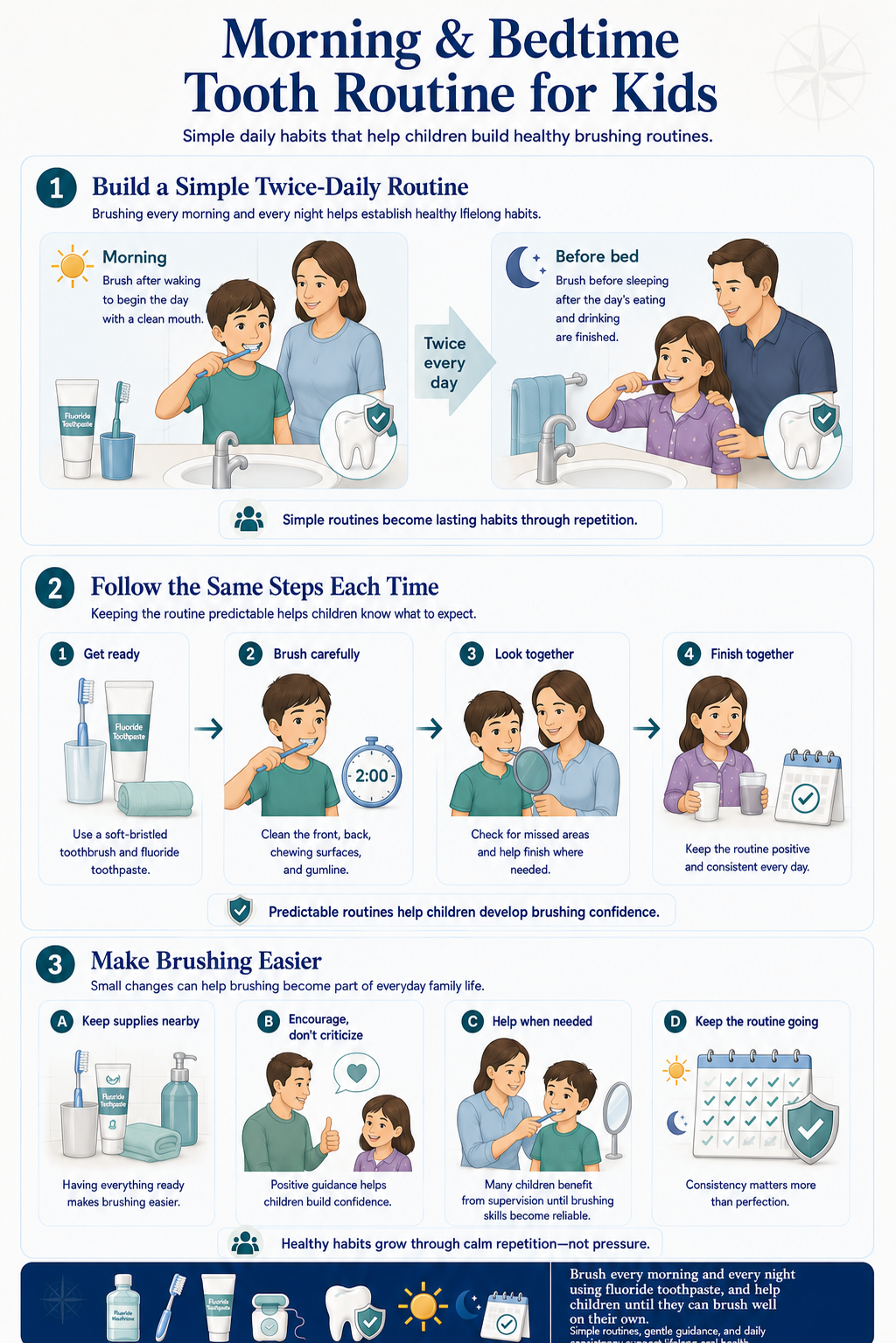
Why routines break down
Most families do not skip brushing because they do not care. Mornings get rushed. Bedtime gets emotional. Toothbrushes disappear. Children want independence before they can clean every surface well.
A routine helps because it removes some of the daily negotiation. Instead of asking, “Should we brush now?” the family pattern becomes, “This is what happens after breakfast,” or, “This is what happens before stories.”
The morning lane
Choose one morning cue and keep it as steady as possible. For some families, brushing works before getting dressed. For others, it works after breakfast. The exact cue can vary, but the routine should be easy to repeat.
A simple morning lane can look like this:
- Bathroom stop.
- Brush teeth with the child’s toothbrush and toothpaste.
- Caregiver helps or checks, depending on the child’s age and ability.
- Follow the dentist’s guidance about toothpaste amount and safe use.
- Toothbrush goes back where it belongs.
If mornings are rushed, place the toothbrush, toothpaste, and a cup where the child can see them. A visible checklist or another visual cue can give the child something to follow besides repeated verbal reminders.
The bedtime lane
Bedtime brushing often works best when it happens before the child is completely exhausted. Try attaching it to a familiar sequence, such as pajamas, bathroom, brushing, then stories.
A simple bedtime lane can look like this:
- Finish evening food and drinks.
- Brush teeth before the final calming activity.
- Caregiver helps with hard-to-reach areas.
- Keep water available if the child needs a drink after brushing.
- Put the toothbrush away so it is ready for morning.
This article is not a feeding or sleep-training plan. If a child has specific feeding, medical, or dental needs, the family dentist, pediatrician, or care team can give more tailored guidance.
For more detail about the final food, drink, and brushing sequence, see the guide to tooth-friendly bedtime habits.
Match the caregiver role to the child
Young children usually need adults to brush for them, help them, or check their work. As children get older, they can take on more of the routine, but independence should build gradually.
A helpful middle ground is shared responsibility. The related guide to brushing independence gives more detail on this handoff:
- The child gets a turn to practice.
- The caregiver gets a turn to finish or check.
- The child helps put supplies away.
- The dentist can help decide when less supervision is reasonable.
This keeps the routine from becoming an all-or-nothing power struggle.
As the child takes on more of the job, a planned caregiver check-back can keep the helper turn brief and neutral instead of making it feel like a surprise inspection.
Build in a backup plan
A missed brushing session does not mean the routine has failed. The useful question is: what made it hard today?
Common backups include:
- Keeping one spare toothbrush in a predictable place.
- Moving brushing earlier in the bedtime sequence.
- Using a short song, timer, or checklist as a cue.
- Letting the child choose between two acceptable toothbrushes or toothpaste flavors.
- Asking the dentist for ideas if brushing is consistently difficult.
Practical routine tools can support brushing, but they do not guarantee cooperation or prevent every cavity. They simply make the healthy action easier to repeat.
If brush feel, toothpaste texture, sound, positioning, or the bathroom environment is the main barrier, the sensory-friendly toothbrushing guide offers general adjustments that can fit inside the same routine.
The calm takeaway
For kids, a tooth routine is not just about technique. It is about where brushing fits in the day, who helps, and what happens when the schedule gets messy. Stable cues, visible supplies, and calm caregiver follow-through can make mornings and bedtimes easier to manage.
Sources
- Brushing Your Teeth — MouthHealthy / American Dental Association
- Baby Teeth — MouthHealthy / American Dental Association
- FAQ — American Academy of Pediatric Dentistry