A dental impression or intraoral scan is a record of the shape and position of teeth, gums, and other mouth structures. It helps a dental team and laboratory plan care or make something that needs to fit, such as a crown, bridge, denture, retainer, aligner, night guard, or study model.
In short: a traditional impression uses soft material in a tray, while an intraoral scan uses a camera-like wand to build a digital three-dimensional surface model. An intraoral scan is not a dental X-ray and does not use X-rays to create this surface model.
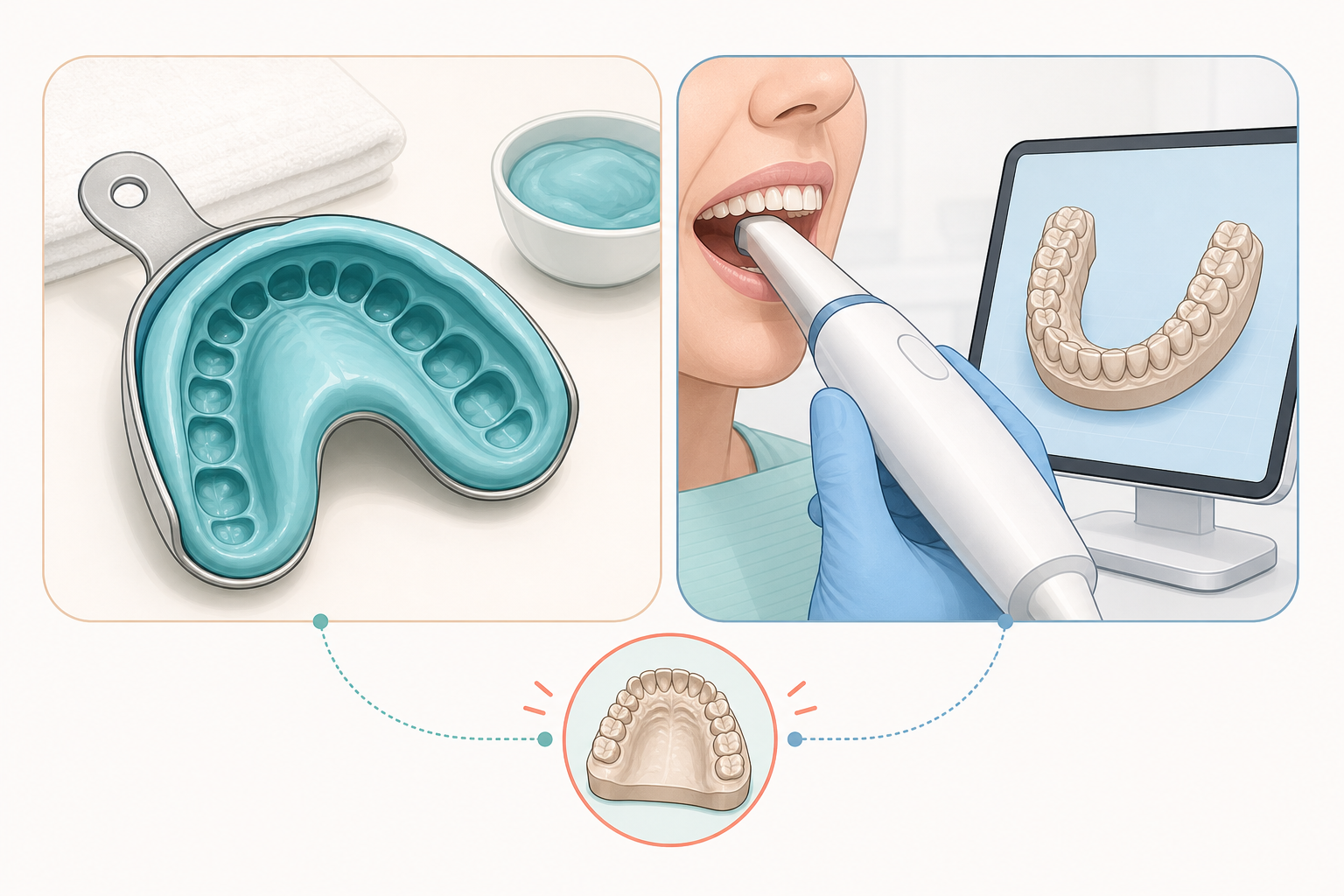
What is a traditional dental impression?
For a conventional impression, a dental professional places a mixed impression material in a tray and positions it over the teeth. The material sets while the tray stays still, then the tray is removed. The finished impression is a negative copy of the mouth that can be used to make a physical model or sent through a laboratory workflow.
You may notice pressure, a full feeling, an unfamiliar taste, or the need to breathe steadily through your nose. The material should not block your breathing, but some people find the experience uncomfortable or gag-provoking. Tell the dental team if you are worried about gagging, breathing, or a previous difficult impression so they can explain the plan and discuss practical accommodations.
What is an intraoral digital scan?
For an intraoral scan, the clinician moves a wand around the teeth and gums. The device captures many optical images, and software combines them into a three-dimensional surface model on a screen.
The wand still needs room to move around the mouth, and the process may take several passes. Digital scanning avoids a tray full of setting impression material, and research suggests many patients prefer it or find it less unpleasant. That does not guarantee a completely gag-free or effortless experience for every person.
What are impressions and scans used for?
The same basic goal—an accurate record of shape and position—supports many different tasks. Common uses include:
- crowns and some bridges
- complete or partial dentures
- retainers, clear aligners, and other orthodontic records
- night guards and some sports mouthguards
- implant-related restorations
- study models used to review the bite or track changes
The exact record needed depends on what is being planned. A scan suitable for one tooth is not automatically sufficient for a full arch, a person with no teeth, or a complex implant restoration.
Is a digital scan better than a traditional impression?
Not in every situation. Digital scans can make it easier to view the record immediately, identify a missing area, rescan a small section, and transfer a file electronically. Many patients find scanning more comfortable than conventional impressions.
Traditional impressions remain useful and reliable. Evidence comparing accuracy varies with the size of the area, the scanner and material, the clinical situation, the operator, and how accuracy is measured. Reviews generally find digital scanning clinically useful for many applications, while full-arch, toothless, and some implant situations remain more challenging or have mixed evidence.
A practice may also choose a method based on the restoration, laboratory workflow, equipment, clinician experience, mouth opening, and what tissues must be recorded. Sometimes a combined workflow is appropriate. The choice is not a test of which method is “better” for every patient.
Why do moisture and stillness matter?
An accurate record needs clear detail in the areas that matter. Saliva, blood, movement, limited space, reflective surfaces, and tissue position can affect a digital scan. Bubbles, tray movement, material distortion, poor seating, or moisture can affect a traditional impression.
The clinician may use suction, air, cotton, or other routine isolation methods and ask you to hold still. These steps are about capturing usable detail, not about judging how well you are cooperating.
Why might it need to be repeated?
A scan may have a missed, distorted, or unclear area. Often the clinician can recapture only that part. A traditional impression may need to be retaken if it has a void, pull, movement, incomplete edge, or other defect in a critical area.
A repeat does not necessarily mean something went seriously wrong. It usually means the record did not show enough dependable detail for the next step. Accuracy matters because the record guides design and fit.
If the record is being made for a crown, Dental Crowns: The Basics explains the larger process. For dentures and other ways to replace teeth, see Tooth Replacement Options: The Basics. If the scan or impression is part of a broader appointment, What Happens at a Dental Checkup? explains common parts of that visit. A surface scan also does not replace imaging when a dental team needs information below the visible surface; Are Dental X-Rays Safe? explains that separate kind of record.
Questions people often ask
Is a dental impression the same as a scan?
No. A traditional impression records the mouth with material that sets in a tray. An intraoral scan records surface information with optical images and software. Both are records used to support dental planning or fabrication.
Which is more accurate: an impression or a scan?
There is no universal winner. Accuracy depends on the area being recorded, the materials or scanner, the operator, moisture and movement control, and how the result is measured. Evidence is more mixed for long full-arch, toothless, and some implant workflows than for simpler, limited areas.
Does an intraoral scan hurt or cause gagging?
The wand may feel unfamiliar and the process may require several passes, but it avoids setting material in a tray. Many patients prefer scanning, while others may still find it tiring or uncomfortable. Tell the dental team about gagging, breathing concerns, or a previous difficult experience.
Why would a dentist repeat an impression or scan?
The record may have a missed, distorted, or unclear area that matters for the planned work. A repeat is usually about getting dependable detail for the next step; it does not by itself mean that something serious happened.
The takeaway
Traditional impressions use a tray and setting material; intraoral scans use optical images to create a digital surface model. Both can produce useful records, and neither method is automatically best for every mouth or every purpose. Your dental team chooses based on the detail needed, the planned work, the clinical setting, and the strengths and limits of each workflow.
Sources
- Digital Impressions Versus Conventional Impressions in Prosthodontics: A Systematic Review — Cureus / PubMed Central
- Accuracy of Full-Arch Intraoral Scans Versus Conventional Impression: A Systematic Review with a Meta-Analysis — Journal of Clinical Medicine / PubMed Central
- Validation of Digital Impressions’ Accuracy Obtained Using Intraoral and Extraoral Scanners: A Systematic Review — Journal of Clinical Medicine / PubMed Central
- Patient-related outcomes of conventional impression making versus intraoral scanning for prosthetic rehabilitation: A systematic review and meta-analysis — Journal of Prosthetic Dentistry / PubMed