The simple answer
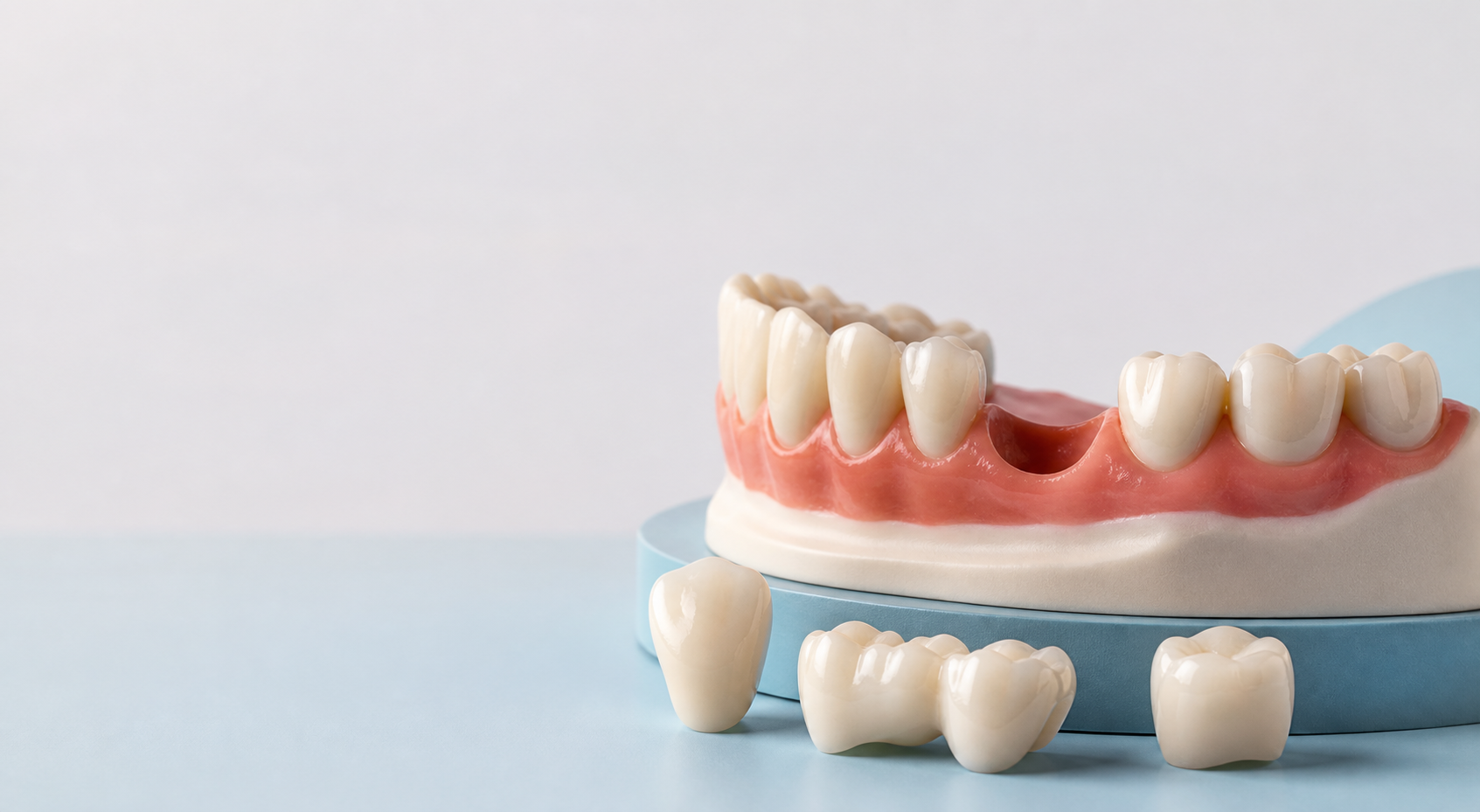
Bridges, implants, and dentures can all replace missing teeth, but they do not work the same way. A bridge uses surrounding teeth or implants for support. A dental implant is a post placed in the jaw to anchor a replacement. A denture is a removable appliance that may be supported by oral tissues, remaining teeth, implants, or a combination of these.
No category is automatically best. The useful question is which design fits the missing-tooth space, available support, oral and general health, preferences, maintenance needs, and a clinician’s evaluation.
Why replacement is discussed
Missing teeth can affect chewing, speaking, and appearance. A dentist may discuss replacement to fill a space and restore some function. That discussion may also happen before or after an extraction; this extraction overview explains why removing a tooth and deciding what happens to the space are separate decisions.
The important point is that “tooth replacement” is not one treatment. It is a set of categories with different sources of support, steps, and care needs. Not every missing-tooth situation has the same urgency or the same reasonable options.
Dental bridges
A dental bridge replaces one or more missing teeth with artificial teeth attached to surrounding teeth or implants for support. A traditional bridge is fixed in place and can be removed only by a dentist.
The broad idea is support from nearby structures. A tooth-supported bridge commonly includes crowns on the supporting teeth, but a crown on a tooth and an implant placed in the jaw are not the same thing. A dentist has to evaluate the proposed supports and explain what care the bridge will require.
Dental implants
A dental implant is a post surgically placed in the jaw to anchor a replacement tooth, bridge, or denture. People often use the word “implant” to mean the whole replacement tooth, but the implant itself is the support in the jaw. The visible replacement attached later may be a crown or part of a larger design.
Implants involve surgical placement and healing. Some people need months before the replacement is attached, while timing can differ for others. Suitability and timing require professional evaluation of oral health, anatomy, healing factors, and medical context; an online comparison cannot establish candidacy.
Dentures
Dentures are removable appliances that replace missing teeth. A partial denture replaces some teeth. A complete denture is used when all natural teeth in an arch are missing.
Denture designs vary. They may rest on oral tissues, use remaining teeth for support or retention, fit over selected prepared teeth, or connect with implants. Fit, adjustment, daily care, and follow-up are part of the plan; persistent soreness or fit problems deserve dental evaluation.
Bridges vs. implants vs. dentures at a glance
Bridge
- Support: surrounding teeth or implants
- Design: a traditional bridge is fixed
- Planning focus: condition of the supports, design, and cleaning around and under the bridge
Implant-supported replacement
- Support: one or more implants placed in the jaw
- Design: the attached crown or bridge is commonly fixed; some implant-supported dentures are removable
- Planning focus: surgical placement, healing, oral and general health, and the final restoration
Denture
- Support: oral tissues, remaining teeth, implants, or a combination, depending on design
- Design: removable
- Planning focus: fit, adjustment, cleaning, retention, and follow-up
These are category-level differences, not a treatment recommendation. A dental impression or scan may be one part of planning, but records alone do not choose the design.
How to compare the categories
A useful comparison is not “Which one is best?” It is “What does this option require, and what problem is it trying to solve?”
Questions that can help:
- Which teeth are missing or likely to be removed?
- What would support the replacement?
- Would the replacement be fixed or removable?
- What daily cleaning and professional follow-up would I be responsible for?
- What are the main tradeoffs for my mouth and health history?
- What are the expected steps, healing periods, adjustments, and costs?
- What happens if I wait, use a temporary option, or decide not to replace the tooth now?
These are planning questions for a dentist or specialist, not a self-test. For a broader way to discuss alternatives, timing, and uncertainty, use this guide to questions before dental treatment.
Takeaway
Bridges, implants, and dentures differ mainly in what supports them, whether the design is fixed or removable, and what placement and maintenance involve. Understanding those differences can make a consultation easier, but only a clinical evaluation can determine which options are reasonable for a particular missing-tooth space.