Fluoride advice can sound contradictory when several different questions are compressed into one: Is the topic toothpaste, drinking water, a professional varnish, a supplement, a young child, or an adult with a particular cavity risk?
Those contexts involve different amounts, exposure patterns, goals, and safeguards. A calm way to evaluate a fluoride claim is to ask: Which source of fluoride? For whom? At what amount? For what purpose? Based on which evidence?
The basic point public guidance agrees on
Fluoride is a naturally occurring mineral used to help prevent tooth decay. At the tooth surface, it can make enamel more resistant to acid and support replacement of minerals lost during the earliest stages of decay.
That does not mean every fluoride exposure is identical or that “more is better.” Benefit and risk depend on context and amount. It also does not mean fluoride is the only part of prevention; brushing, cleaning between teeth, eating and drinking patterns, and dental care still matter. See the broader guide to preventing cavities.
Why one word creates several conversations
Fluoride toothpaste
Toothpaste places a relatively concentrated amount of fluoride on the teeth during brushing. Guidance includes how often to brush, how much toothpaste a child should use, supervision, and what to do after brushing.
That is why adult directions should not be copied onto a toddler’s brush. Our age-specific guide explains how much toothpaste children should use, and Should You Rinse After Brushing? explains why post-brushing advice may sound different from general “rinse your mouth” habits.
Community water fluoridation
Community water fluoridation adjusts fluoride in a public water supply to a level intended to help prevent cavities. It provides frequent contact with a much lower fluoride concentration than toothpaste. Decisions about fluoridation are made at state or local levels, and the fluoride level in a person’s water depends on the water source.
Advice about community water should therefore be checked against the local water utility or a tested private well—not guessed from whether the water is bottled, filtered, or clear.
Professional fluoride
Dentists and some other trained health professionals can place fluoride varnish or gel directly on teeth. This is a professional preventive context, not a home recipe or proof that a person has a cavity.
Whether professional fluoride is appropriate depends on age, cavity risk, other fluoride exposure, and clinical judgment. A general article cannot set the schedule for an individual.
Dietary supplements
Fluoride supplements are a separate clinical decision. They are not interchangeable with toothpaste or varnish, and they should not be started or dosed from social-media advice. Water fluoride, age, other sources, and cavity risk all matter, so supplement questions belong with a dentist or physician.
Myth: “Fluoride is fluoride, so all advice should be the same”
The same substance can be used in different ways. Toothpaste is applied during brushing, community water supplies frequent low-level exposure, and varnish is professionally applied. Advice changes because the setting and amount change.
When two recommendations appear to conflict, check whether they are actually talking about the same source, age group, and use.
Myth: “If some fluoride helps, more must help more”
No. Public guidance aims to use an amount that supports cavity prevention while limiting avoidable exposure. During the years when permanent teeth are forming, taking in too much fluoride can contribute to dental fluorosis, a change in enamel appearance that is usually mild in the United States.
This is why young-child toothpaste amounts, supervision, water concentration, and supplement decisions receive special attention. It is not a reason to improvise a zero-fluoride or extra-fluoride plan without context.
Myth: “Fluoridated water and fluoride toothpaste are duplicates”
They provide fluoride in different patterns. CDC guidance describes water and toothpaste as working together: water maintains frequent low-level contact, while toothpaste provides a higher topical concentration during brushing.
That general public-health guidance does not answer every individual question. A person using well water, living where natural fluoride is high, swallowing toothpaste, or considering supplements may need more specific advice.
Myth: “One alarming study settles every fluoride question”
Research findings must be matched to the exposure being studied. Evidence about very high fluoride exposure should not automatically be treated as evidence about the recommended U.S. community-water level, toothpaste used as directed, or professional varnish. The reverse is also true: evidence supporting one use should not be stretched to every amount or population.
NIDCR notes that research has found an association between higher fluoride exposure and lower IQ in children at levels above the recommended U.S. drinking-water concentration, while important questions about causation and lower exposure remain. This is a reason to read the dose and setting carefully—not to dismiss research or turn one result into a universal claim.
A better checklist for fluoride claims
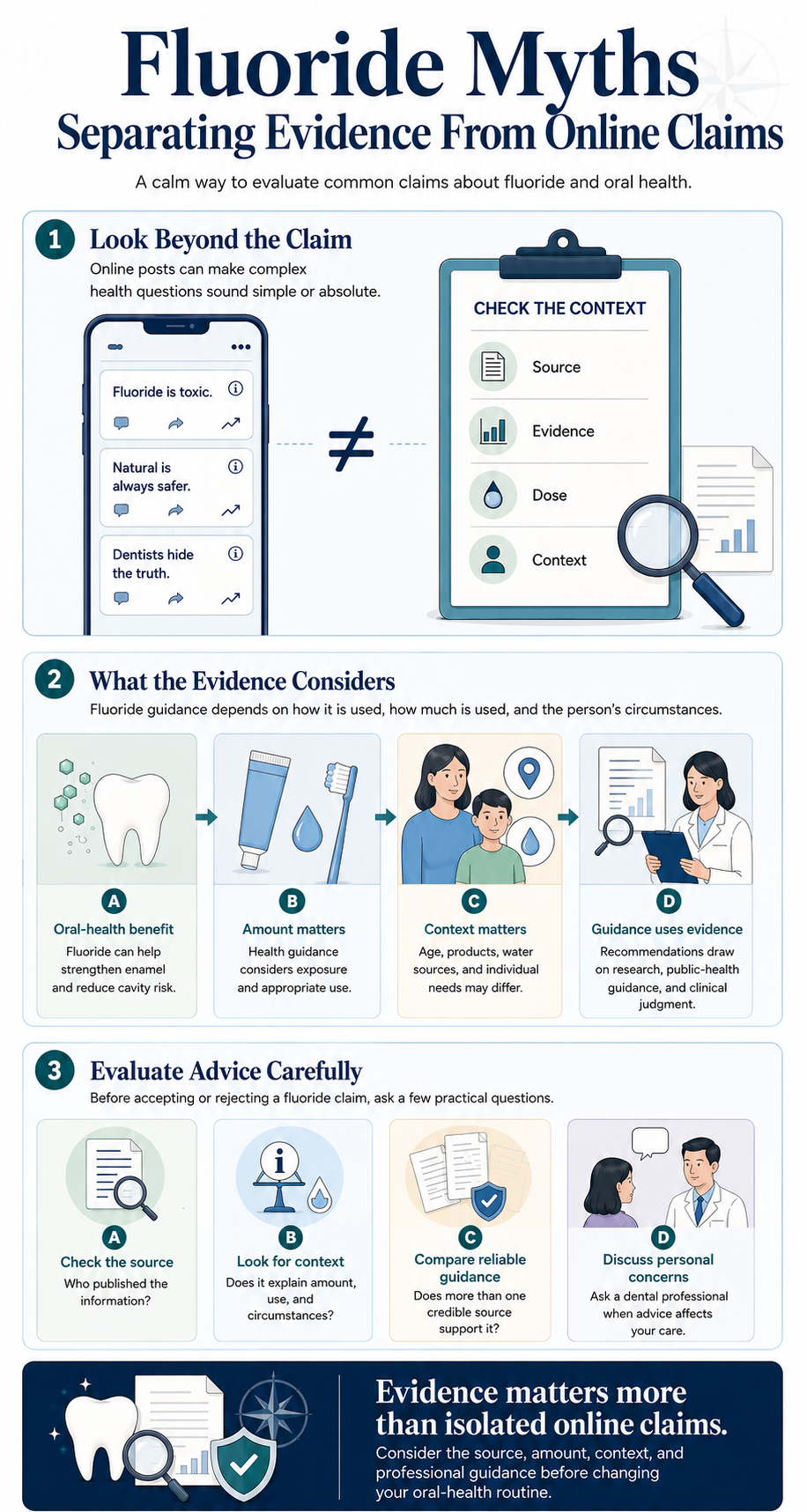
Before accepting a post, headline, or product claim, ask:
- Which fluoride source is being discussed?
- Is the exposure swallowed, placed on teeth, or both?
- What age group and amount were studied?
- Is the claim about cavity prevention, fluorosis, another health outcome, or politics?
- Does the source compare like with like?
- Is the advice from a public-health agency, professional guideline, or a seller with a financial interest?
When to ask for individual guidance
Talk with a dentist or physician about child-specific use, supplements, swallowing concerns, private-well water, unusually high local fluoride, or health conditions that may change advice. Your water provider or local health department can help identify the fluoride level in a public supply; private wells require testing.
The practical takeaway
Fluoride guidance becomes clearer when the context is named. Toothpaste, drinking water, professional applications, and supplements are different questions. Age, amount, exposure pattern, cavity risk, and local water all matter. Ask those questions before treating a confident fluoride claim as complete.
Sources
- Fluoride & Dental Health — National Institute of Dental and Craniofacial Research
- Ask the Expert: Why is fluoride good for dental health? — National Institute of Dental and Craniofacial Research
- Community Water Fluoridation Frequently Asked Questions — Centers for Disease Control and Prevention
- CDC Scientific Statement on Community Water Fluoridation — Centers for Disease Control and Prevention
- Fluoride Therapy — American Academy of Pediatric Dentistry