The toothpaste aisle can make a basic purchase feel complicated. For most people, a practical starting point is a fluoride toothpaste they can tolerate and use consistently. After that, choose added features for a specific need—not because the package uses the most impressive language.
There is no single “best” toothpaste for everyone. Sensitivity, surface stains, gum concerns, age, and comfort can all change what makes sense.
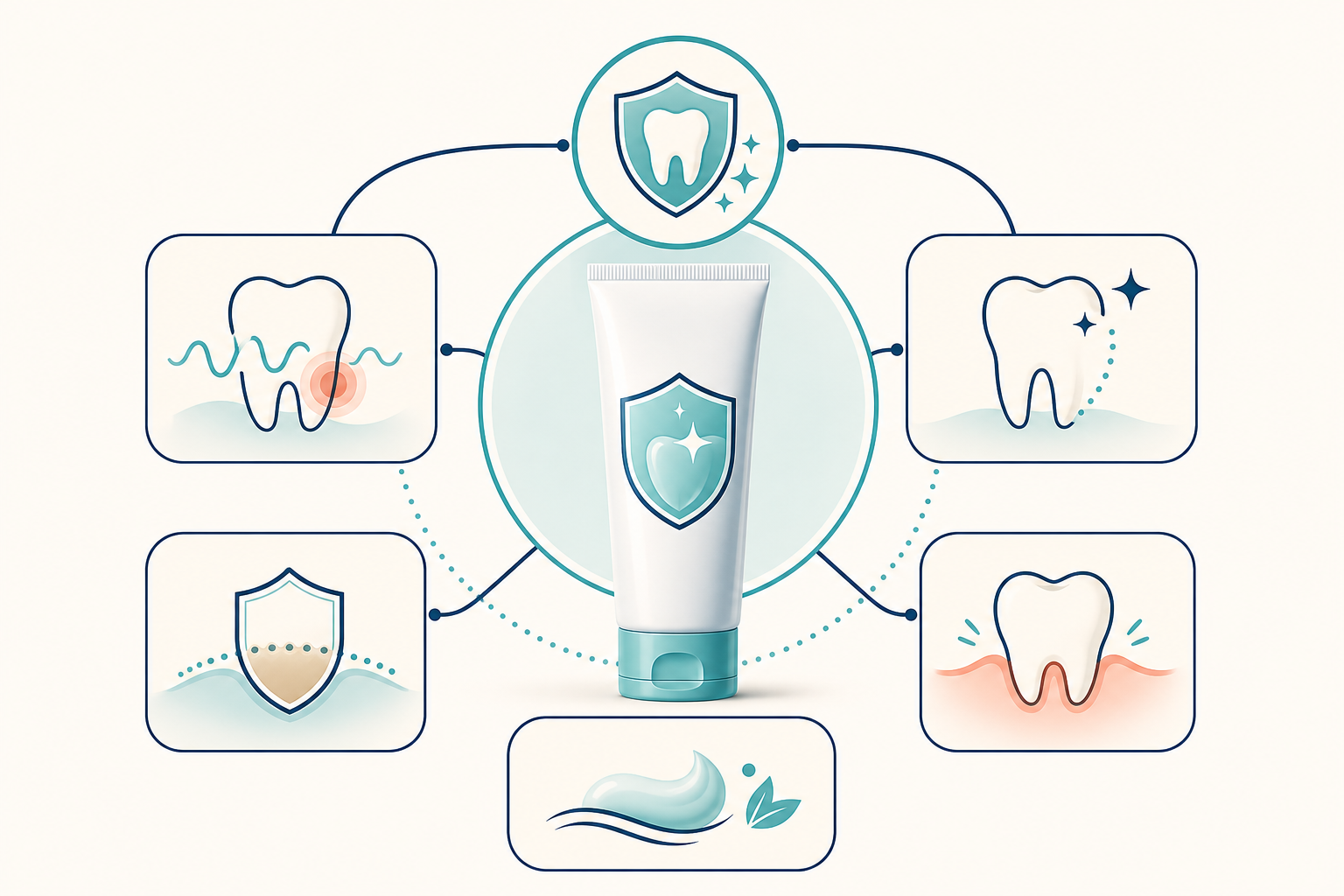
Start with cavity protection
Fluoride is the standard cavity-prevention ingredient in everyday toothpaste. It helps strengthen enamel and supports repair of the earliest mineral loss before a cavity becomes a hole. That is why brushing with fluoride toothpaste is a basic part of cavity prevention.
Check the active-ingredients panel rather than relying only on words such as “complete,” “advanced,” or “natural.” A fluoride-free product does not automatically become safer because of its marketing style, and it leaves out this well-established cavity-prevention benefit. The guide to natural toothpaste claims explains how to evaluate that label without treating it as proof of safety or effectiveness.
Some people need more individualized guidance because of frequent cavities, dry mouth, exposed roots, dental restorations, or other factors. A dentist can help with that decision without turning one product into a universal answer.
What an acceptance seal can tell you
In the United States, the ADA Seal of Acceptance means a product maker submitted evidence for review and the American Dental Association determined that the product met requirements for safety and effectiveness for the claims named on its package.
The wording beside the seal matters. A seal for cavity protection, sensitivity relief, or stain removal supports that particular claim; it does not mean the product is superior in every way. A product without the seal is not automatically unsafe, because participation in the program is voluntary. The seal is simply one useful evidence check when labels feel hard to compare.
Match the extra claim to the need
Sensitive teeth
Desensitizing toothpastes use active ingredients intended to reduce dentin sensitivity. They may help some people, but sensitivity has more than one possible cause. A toothpaste cannot tell whether cold pain comes from exposed dentin, a cavity, a crack, or another problem.
If sensitivity is new, getting worse, limited to one tooth, or not improving, a dental examination matters. See why teeth may hurt with cold foods or drinks for a broader explanation.
Whitening
Most whitening toothpastes mainly help remove stains on the tooth surface. They generally do not change the underlying color of a tooth in the same way that bleaching products can, and they do not change the color of fillings, crowns, or veneers.
More scrubbing or a grittier feel does not mean better or safer whitening. Use the product as directed and keep brushing pressure gentle.
Tartar control
Tartar-control toothpaste may help reduce new tartar buildup. It cannot brush away tartar that has already hardened on the teeth; hardened tartar requires professional removal.
This makes “tartar control” a prevention claim, not a promise to remove an existing deposit.
Gum-health claims
Some fluoride toothpastes contain active ingredients with evidence for reducing plaque or gingivitis. Read the exact claim instead of treating “gum health” as a guarantee that all bleeding or swelling will resolve.
Toothpaste is only one part of gum care. Gentle brushing at the gumline, cleaning between teeth, and professional evaluation for ongoing bleeding, swelling, or tenderness still matter.
Comfort is a useful feature
Flavor, texture, and foam do not need to feel intense for a toothpaste to work. Foaming agents help disperse the paste, but a stronger foam is not proof of better cleaning.
Some people find particular flavors or ingredients irritating. If a paste repeatedly causes burning, peeling, sores, or another reaction, stop treating discomfort as something you must tolerate and ask a dentist or other health professional for help identifying a suitable option. A milder flavor or different formula may also make regular brushing easier.
Choosing toothpaste for a child
Children should use fluoride toothpaste in an age-appropriate amount with caregiver supervision. Current U.S. guidance uses a rice-grain-sized smear for children younger than 3 and a pea-sized amount from ages 3 through 6, while teaching children to spit rather than swallow.
A child-friendly flavor can improve acceptance, but the package still needs the same careful look at fluoride and directions. Questions about swallowing, cavity risk, water fluoride, or specialized products are better handled with the child’s dentist or pediatrician than with a general product rule.
A simple label-reading order
When comparing toothpastes, use this order:
- Cavity protection: Look for fluoride in the active-ingredients panel.
- Specific need: Choose sensitivity, stain-removal, tartar-control, or gum-health claims only when they match your goal.
- Evidence check: Read what an acceptance seal actually covers, if one is present.
- Tolerability: Pick a flavor, texture, and foaming level you can comfortably use twice a day.
- Personal context: Ask a dentist when symptoms, repeated cavities, young-child needs, or dental work make the choice less straightforward.
The paste still needs good technique to be useful. Brushing properly and doing it consistently matter more than chasing every new label claim.
The practical takeaway
Choose toothpaste by function. For most people, begin with fluoride for cavity prevention, then add only the feature that addresses a real need. Treat whitening, tartar-control, and gum-health language as specific claims with limits—not proof that one tube is best for everyone.
Sources
- Toothpastes — American Dental Association
- ADA Seal of Acceptance — American Dental Association
- Teeth Whitening — MouthHealthy, American Dental Association
- Dental Floss/Interdental Cleaners — American Dental Association
- About Fluoride — Centers for Disease Control and Prevention
- Home Oral Care — American Dental Association