Why do teeth hurt with cold food or drinks?
Teeth can hurt with cold food or drinks for more than one reason. Brief, sharp pain can happen when dentin—the layer beneath enamel or the root covering—is exposed. Cold can also trigger pain from tooth decay, a crack, a worn filling, gum changes, or another problem that needs an examination.
The pattern is useful to report, but it is not a diagnosis. Notice which tooth hurts, what triggers it, how intense it feels, and whether the pain stops quickly or lingers.
Why cold can trigger tooth pain
The outer part of a tooth is protected by enamel. Below that layer is dentin, which contains tiny pathways connected to the inner part of the tooth.
When dentin becomes exposed, cold food, drinks, air, touch, or sweet foods may trigger a quick, sharp sensation. This is commonly called dentin hypersensitivity or tooth sensitivity. A brief response is compatible with sensitivity, but it does not prove that the tooth is otherwise healthy.
Sensitivity can be uncomfortable, but it is not the only possible explanation for cold-triggered tooth pain.
Common categories that can cause cold sensitivity
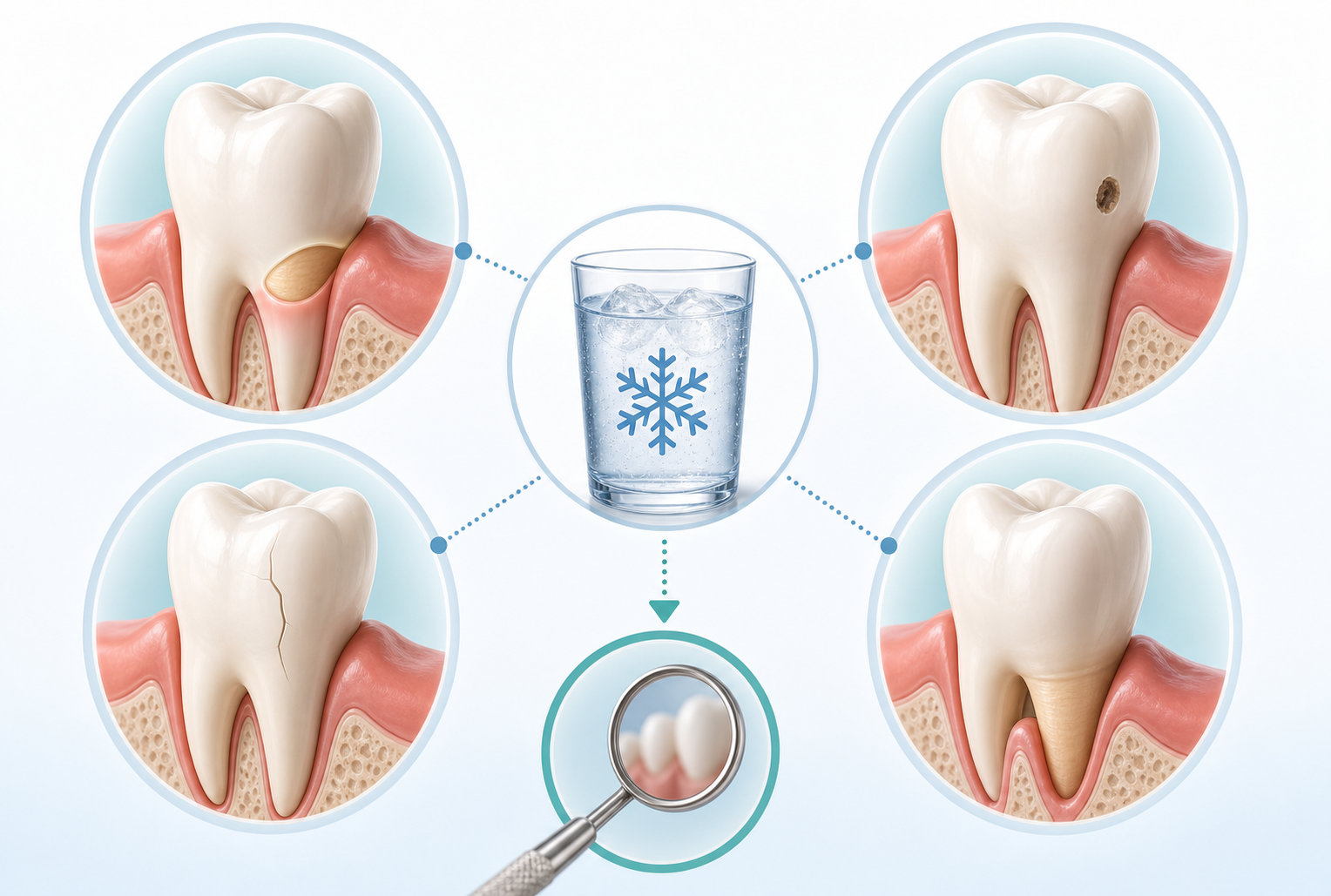
Exposed dentin or tooth root
Dentin may become exposed when enamel wears down or when gums recede and expose part of the root surface. Root surfaces are covered by cementum rather than the enamel that protects the crown, so they may be more sensitive to temperature changes.
This can make a tooth more reactive to cold, especially near the gumline.
Tooth decay or a cavity
A cavity can create a damaged area in a tooth. As decay advances, it may cause sensitivity to cold or sweets, tooth pain, or—if infection develops—swelling and fever.
A cavity cannot be confirmed from symptoms alone. A dental examination helps determine whether decay is involved.
A crack, worn filling, or other damage
A crack, a worn filling, or other damage to a tooth is another possible cause of cold-triggered pain. A crack may be difficult to see without an examination.
Damage is not always easy to see without an examination. Share any temperature or biting triggers with your dentist.
Gum changes or recent dental work
When gums recede, root surfaces may become more exposed. Sensitivity can also occur after some dental procedures and may improve, but the expected course depends on what was done and what caused the symptom. A dental professional can tell you what is expected for your situation.
Patterns that are useful to notice
You do not need to track every sensation. But a few details can help a dentist understand what may be happening:
- Is it one tooth or several?
- Is the trigger cold only, or also sweet foods, heat, air, or biting?
- Is the pain brief, or does it keep going after the cold is gone?
- Has the pattern stayed the same, or is it getting worse?
- Did it begin after an injury or a change in your routine?
These details do not provide a diagnosis, but they can make a dental conversation more useful.
What you can do while you arrange care
Keep your routine gentle and consistent. Brush twice daily with fluoride toothpaste and clean between your teeth as comfortable. Avoid repeatedly testing the tooth with cold foods or drinks to see whether it still hurts.
If one tooth is sensitive, choose foods and drinks that are more comfortable until you can get guidance. Do not put aspirin or another medication directly on the tooth or gum.
A sensitivity toothpaste may reduce dentin-sensitivity pain for some people, but it will not identify or treat every possible cause of cold-triggered pain. Follow the product directions, and ask a dentist or pharmacist if you are unsure whether it is appropriate for you. Improvement does not rule out decay, a crack, gum disease, or another problem.
When to contact a dentist
Contact a dentist if cold sensitivity is new, keeps returning, becomes more intense, affects one tooth consistently, or lasts more than two days.
Contact a dental office sooner if you have swelling in or around your mouth, severe or uncontrolled pain, fever, pain when biting, a bad taste, a broken tooth, or a loose tooth.
Seek emergency medical care now if swelling in your mouth or neck makes it difficult to breathe, swallow, or speak.
These symptoms can have different causes. A dental professional can assess the pattern and advise on the appropriate next step.
Frequently asked questions
Does cold sensitivity always mean a cavity?
No. Exposed dentin, gum recession, enamel wear, a crack, a worn filling, recent dental work, and tooth decay can all be involved. Symptoms alone cannot tell you which cause is present.
Why does the pain sometimes linger after the cold is gone?
Lingering pain is a reason to arrange a dental assessment, especially if it is new or worsening. The duration and trigger can help a dentist evaluate the tooth, but they do not let you diagnose the cause at home.
Can sensitivity toothpaste fix the problem?
It may help reduce pain from dentin sensitivity, but it is not a universal treatment. It cannot confirm or rule out decay, a crack, gum changes, or infection, so persistent or recurring symptoms still deserve dental advice.
Takeaway
Cold sensitivity is common, but it is not something you need to solve alone. Brief sensitivity can happen when dentin is exposed, while decay, cracks, gum changes, and recent dental work can also play a role.
Notice the pattern, protect the tooth from repeated triggers, and contact a dentist when the pain is new, persistent, worsening, or connected to other symptoms. The existing illustration is educational only; it cannot identify the cause of an individual toothache.
Sources
- Toothache — NHS
- Sensitive Teeth — MouthHealthy / American Dental Association
- Tooth Decay — National Institute of Dental and Craniofacial Research