“Natural,” “clean,” “non-toxic,” and “fluoride-free” can make a toothpaste label sound decisive. Those words may reflect preferences that matter to you, but they do not by themselves show what the toothpaste does, how well a specific claim is supported, or whether it fits your dental needs.
Is natural toothpaste better?
Not automatically. “Natural” is too broad to predict cavity protection, sensitivity relief, stain removal, comfort, or safety for a particular person. The useful comparison is between specific formulas and specific jobs—not between a “natural” category and every conventional toothpaste.
A product can match your ingredient or flavor preferences and still need a separate check for the benefit you want. It can also contain a familiar ingredient and still irritate your mouth. The front-of-package style is a starting point, not the verdict.
Start with what the toothpaste is meant to do
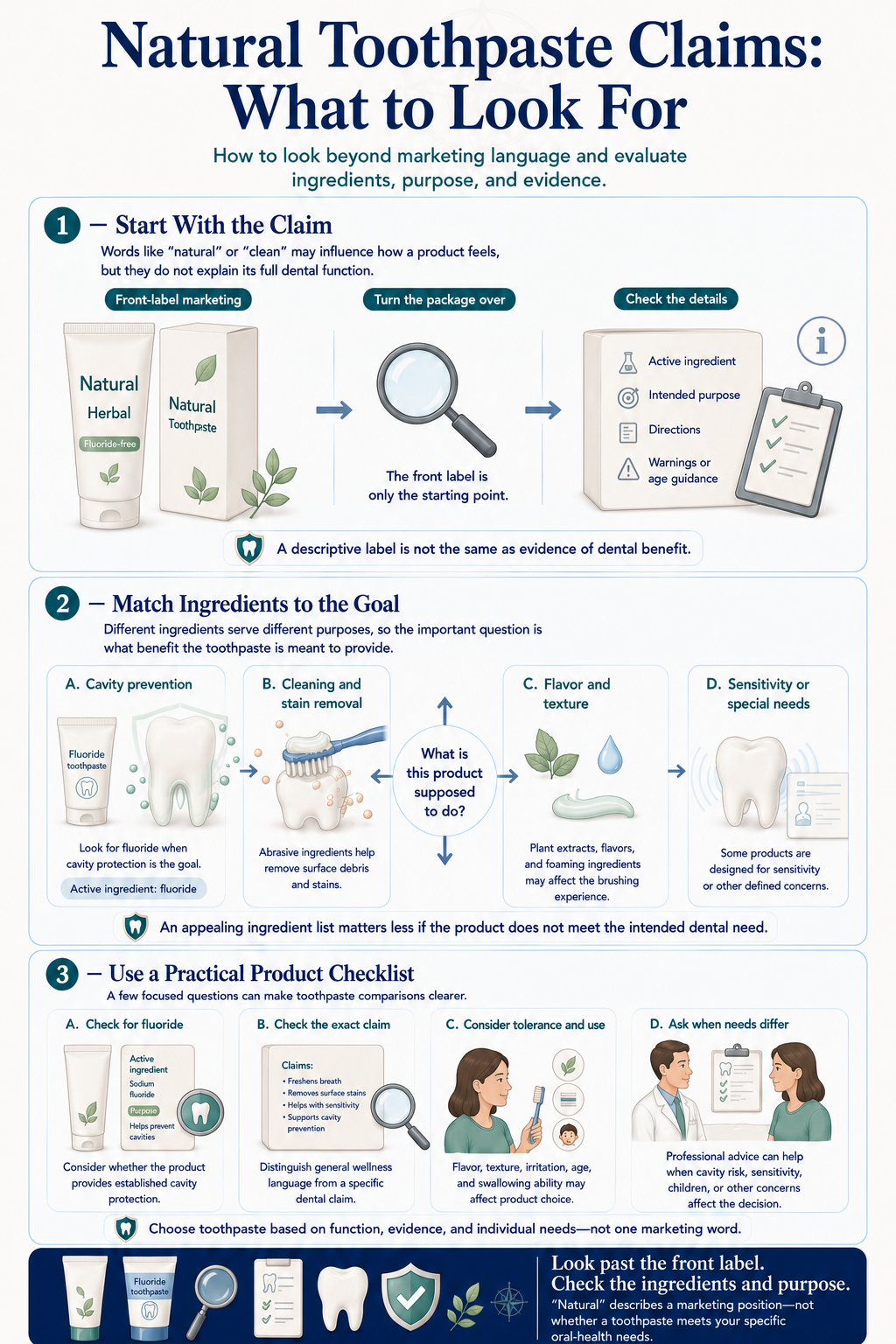
Before deciding whether a label sounds appealing, look for the product’s intended function. Is it making a cavity-prevention claim, a sensitivity claim, a whitening claim, or simply describing flavor and ingredients? Different functions need different evidence.
For cavity prevention, fluoride toothpaste has an established benefit. A fluoride-free paste may match a personal preference, but it does not provide that fluoride benefit. That is a tradeoff to understand—not a reason to shame the preference or pretend every toothpaste decision is identical. Fluoride myths and public advice explains the evidence boundary in more detail.
Treat broad wellness words as prompts, not proof
Words such as “natural” and “clean” do not, by themselves, describe how well a formula prevents cavities, removes surface stains, reduces sensitivity, or suits a particular mouth. They also do not establish that an ingredient is safer for everyone.
Instead, ask:
- What specific benefit is being claimed?
- Is the claim about a cosmetic result, a comfort feature, or cavity prevention?
- Does the package identify active ingredients and directions?
- Is there evidence or an acceptance seal tied to that exact claim?
The ADA Seal of Acceptance reflects review of submitted laboratory or clinical evidence against requirements for the product category and the specific accepted claim. It is useful context, but participation is voluntary: the absence of a Seal does not by itself prove that a product is unsafe or ineffective.
What do ingredient exclusions tell you?
Flavor, foam, color, texture, and ingredient exclusions can matter for comfort, values, or sensory needs. They do not automatically predict cavity protection or make a formula harmless for every mouth. Toothpastes contain combinations of active and inactive ingredients, and reactions can be formula-specific.
The ADA notes that toothpaste ingredients can rarely contribute to irritation or allergic reactions. Burning, peeling, swelling, or sores do not identify the cause on their own. If a toothpaste repeatedly seems to trigger a reaction, pause it and ask a dentist or other health professional for guidance.
A new or persistent tooth symptom also needs an assessment rather than repeated product swapping. A label cannot diagnose sensitivity, decay, dry mouth, gum disease, or an allergy.
A calmer label-reading order
- Identify the main job you want the toothpaste to do.
- Check the active ingredients, directions, age limits, and warnings.
- Separate the claim you care about from broad wellness language.
- Look for support tied to that exact benefit, not just the ingredient story.
- Treat an acceptance seal as one source of claim-specific evidence, not the only possible source.
- Ask what you would give up by choosing the formula—for example, the cavity-prevention benefit of fluoride.
- Ask a dentist when repeated cavities, significant sensitivity, dry mouth, exposed roots, extensive dental work, a prescription toothpaste, or a suspected reaction makes the choice less simple.
How to choose a toothpaste offers a broader feature-by-feature guide. Charcoal toothpaste claims and toothpaste rebuild-enamel claims look more closely at two common marketing themes.
The takeaway
Natural-language marketing can be meaningful to a shopper, but it is not clinical evidence on its own. Read the label for the product’s actual function, active ingredients, directions, warnings, and claim-specific support. Keep the choice connected to your oral-health goal and your comfort—not to fear or hype.
Sources
- Toothpastes — American Dental Association
- ADA Seal of Acceptance — American Dental Association
- About Fluoride — Centers for Disease Control and Prevention