Oil pulling is often presented online as a simple way to whiten teeth, heal gums, prevent cavities, or “detox” the body. It is understandable to wonder whether a traditional practice has been overlooked.
Does oil pulling work? That depends on the outcome. Reviews report possible short-term changes in plaque scores, gum scores, or oral bacteria, but their findings do not fully agree and the underlying studies have important limitations. They do not establish that oil pulling prevents cavities, treats gum disease, whitens teeth, or improves whole-body health.
What oil pulling is—and what claims tend to surround it
Oil pulling generally means swishing oil in the mouth and then discarding it. Claims can range from fresher breath or cleaner teeth to whitening, gum-disease treatment, cavity prevention, and systemic “detoxification.” Those claims are not all the same, so they should not be evaluated as if one small oral-health finding proves every promise.
What research has actually examined
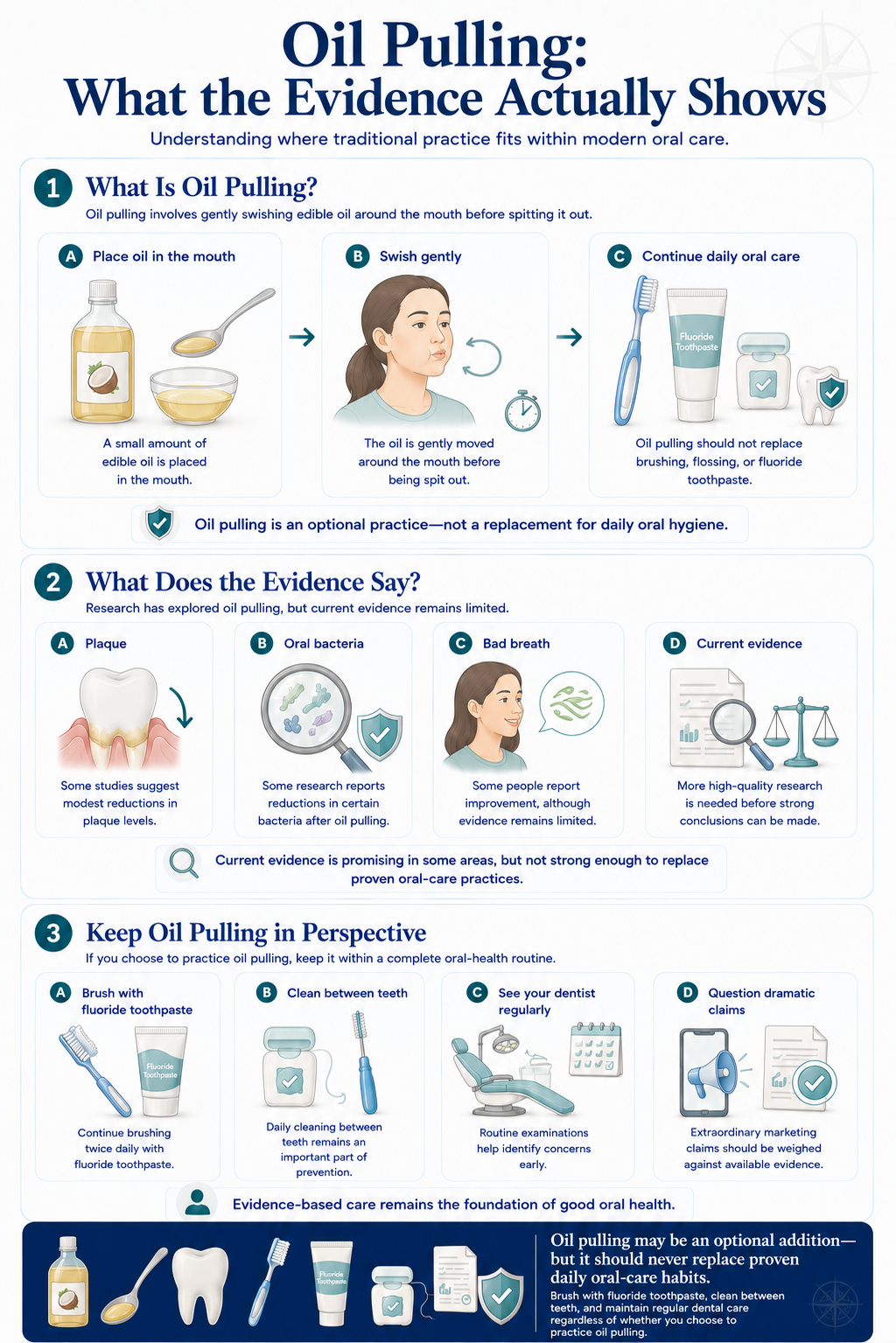
Systematic reviews have collected mostly short-term trials comparing oil pulling with other rinses, water, or oral-care practices. These studies have looked at outcomes such as salivary bacteria counts, plaque scores, and gingival scores. The oils, comparison groups, study lengths, and measurement methods differ.
A 2026 review reported moderate reductions in microbial load and some improvement in gingival measures, while also emphasizing variation and methodological limitations. A 2024 meta-analysis rated the evidence for the measured outcomes very low quality. A 2022 meta-analysis found a possible reduction in total salivary bacterial count but no significant effect on plaque or gingival scores. These different results make certainty lower, not higher.
Just as importantly, a change in a bacteria count or a short-term plaque score is not the same as showing fewer cavities, treating periodontitis, producing durable whitening, or improving overall health. Those larger outcomes need direct evidence.
What the evidence cannot establish
There is no good basis to treat oil pulling as a substitute for the core parts of oral care: brushing with fluoride toothpaste, cleaning between teeth, and regular dental care. The American Dental Association does not recommend oil pulling as a dental-hygiene practice because reliable evidence for those benefits is lacking.
The dental trials in these reviews also did not test or demonstrate systemic “detoxification.” “Detox” is often a broad marketing word rather than a specific, measurable dental outcome.
If a claim jumps from a mouth-rinsing practice to promises about infections, chronic illness, toxins, or healing the body, ask what outcome was actually studied, compared with what, and for how long. A claim should not become larger than the research behind it.
For a useful foundation, see what plaque is and what healthy gums often look like. Do viral whitening trends work? offers a similar way to think about cosmetic claims. The same replacement principle appears in Does Mouthwash Replace Flossing?.
A calm way to evaluate a claim
- Is the claim about a measured oral outcome, or a vague promise?
- Was the study large enough and designed to answer that question?
- Did it compare oil pulling with established oral care, or only with doing nothing?
- Do several good studies reach a similar result?
- Is anyone suggesting that it replace proven care or delay a dental conversation?
These questions do not prove that a practice is harmful for everyone. They help separate uncertainty from a marketing guarantee.
If a symptom or diagnosed condition is part of the question, ask a dentist rather than using oil pulling to test or treat it. Choosing to use it should not mean delaying care or dropping established daily habits.
The takeaway
Oil pulling has been studied for several short-term oral-health measures, with mixed results and important limitations. The evidence does not establish whitening, gum-disease treatment, cavity prevention, detoxification, or whole-body-health claims. Keep the basics—fluoride toothpaste, cleaning between teeth, and dental care—at the center of oral health, and treat sweeping claims with healthy skepticism.
Sources
- Traditional Oral Hygiene Practices and Their Effectiveness: A Systematic Review of the Evidence — PubMed / Oral Health & Preventive Dentistry
- The effect of oil pulling in comparison with chlorhexidine and other mouthwash interventions in promoting oral health: A systematic review and meta-analysis — PubMed / International Journal of Dental Hygiene
- Effectiveness of Oil Pulling for Improving Oral Health: A Meta-Analysis — Healthcare
- Oil Pulling — MouthHealthy / American Dental Association
- Home Oral Care — American Dental Association