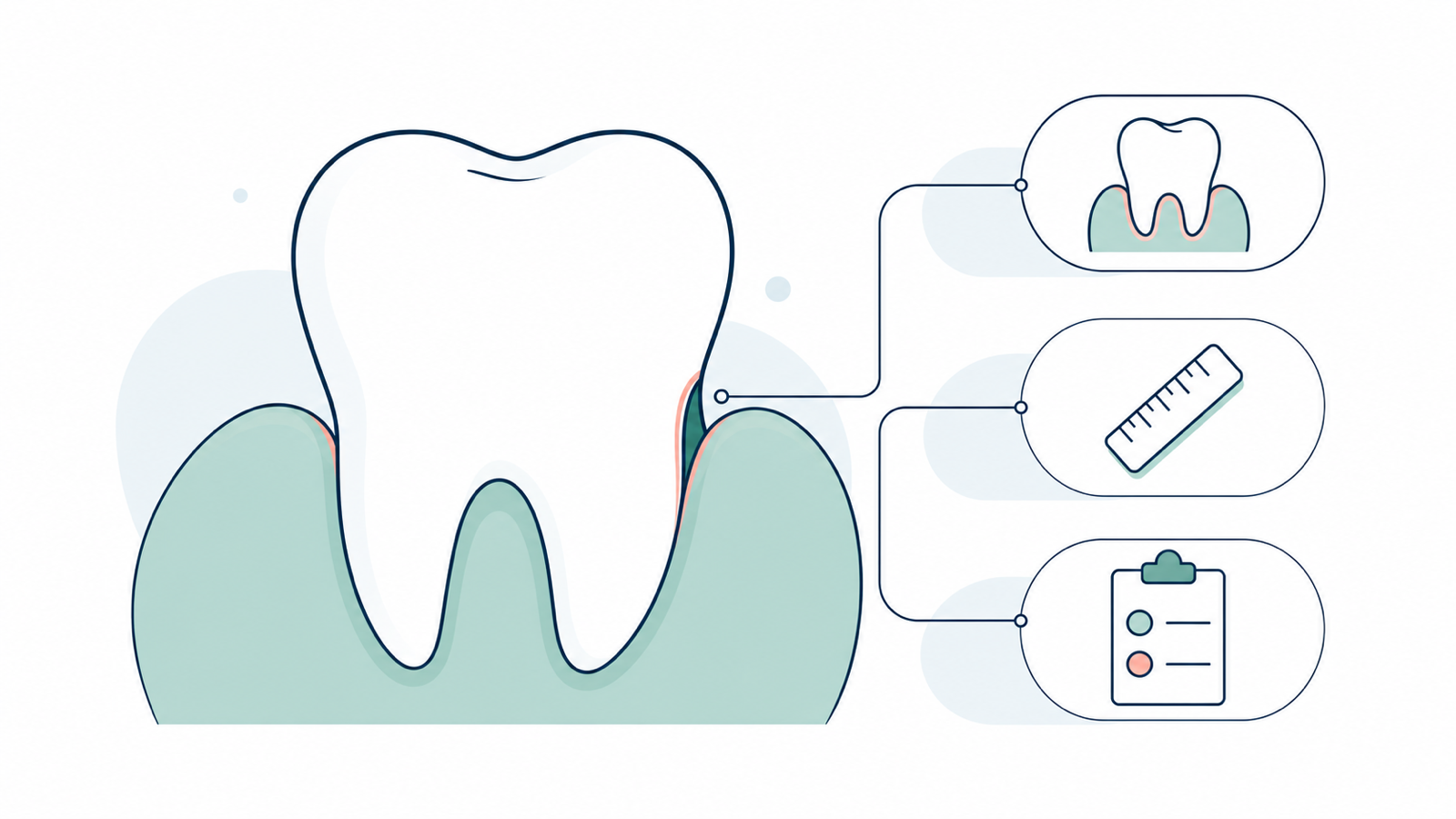
Gum pockets are the small spaces between the gum tissue and the tooth. A dentist or dental hygienist can gently measure them with a periodontal probe as one part of a broader gum-health assessment. The measurement is clinical vocabulary—not a home test or a diagnosis you can make from a number alone.
What does a gum-pocket measurement show?
Healthy gums fit closely around teeth, but the gum-tooth edge is not a sealed line. During an exam, a dental professional may gently measure several places around a tooth and record the pattern across the mouth. A measurement can help the dental team notice areas that need closer evaluation or follow-up.
The measurement is interpreted with the gum’s appearance, bleeding during the exam, plaque or tartar, recession or swelling, tooth mobility, medical history, and—when appropriate—X-rays that show supporting bone. The exact combination depends on the person and the exam; no single finding explains every case.
Why a number is not a diagnosis
Pocket measurements can help a dental professional assess periodontal health, but a number by itself does not establish a particular stage of gum disease, predict what will happen, or determine which treatment is appropriate. Measurements may differ by location and tooth shape, and swelling, recession, inflammation, probing technique, and the wider clinical picture can affect how they are understood.
This is why this guide does not provide a number chart for self-staging. If you were given a measurement, ask what your dental team noticed around it and whether they want to compare it with an earlier exam.
How gum pockets connect to daily care
Plaque is a sticky film that can collect near the gumline. When it is not removed regularly, it can irritate gum tissue; plaque can harden into tartar, which requires professional removal. Brushing, cleaning between the teeth, and routine dental visits support gum health, but daily care cannot tell you what a pocket measurement means for you.
For the everyday picture, see plaque at the gumline and what healthy gums can look like.
Questions to ask at a visit
- What did you notice besides the measurements?
- Are there areas you want to compare or watch over time?
- Was there bleeding, swelling, recession, plaque, tartar, or another finding that helps explain the pattern?
- What daily-care technique would you like me to review?
- What follow-up, if any, do you recommend, and what is it intended to address?
What a dental cleaning is explains routine-cleaning vocabulary. For help preparing questions about a specific concern, see questions to ask about a tooth problem.
When to contact a dentist
Consider arranging a dental visit if you notice persistent bleeding, swelling, pain, a changing gumline, pus, or a loose or separating tooth. These signs can have different causes, and their absence does not prove that gum tissue is healthy. A dental team can evaluate the findings together and explain whether follow-up is needed.
The takeaway
Gum pockets are the gum-tooth spaces a dental professional may measure during an exam. They are useful assessment vocabulary, but a number is not a self-diagnosis or a treatment plan. The most useful response to a measurement is to ask what it means alongside the rest of your exam and what, if anything, your dental team wants you to do next.
Sources
- Periodontal (Gum) Disease — National Institute of Dental and Craniofacial Research
- Gum Disease Information — American Academy of Periodontology
- FAQs — American Academy of Periodontology