The simple answer
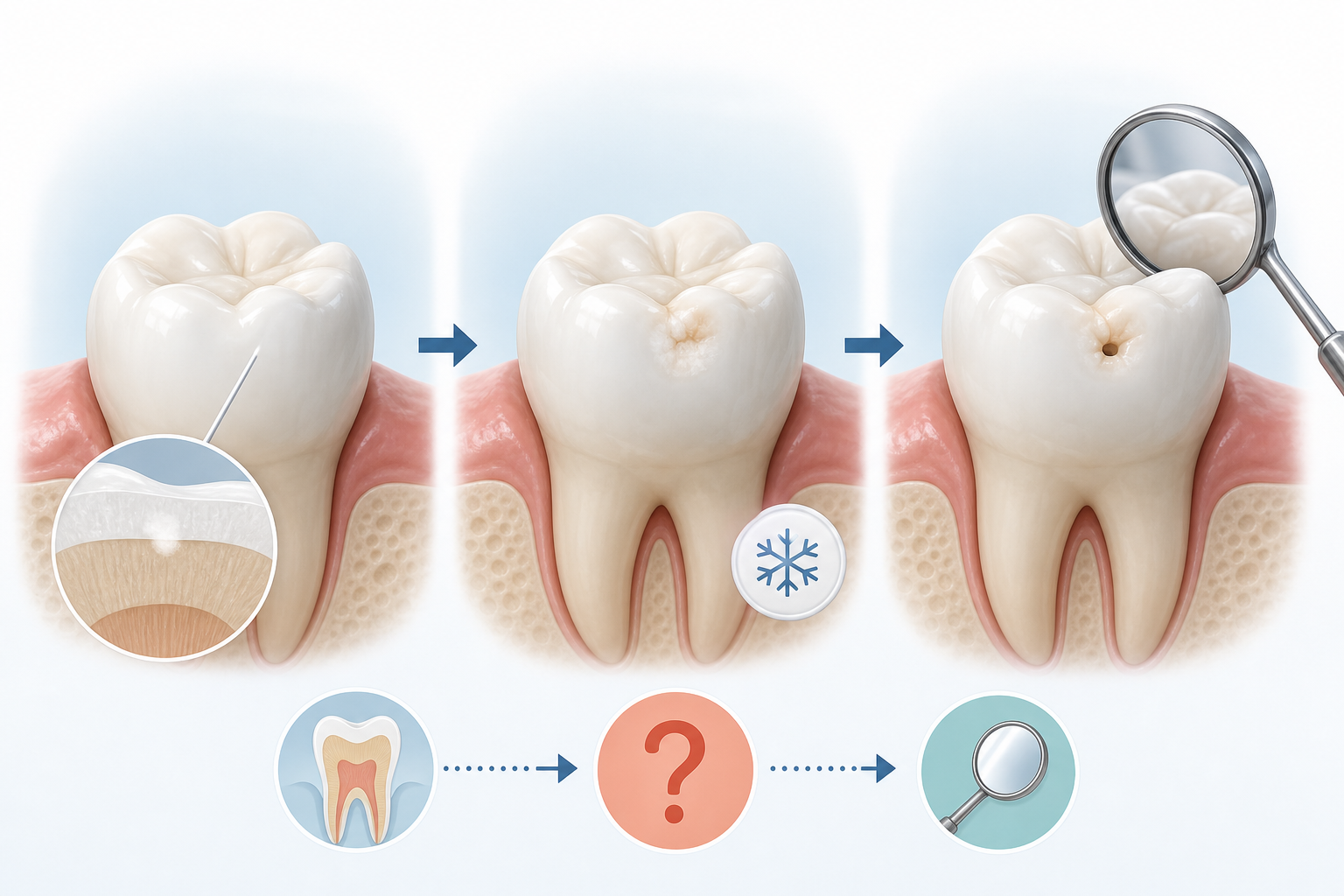
A cavity may not look or feel like anything at first. As tooth decay advances, possible signs include a white, brown, or dark spot, a rough area or hole, sensitivity to cold, hot, or sweet foods and drinks, or tooth pain.
None of those signs confirms a cavity. Spots, sensitivity, and pain can have more than one cause, and decay can be hidden between teeth or inside a groove. A dentist needs to examine the tooth and may use other tests to determine what is happening.
What a cavity is—and why it may be silent
A cavity is a hole or damaged area caused by tooth decay. Decay begins when plaque bacteria use sugars and starches to make acids that remove minerals from enamel, the tooth’s hard outer surface.
Early mineral loss may not cause symptoms and may be stopped or reversed in some circumstances with saliva, fluoride, and dental care. If the process continues, enamel can break down and a cavity can form. A formed hole is permanent tooth damage; it cannot be brushed away.
That is why a tooth can have decay without hurting, and why the end of a toothache does not prove that the problem is gone. Learn how cavities form for the wider plaque–acid process.
What a cavity can look like
A cavity is not always obvious in a mirror. Early tooth decay may not be visible to you, especially if it is between teeth or in a groove on a back tooth.
When visible changes are present, they may include:
- White spots on a tooth.
- Brown or black spots.
- A rough area or a hole.
- A change around the edge of an existing filling.
These are possible signs, not a diagnosis. A dark area is not always active decay, and a cavity can be present even when you see nothing unusual. What a dental checkup includes explains how a professional looks for findings that are hard to see at home.
What a cavity can feel like
Cavities may not cause pain at first.
As decay progresses, some people notice:
- Toothache or ongoing tooth pain.
- Sharp sensitivity to cold, hot, or sweet foods and drinks.
These symptoms can have more than one cause. Symptoms alone cannot tell you whether decay is present, how deep it is, or what treatment might be needed.
What not to do
Avoid trying to test a tooth repeatedly with cold drinks, sweets, or hard foods to see whether it still hurts.
Also avoid assuming that a symptom will resolve on its own simply because it comes and goes. Pain that stops can still deserve evaluation.
When to contact a dentist
Contact a dentist if you have tooth pain, sharp sensitivity when eating or drinking, a visible hole or new spot on a tooth, or a problem that keeps returning. If you are unsure whether a spot is decay, an examination is safer than trying to interpret it from a mirror or photo.
Contact a dental office promptly if you have swelling in or around your mouth, severe pain, fever, a broken tooth, or a loose tooth.
Seek emergency medical care now if swelling in your mouth or neck makes it difficult to breathe, swallow, or speak.
These signs can have different causes. A dental professional can assess the tooth and advise on the appropriate next step.
Common questions
Can a cavity look like a white spot?
It can. A white spot may be an early sign of mineral loss, but white areas can also have other explanations. A dentist needs to assess the tooth rather than diagnosing it from appearance alone.
Can you have a cavity without pain?
Yes. Early decay often causes no symptoms, and decay can be hidden from view. Lack of pain does not rule out a cavity.
Is every dark spot a cavity?
No. A dark spot can have more than one cause, and appearance alone cannot show whether decay is active. Ask a dentist to evaluate a new or changing spot.
Does a cavity go away if it stops hurting?
Not necessarily. Pain can come and go, and a cavity may be silent. If a tooth has been painful or looks different, arrange an evaluation rather than using symptom relief as proof that the problem has resolved.
Takeaway
Cavities can be easy to miss early on, and they do not always hurt. Possible signs include sensitivity, pain, visible spots, or a hole in a tooth, but none of those signs can confirm a cavity by themselves.
If something looks or feels different, a dental exam is the clearest way to understand what is going on. Possible signs are useful reasons to ask for help, not a way to diagnose yourself.
Sources
- Tooth decay — NHS
- Cavities — MouthHealthy / American Dental Association
- Toothache — NHS
- Tooth Decay — National Institute of Dental and Craniofacial Research
- About Cavities (Tooth Decay) — Centers for Disease Control and Prevention