If a dentist says you need a “deep cleaning,” it is reasonable to ask what that phrase means in your situation. In dentistry, it commonly refers to scaling and root planing: professional periodontal care that reaches below the gumline. It is different from a routine preventive cleaning, but the phrase alone does not tell you your diagnosis or treatment plan.
What “deep cleaning” usually means
Scaling and root planing is a nonsurgical treatment used in certain gum-disease contexts. Scaling means removing plaque and hardened deposits, also called calculus or tartar, from tooth surfaces. Root planing refers to carefully cleaning root surfaces below the gumline so the area can be managed as part of a periodontal-care plan.
The goal is not to make a reader identify gum disease at home. It is to understand the vocabulary a dental team may use and the reason they may recommend a treatment beyond a routine cleaning.
How it differs from a routine cleaning
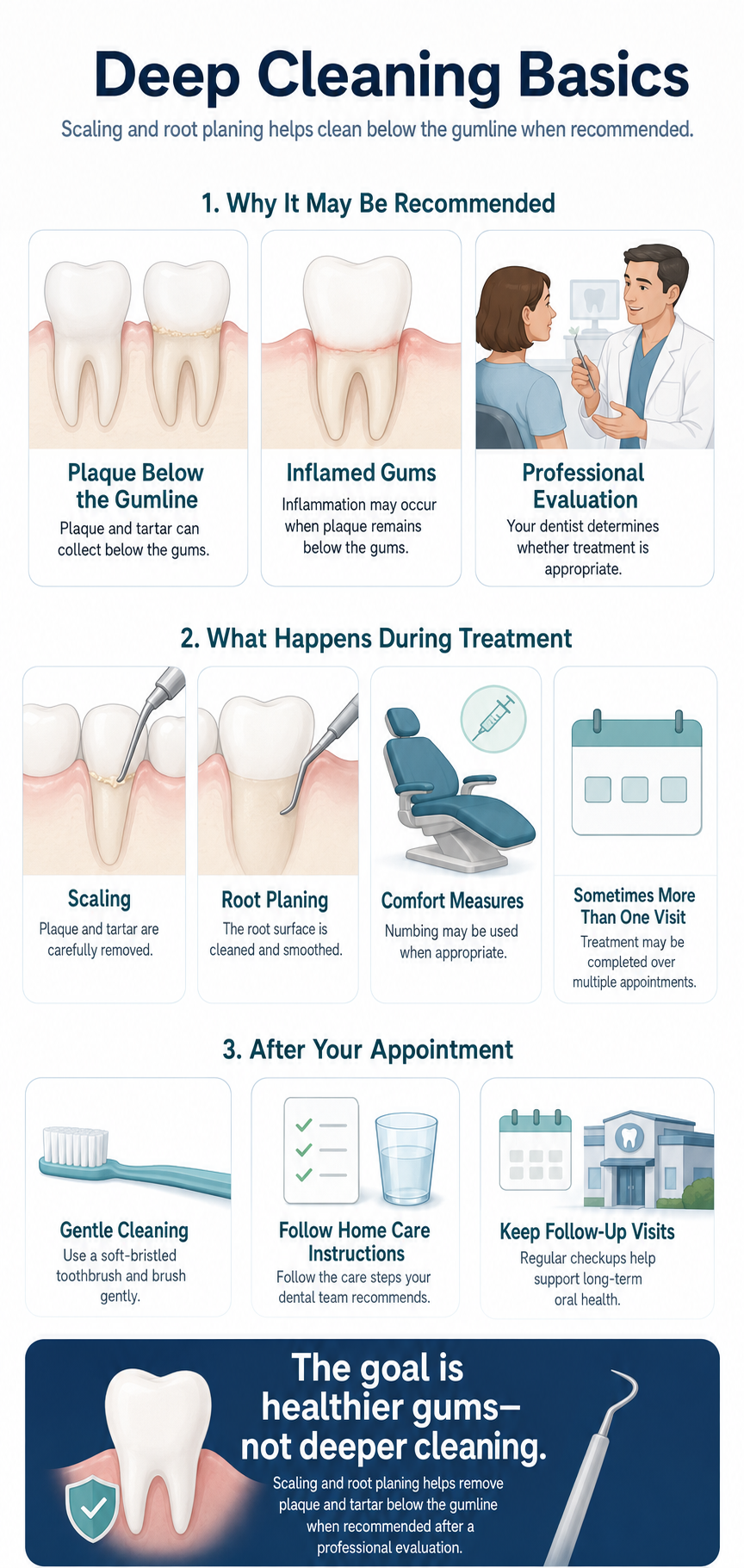
A routine cleaning is preventive care focused on removing plaque and tartar from accessible tooth surfaces. A deep cleaning addresses deposits and root surfaces below the gumline when periodontal assessment indicates that this type of care may be needed.
The services are not interchangeable, and neither title tells the whole story by itself. What is a dental cleaning? explains routine cleaning in more detail.
Why below-the-gumline context matters
Plaque is a sticky bacterial film that forms on teeth. If it stays in place, it can harden into tartar, which cannot be removed with ordinary brushing. Buildup near and below the gumline can be part of a gum-health problem, but the location and condition of supporting tissues need professional assessment.
Plaque at the gumline and gingivitis basics give useful background. They cannot tell you whether scaling and root planing is appropriate for your mouth.
Why an assessment comes first
A dental professional may consider gum appearance, bleeding, plaque and tartar, measurements around teeth, imaging when appropriate, health history, and other findings. Individual findings work together; a single symptom, a photo, or a number without context is not enough for self-diagnosis or staging.
That is also why a recommendation may be different for two people who both use the phrase “deep cleaning.” The proposed treatment should be explained in terms of the findings and its goal for you.
When to arrange a dental evaluation
Bleeding, red, swollen, or tender gums; gums that seem to pull away from teeth; persistent bad breath; loose or sensitive teeth; painful chewing; or a change in how teeth fit together are reasons to arrange a dental evaluation. These signs can have different causes and do not, by themselves, show that you need scaling and root planing.
For facial swelling, fever, trouble breathing or swallowing, significant injury, or another urgent concern, seek urgent dental or medical care.
Follow-up and periodontal maintenance
Scaling and root planing is only one part of care when it is recommended. A dental professional may reassess healing and periodontal measurements, discuss home care, and recommend periodontal maintenance at an interval based on your findings and response. Some people need additional treatment and others may not; follow-up is meant to manage gum health over time, not to promise a cure or a particular result.
Questions to ask before treatment
- What findings led you to recommend scaling and root planing?
- Which areas are involved, and what is the treatment intended to address?
- How is this different from a routine cleaning in my case?
- What will the appointment and follow-up conversation generally involve?
- What home-care focus or future reassessment will you recommend?
- Are there alternatives or timing questions I should understand?
Questions to ask before a common dental treatment can help you organize a broader conversation without choosing treatment from an article.
The takeaway
“Deep cleaning” commonly means scaling and root planing, a professional periodontal treatment that includes care below the gumline. The useful next step is not to stage your gums yourself; it is to ask what the assessment found, why this care was recommended, and how follow-up will work.
Sources
- Periodontal (Gum) Disease — National Institute of Dental and Craniofacial Research
- About Periodontal (Gum) Disease — Centers for Disease Control and Prevention
- Scaling and Root Planing — American Dental Association
- Non-Surgical Treatments — American Academy of Periodontology