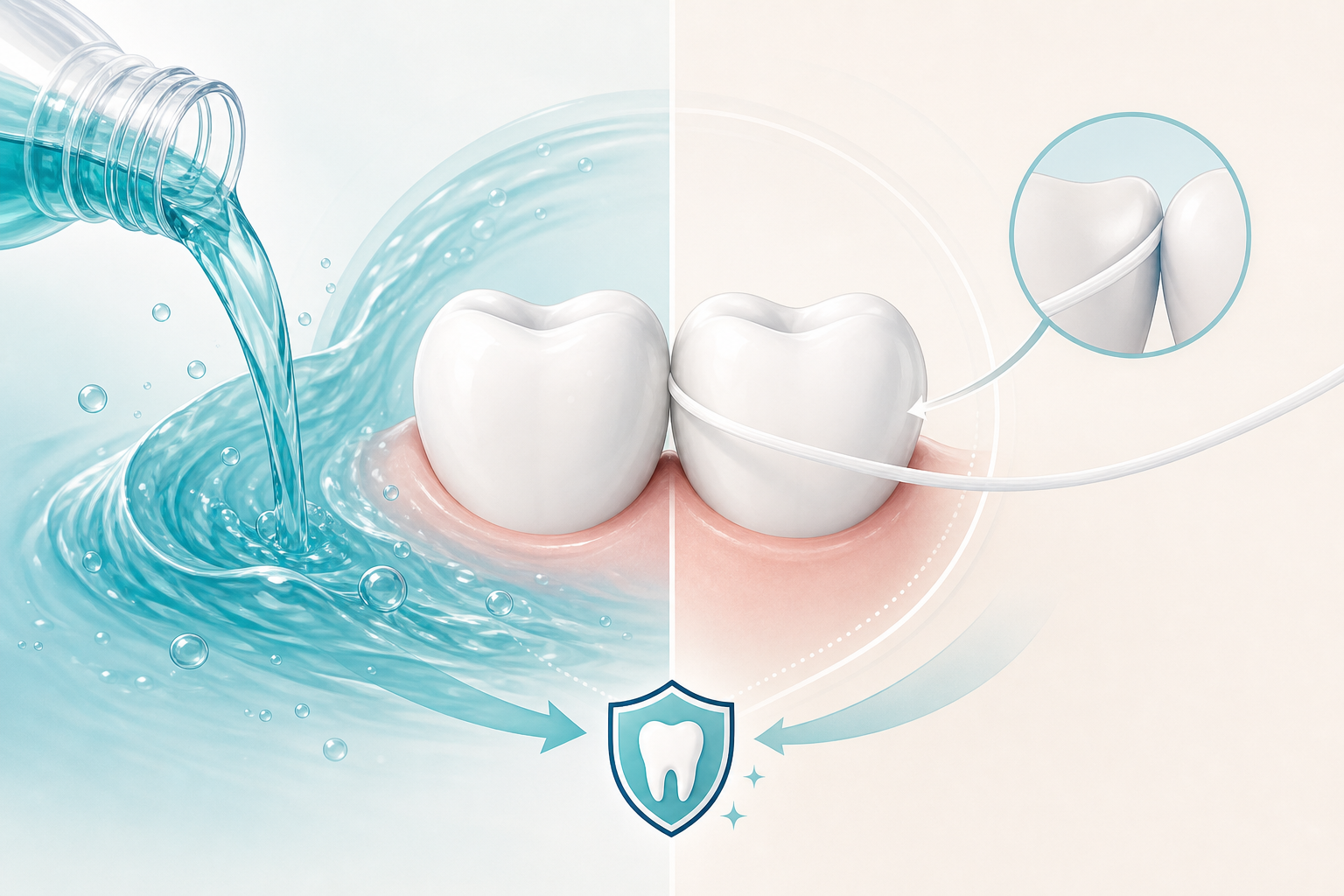
Mouthwash generally does not replace cleaning between the teeth. A rinse can reach around the mouth and may add a specific benefit, but floss or another interdental cleaner does a different job: it physically disrupts plaque on the sides of teeth and near the gumline.
That does not make mouthwash useless. It means mouthwash is usually an addition to brushing and interdental cleaning, not a substitute for them.
Rinsing and cleaning are different actions
Dental plaque is a sticky film that forms on tooth surfaces. Daily brushing and cleaning between teeth are meant to disturb that film regularly. See what plaque is and why it matters for the basic process.
Mouthwash moves through spaces that can be difficult for a toothbrush to reach, but access alone is not the same as wiping or brushing an attached film from a surface. Therapeutic ingredients may help control plaque, gingivitis, cavities, bad breath, or another stated concern, depending on the formula. The rinse still does not perform the same mechanical cleaning as floss, a small interdental brush, or another between-teeth device.
When mouthwash may add value
Therapeutic mouthwashes contain active ingredients for a specific purpose. Depending on the product, that purpose may include helping reduce plaque or gingivitis, supporting cavity prevention, controlling bad breath, or easing dry-mouth symptoms.
The benefit is product-specific. A cosmetic rinse may mainly freshen breath for a short time, while a therapeutic rinse needs evidence for the claim on its label. Neither category should be assumed to clean between teeth in the same way as an interdental tool.
If a dentist has recommended a rinse for a particular reason, that can add to the routine they advised. It does not automatically cancel the need for mechanical cleaning unless the dental professional has given different instructions for a specific situation.
For after-brushing timing, see should you rinse after brushing?. This article does not provide individualized antimicrobial or prescription-rinse directions.
You do not have to use string floss
“Clean between your teeth” is a broader goal than “everyone must use string floss.” Useful options include:
- String floss or dental tape: Flexible material that can wrap around the side of a tooth. It can work well where contacts are tight.
- Interdental brushes: Small brushes that move through spaces between teeth. They may be easier in more open spaces, but the brush needs to fit without being forced.
- Water flossers, also called oral irrigators: Devices that direct a stream of water along the gumline and between teeth. Some people find them easier to handle, and some products have evidence for plaque and gingivitis benefits.
The evidence does not establish one method as best for every person. A Cochrane review found low- to very-low-certainty evidence for many comparisons among floss, interdental brushes, and oral irrigators, with limited and inconsistent evidence for oral irrigators in some outcomes. Space size, dental work, braces, hand control, comfort, and technique can all affect what is practical.
A dentist or dental hygienist can show how a tool fits your mouth. If string floss works for you, how to floss properly explains a gentle technique. For routine frequency, see how often to clean between your teeth.
What if flossing is difficult?
Do not turn difficulty into an all-or-nothing choice between string floss and mouthwash. First identify the barrier:
- Tight contacts may call for a gentler floss technique or a different floss format.
- Larger spaces may be easier to clean with a correctly sized interdental brush.
- Limited hand control may make a floss holder, interdental brush, or water flosser easier to manage.
- Braces, bridges, implants, or other dental work may require a demonstration of where and how to clean.
If a tool catches, shreds, will not pass, or causes ongoing pain in one area, do not force it. A dental professional can check the area and help choose an approach.
Bleeding is a reason to look closer, not give up automatically
Gums can bleed for several reasons. New or rough technique can irritate the tissue, while plaque-related inflammation can also make gums more likely to bleed. Stopping all between-teeth cleaning may leave the plaque-related part of the problem unchanged.
Keep the technique gentle and do not snap or force a tool into the gums. If bleeding happens regularly, concerns you, or comes with pain or swelling, contact a dentist. Ongoing discomfort may mean the technique, tool size, or underlying gum health needs attention—not that mouthwash should simply replace mechanical cleaning.
A realistic routine
For most people, the basic roles are:
- Brush accessible tooth surfaces with fluoride toothpaste.
- Clean between teeth with floss or another suitable interdental cleaner.
- Use mouthwash only when it has a clear purpose and follow its label or professional instructions.
You do not need the most complicated routine. You need each chosen tool to have a job you understand and can repeat consistently.
The practical takeaway
Mouthwash can be useful, but it generally does not replace flossing or another way of mechanically cleaning between teeth. If string floss is hard to use, consider another interdental tool rather than assuming a rinse performs the same task. The best practical method is one that fits your spaces, abilities, and routine without overstating what the evidence can prove.
Sources
- Mouthrinse (Mouthwash) — American Dental Association
- Dental Floss/Interdental Cleaners — American Dental Association
- Home Use of Devices for Cleaning Between the Teeth (in Addition to Toothbrushing) to Prevent and Control Gum Diseases and Tooth Decay — Cochrane
- Bleeding Gums — MouthHealthy, American Dental Association
- How to Keep Your Teeth Clean — National Health Service
- Flossing — MouthHealthy, American Dental Association
- Home Oral Care — American Dental Association