Brushing with fixed braces takes a little more attention because brackets and wires create extra edges where plaque and food can collect. The practical goal is to clean the gumline, every tooth surface, and the areas above, below, and around each bracket without pushing hard on the appliance.
Use fluoride toothpaste and a toothbrush you can control comfortably. Work in the same order each time so the spaces around the braces are less likely to be missed. Your orthodontic team may adjust the routine for your appliance or oral-health needs.
A step-by-step braces brushing routine
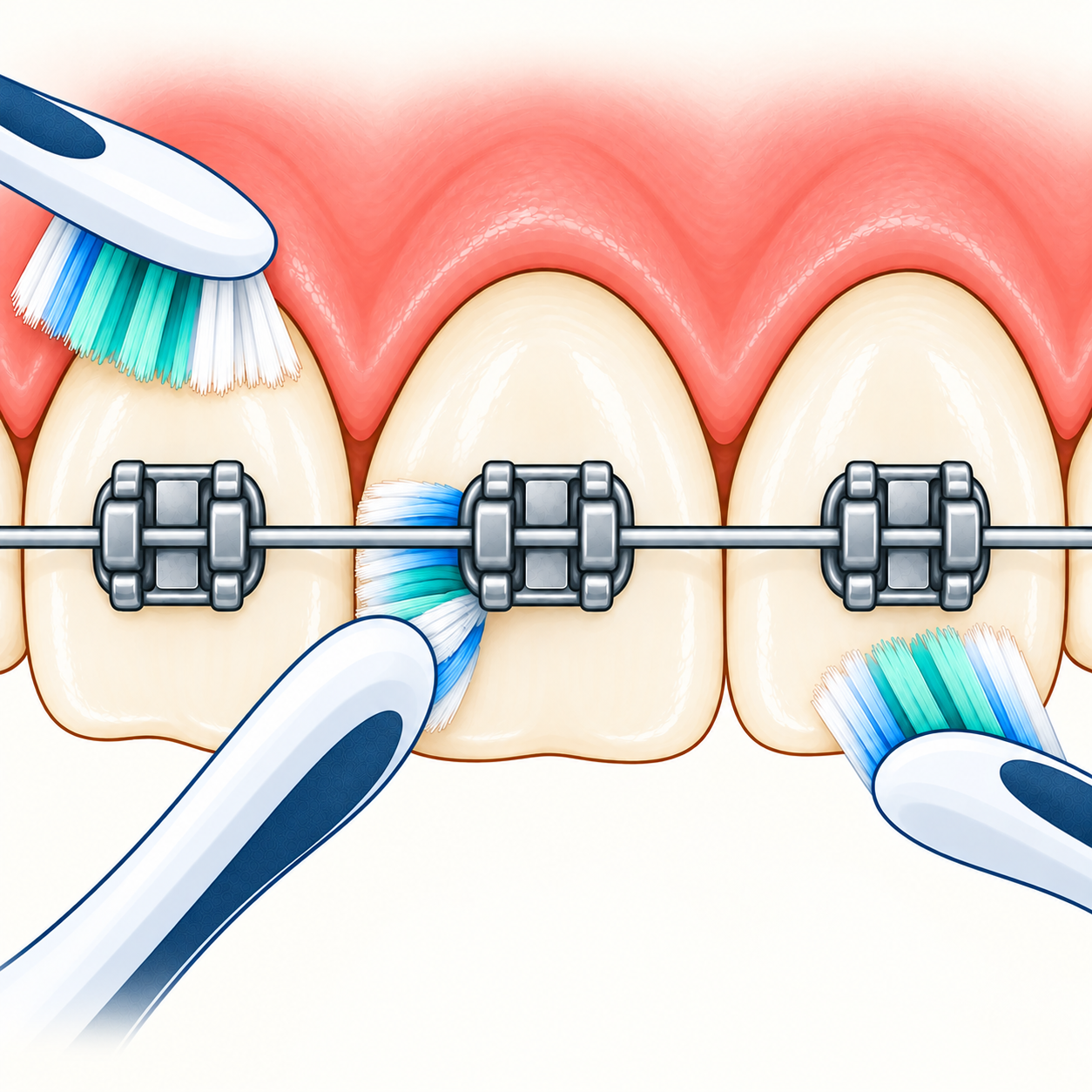
1. Start where the teeth meet the gums
Look in a mirror and place the brush at the gumline. Use gentle, controlled movements to clean where each tooth meets the gum.
Do not scrub harder to compensate for the braces. Careful positioning matters more than force.
2. Clean above each row of brackets
Angle the bristles so they reach the tooth surface between the gumline and the top of each bracket. Move tooth by tooth across the upper and lower arches.
Pause at crowded or hard-to-see areas. A consistent route—such as right to left on the outside, then right to left on the inside—can help you remember where you have been.
3. Clean directly around the brackets and wire
Brush the front of each bracket and the visible tooth surface around its edges. Angle the bristles carefully so they reach under the wire and beside the brackets without pulling or prying at the appliance.
If a space cannot be reached with the regular brush, an orthodontic or interdental brush may help clean around brackets and under the wire. Choose a size your dental or orthodontic team has shown you, and never force it into a space.
4. Clean below the brackets
Change the brush angle to reach the tooth surface between the bottom edge of each bracket and the biting edge of the tooth. Again, work around the whole mouth rather than brushing only the places where food is visible.
5. Brush the inside and chewing surfaces
Braces are on the front of many teeth, but the other surfaces still need attention. Brush the tongue-side surfaces of every tooth and the chewing surfaces of the back teeth.
The general guide to brushing your teeth properly explains how to cover every surface without aggressive scrubbing.
6. Check your work, then spit
Use the mirror to look for food or visible buildup around brackets and along the gumline. If you missed an area, return to it gently.
Spit out excess toothpaste when you finish. Avoid rinsing immediately with water, because rinsing washes away fluoride left from the toothpaste. Should You Rinse After Brushing? explains how to separate mouthwash from brushing if both are part of your routine.
How often should you brush with braces?
Brush with fluoride toothpaste in the morning and at night. The NHS also advises people with braces to brush after meals, while your own orthodontic team may give more specific instructions based on your appliance and oral health.
A portable brush can make after-meal cleaning easier when you are away from home. If brushing is not immediately practical, follow the advice your orthodontic team has given you rather than improvising with a sharp object or trying to pick around the wire.
Brushing does not clean every space
A toothbrush can clean the visible surfaces around brackets, but it does not fully clean between teeth. The NHS advises daily use of an interdental brush to clean between teeth and under fixed braces. Other tools may be appropriate for some spaces.
How to Floss With Braces explains how a floss threader, orthodontic floss, interdental brush, or water flosser may fit into a between-teeth routine. Ask your dental or orthodontic team which tools and sizes suit your appliance.
Manual or powered toothbrush?
Either can be used if it lets you clean every tooth surface and around the appliance. With a manual brush, use small, controlled movements. With a powered brush, guide the head slowly around each tooth and bracket rather than adding a hard scrubbing motion.
The best choice is one you can position accurately and use consistently. Your orthodontic team can watch your technique and point out areas that need more attention.
When to contact your dental or orthodontic team
Contact your orthodontic team if a bracket or wire is broken or loose. Do not try to bend, remove, or repair it yourself.
Also ask for professional advice if:
- your gums are very red, swollen, or painful;
- an area keeps bleeding or remains difficult to clean;
- brushing causes persistent pain; or
- you are unsure how to clean around a particular part of the appliance.
Keep regular dental checkups while you have braces. The orthodontic team monitors the appliance and tooth movement, while your regular dental team continues to check the health of your teeth and gums.
The main takeaway
Brush with fluoride toothpaste and follow a repeatable route: clean the gumline, above each bracket, around the brackets and wire, below the brackets, then the inside and chewing surfaces. Use gentle positioning, check your work in a mirror, and clean between teeth with a tool suited to your braces.
If a space is hard to reach or the appliance feels damaged, ask your dental or orthodontic team for help instead of forcing the brush or trying to repair the braces.
Sources
- Braces — NHS
- Orthodontic treatment with fixed appliances — Queen Victoria Hospital NHS Foundation Trust
- How to keep your teeth clean — NHS
- Living with Braces: Food, Oral Hygiene, & Care Tips — American Association of Orthodontists