Flossing with braces can feel slow because the archwire blocks the straight path that floss normally takes between teeth. The goal is still to clean the side of each tooth and just below the gumline without snapping floss into the gums or pulling on the appliance.
A floss threader or pre-threaded orthodontic floss can help guide floss under the wire. Other interdental tools may also be useful, depending on the spaces between your teeth and the appliance you have. Your orthodontic team can demonstrate the method that fits your braces.
What you may need
Choose one tool you can control comfortably:
- regular floss plus a floss threader;
- pre-threaded orthodontic floss or floss with a stiff end;
- a floss holder designed to fit under orthodontic wires;
- an interdental brush sized for spaces your dental team has shown you; or
- a water flosser used according to its instructions.
These tools do not all clean in exactly the same way. If you are unsure which option fits a particular space, ask your dentist, hygienist, or orthodontic team.
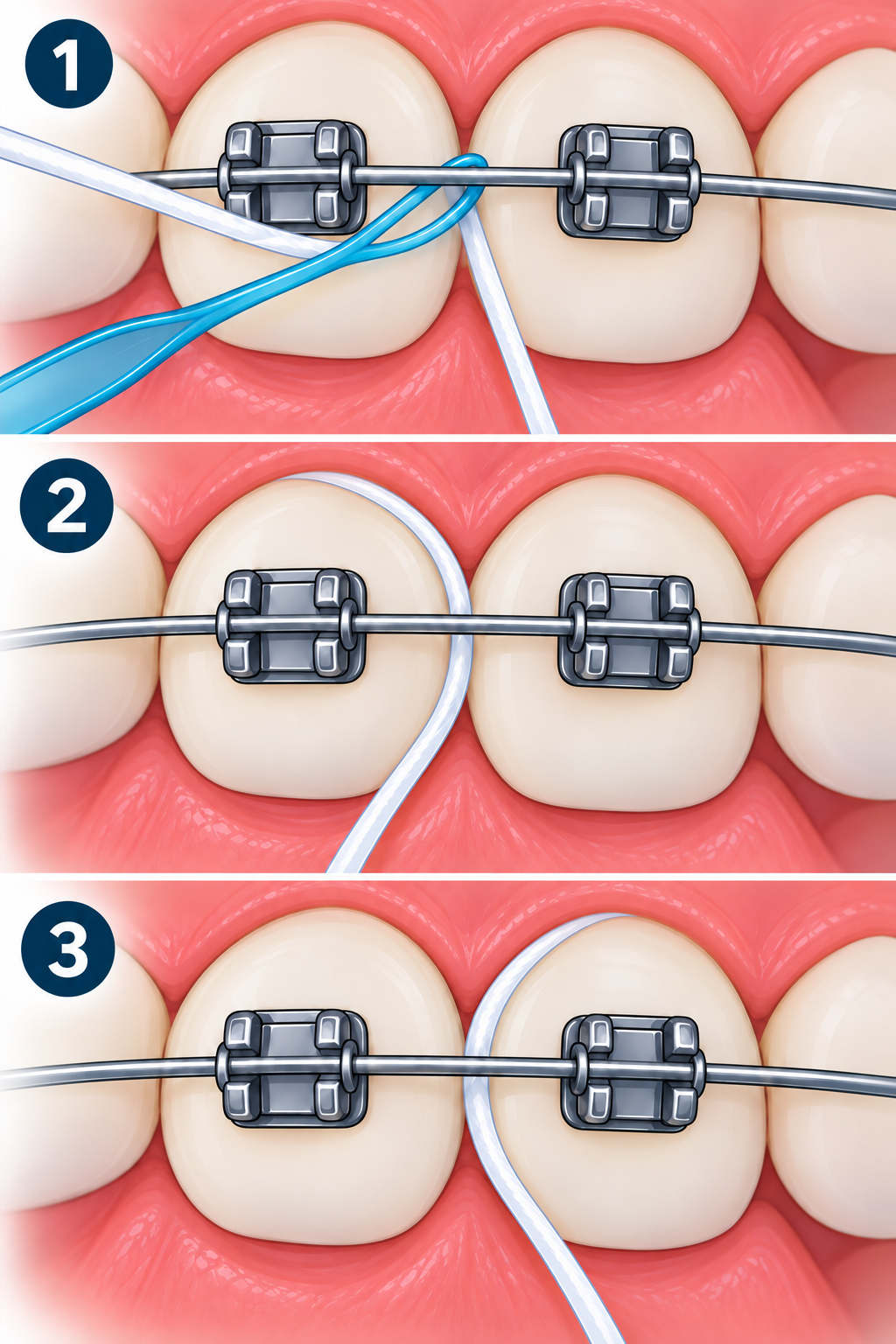
How to use floss under an archwire
1. Guide the floss under the wire
Place the firm end of the threader between two brackets and pass it under the archwire. Pull enough floss through to hold it securely with both hands.
Work slowly. Do not push the threader into the gums or pull hard against the wire.
2. Ease the floss between two teeth
Guide the floss through the contact with a gentle back-and-forth motion. Avoid snapping it toward the gums.
If the contact is tight, slow down rather than forcing the floss. Waxed floss or another tool recommended by your dental team may be easier to control.
3. Clean one tooth at a time
Curve the floss into a C shape against one tooth. Move it gently up and down along the tooth surface and just below the gumline.
Then curve the floss around the neighboring tooth and repeat. Each space has two tooth surfaces to clean.
4. Remove the floss carefully
Ease the floss back out from between the teeth, then pull it out from under the archwire. Do not tug upward against a bracket or wire.
Move to a clean section and repeat at the next space. A consistent order can make it easier to remember where you have cleaned. How to Floss Properly explains the C-shape motion in more detail.
What about interdental brushes?
A small interdental brush can help clean around brackets and under wires, and some people use one between teeth where there is enough room. Slide it gently into an open space without forcing it. The correct size matters, so ask your dental team which spaces it fits and how to angle it around your appliance.
An interdental brush does not automatically replace floss in every tight contact.
Can a water flosser make braces easier?
A water flosser may be practical when braces make other tools difficult to maneuver. Follow the device directions, begin with a comfortable pressure, and guide the stream around brackets, along the gumline, and between teeth without forcing the tip into the tissues.
Water flossers and string floss work differently, and research does not establish one universal best tool for every mouth. What Is a Water Flosser? explains what the device does and where evidence is limited.
How often should you clean between teeth?
The American Dental Association recommends cleaning between teeth once a day with floss or another interdental cleaner. With braces, the routine may take longer at first. It often becomes quicker once threading and following the same order feel familiar.
Choose a time when you are not rushed. Keeping the threader or other tool beside your toothbrush can make it easier to get started.
Common problems
“The floss keeps shredding”
Do not keep pulling hard. Try a fresh section and a slower motion. If floss repeatedly shreds or catches in the same place, ask your orthodontic or dental office to check the area.
“I cannot get under the wire”
Check that you are approaching the open space between brackets rather than pushing against a bracket. Stiff-ended floss or a holder designed for braces may be easier than a separate threader. Your orthodontic team can demonstrate the path around your appliance.
“My gums bleed”
Bleeding can happen when gums are inflamed or the technique is too forceful, but an article cannot tell you the cause. Do not snap the floss harder or avoid one area indefinitely.
Contact a dental professional if bleeding is persistent, worsening, focused in one area, or accompanied by swelling, pain, or another change that concerns you.
“A bracket or wire feels loose”
Stop pulling floss around the loose area and contact your orthodontic office for instructions. Do not try to remove, bend, or repair the appliance yourself.
The main takeaway
Guide floss under the archwire, ease it between two teeth, curve it around each tooth in turn, and remove it without tugging on the appliance. A threader, orthodontic floss, interdental brush, or water flosser may make the routine easier, but the right fit depends on the space and appliance.
Aim for careful daily cleaning, not speed. If a tool will not fit, floss repeatedly catches, your gums keep bleeding, or part of the braces feels loose, ask your dental or orthodontic team for help rather than forcing it.
Sources
- Dental Floss/Interdental Cleaners — American Dental Association
- Flossing — MouthHealthy / American Dental Association
- 6 Teeth Cleaning Essentials to Have When You're On The Go — American Association of Orthodontists
- How Do Braces Work? — American Association of Orthodontists
- Bleeding Gums — MouthHealthy / American Dental Association