Baby teeth are temporary, but they are doing important work right now. They help a child chew, learn to speak, and stay comfortable while the mouth and jaws grow. They also help guide and hold space for permanent teeth. So “they will fall out anyway” is not a reason to ignore them.
What do baby teeth do?
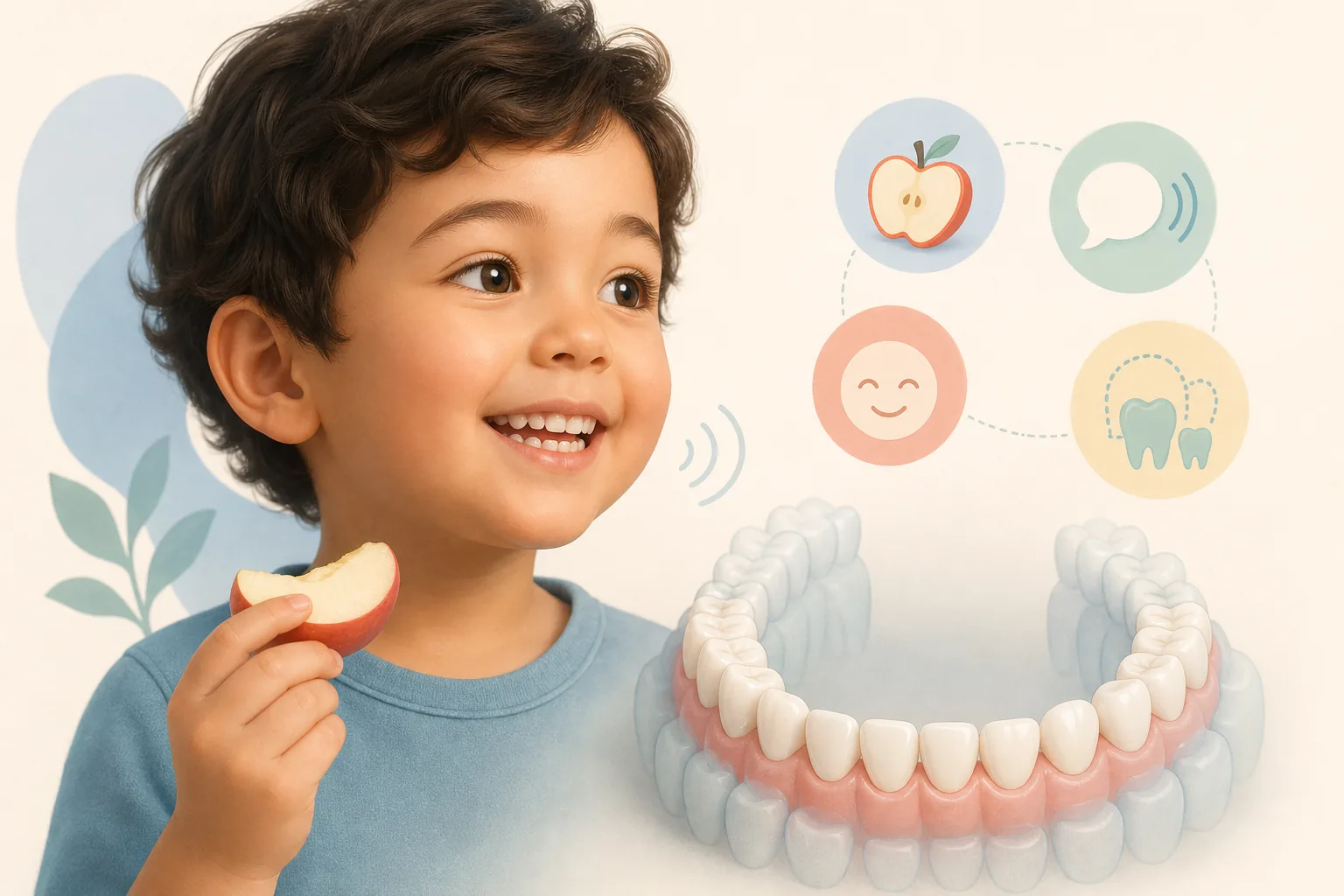
Children usually have 20 primary teeth. Those teeth support several parts of everyday childhood:
- Eating: teeth help children bite and chew a varied diet.
- Speaking: teeth work with the lips and tongue to help form sounds.
- Comfort and participation: untreated decay can cause pain and make eating, sleeping, playing, or learning harder.
- The next set of teeth: primary teeth help preserve a path and space for permanent teeth as they develop and erupt.
If a baby tooth is lost or damaged earlier than expected, the effect depends on the tooth, the child’s development, and the reason it was lost. Early loss does not guarantee a spacing problem, but it is worth discussing with a dentist because nearby teeth can move into the space.
When do baby teeth come in?
Timing varies. A first tooth often appears around 6 months, but some children get a first tooth later. Most children have 20 primary teeth by about age 3. These are general ranges, not milestones every child must meet on an exact schedule.
If you are concerned about a child’s eruption pattern, missing tooth, pain, swelling, injury, unusual spot, or difficulty eating, a dentist can assess the individual situation. A parent cannot confirm tooth health or development from timing alone.
Why care if they will fall out?
Baby teeth can develop cavities as soon as they erupt. Untreated decay can cause pain and infection, and the effects may reach beyond the tooth: a child may find it harder to eat, sleep, play, speak, or learn. That is why the CDC describes early prevention and dental care as part of protecting a child’s health and daily life.
Care also gives children time to learn a routine. Start with the age-appropriate steps in this guide to cleaning a baby’s mouth and teeth. As teeth appear, brush twice daily with a soft, small-headed toothbrush and fluoride toothpaste as recommended for the child’s age. For toothpaste amounts, see how much toothpaste children should use. A caregiver may need to do or supervise brushing until the child can clean effectively and spit reliably.
When should a child first see a dentist?
The AAPD recommends a first dental visit when the first tooth appears or no later than the first birthday. The visit can help a parent learn what is normal, review brushing and feeding habits, and identify concerns early. Follow-up timing depends on the child’s needs and the dentist’s advice; there is no single schedule that fits every family.
When to call a dentist—and when it is urgent
Contact a dentist if a child has tooth pain, a cavity concern, repeated difficulty eating or sleeping, swelling, an injury, a tooth that is lost earlier than expected, or a change that does not seem to be settling. These signs do not identify a cause by themselves, and this article cannot diagnose a child.
Seek urgent medical or dental help if swelling is rapidly increasing, involves the face, eye, mouth, or neck, or makes it difficult to breathe, swallow, or speak. Heavy bleeding after an injury or a serious face or jaw injury also needs urgent care. Local emergency instructions vary, so use your local emergency service for immediate danger.
Common questions from parents
Are baby teeth less important because they are temporary?
No. They are temporary, but they support eating, speech, comfort, and the developing path for permanent teeth. Their care matters for as long as they are present.
Is a late first tooth always a problem?
No. Tooth eruption varies, and a date on its own cannot diagnose a problem. Ask a dentist if the pattern concerns you or if there is pain, swelling, or another change.
Can a parent tell whether a baby tooth is healthy by looking at it?
Not reliably. A visible spot, color change, or lack of pain may need professional evaluation. A dentist can examine the tooth and recommend next steps based on the child’s history and findings.
The bottom line
Baby teeth do not last forever, but they matter while they are here. They help children eat and speak, support comfort and daily participation, and help guide permanent teeth. Gentle daily care, a first visit by age 1, and timely professional advice when something changes give families a safer, calmer start.
Sources
- Baby Teeth — American Dental Association MouthHealthy
- Toothbrushes — American Dental Association
- Frequently Asked Questions — American Academy of Pediatric Dentistry
- Oral Health Tips for Children — Centers for Disease Control and Prevention
- Toothache — NHS