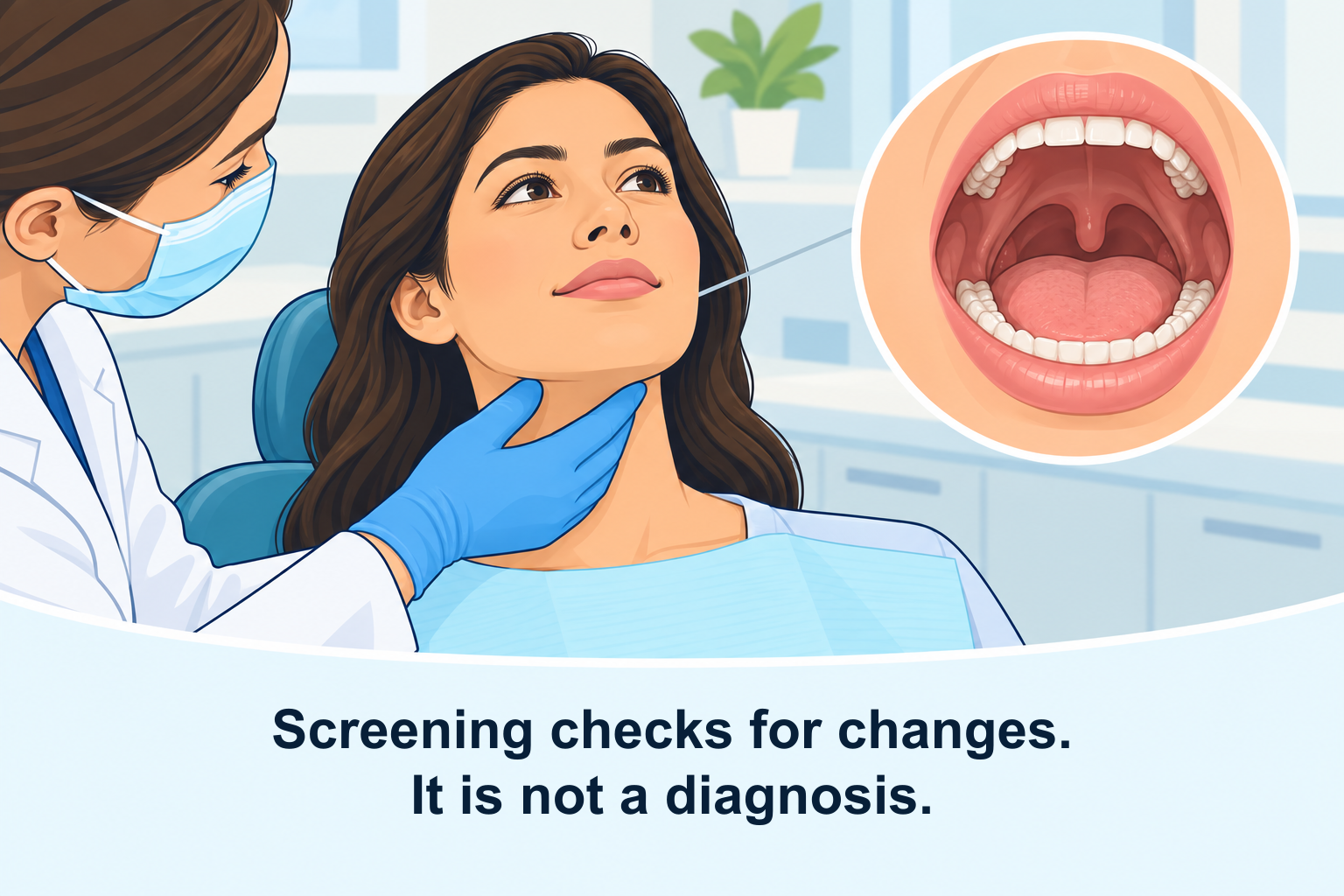
Oral cancer screening is a check for unusual changes in and around the mouth that may need a closer look. A dental professional may inspect the mouth and feel selected areas of the mouth, jaw, and neck. This examination may be included in a dental visit, although the exact process varies.
Screening is not a diagnosis. Many unusual findings are not cancer, but an area may still need to be rechecked or evaluated further. A normal screening also cannot guarantee that every condition is absent.
Screening is a check, not a diagnosis
These terms describe different steps:
- Screening looks for changes that may deserve closer evaluation, often before a person has a known diagnosis.
- Diagnostic evaluation gathers more information about a symptom or finding. It may include another examination, a specialist assessment, or additional tests.
- Referral means another qualified professional is asked to evaluate the area. A referral is a step toward clarification, not a diagnosis.
- Tissue biopsy means removing a small tissue sample so it can be examined. It is the reference standard used to diagnose oral cancer and certain potentially cancerous disorders.
- Definitive diagnosis is the conclusion reached after the appropriate clinical and laboratory information is evaluated.
A screening examination cannot determine the exact cause of every color change, sore, lump, or thickened area. It also cannot “clear” someone indefinitely.
What may happen during an oral cancer screening?
The dental professional may first ask about symptoms or changes you have noticed, along with relevant health history, including tobacco and alcohol use when relevant. Depending on the visit and the practice, the examination may include:
- inspecting the lips and the inside of the cheeks
- looking at the gums
- examining the tongue and the floor of the mouth
- looking at the roof and visible back areas of the mouth
- feeling selected areas inside the mouth
- feeling areas along the jaw and neck
The order, tools, and exact areas examined are not identical in every office. A dental hygienist may take part in the examination, and the dental team may share findings. Our guide to what a dental hygienist does explains how dental-team roles can vary.
What kinds of changes may receive closer attention?
A dental professional may note a change in color or texture, a sore, a lump, a thickened area, asymmetry, unexplained bleeding, or another change that appears unusual or persistent.
These are not cancer-specific findings. Many conditions can change how an area looks or feels. Appearance alone generally cannot establish the cause, which is why an unusual screening finding does not automatically mean cancer.
What can screening tell you—and what can’t it tell you?
Screening can identify an area that may deserve more attention. It generally cannot establish:
- whether the area is cancer
- the exact cause of the change
- whether every abnormal condition is absent
- whether no future change will occur
False-positive and false-negative screening results can occur. In plain language, an examination can raise concern about an area that is not cancer, or it can appear normal even though a condition is present. If you notice a change or develop a symptom, mention it even if a previous screening was normal.
There is also a difference between examining a patient for concerning changes and proving that a screening program improves outcomes across a population. The U.S. Preventive Services Task Force has found insufficient evidence to determine the balance of benefits and harms of screening asymptomatic adults in primary-care settings. That statement does not evaluate screening by dentists or ear, nose, and throat specialists. The National Cancer Institute likewise notes that studies have not shown that oral-cavity screening lowers the risk of dying from the disease. These evidence limits do not make a symptom or clinical finding unimportant; diagnostic evaluation after a concern is found is a different question.
What happens if something unusual is found?
The next step depends on the area, the history, and the clinician’s assessment. Possibilities may include:
- examining the area again after an interval
- documenting and monitoring it for change
- referring you to a clinician with relevant expertise
- using additional testing
- performing a biopsy when clinically appropriate
No one screening result determines which step is right for every person. A recommendation for follow-up means the clinician wants more information or wants to make sure the area is not lost to follow-up; it does not by itself mean that cancer has been diagnosed.
If the explanation is unclear, ask what was found, what remains uncertain, what the next step is meant to clarify, and when the office wants to reassess it. Questions to Ask When a Dentist Finds a Tooth Problem offers a general conversation framework that can also help you organize those questions.
What about lights, dyes, or rinses?
Some practices use lights, dyes, rinses, or cell-collection tools in addition to the clinical examination. These adjuncts do not replace professional judgment, and an abnormal result is not a diagnosis.
Evidence and recommendations depend on the method and setting. Current American Dental Association guidance does not support using certain light-based or vital-staining adjuncts to decide who needs biopsy or referral, or to screen asymptomatic adults who have no visible mucosal abnormality. If an adjunct is offered, you can ask what information it is intended to add and what its limits are.
When should you mention a mouth or throat change?
Tell a dentist or medical professional about a change that persists, keeps returning, or concerns you. Examples worth discussing include:
- a sore that does not resolve
- a persistent lump or thickened area
- unexplained bleeding
- persistent numbness in the mouth or tongue
- ongoing difficulty swallowing
- an unexplained voice or throat change
- a persistent red or white area
These symptoms can have causes other than cancer. The point of discussing them is to get an appropriate examination, not to identify the cause from a list or photograph. New trouble breathing or swallowing, rapidly spreading swelling, heavy bleeding that will not stop, or another emergency warning belongs in Emergency Dental Guidance.
How screening fits into a dental visit
An oral cancer screening may be one part of a broader dental examination. A checkup can also include a health-history update, evaluation of the teeth and gums, and a discussion of findings. What Happens at a Dental Checkup? explains that broader visit without replacing this focused screening guide.
Tobacco use, alcohol use, and older age are among recognized risk factors. HPV infection is an important risk factor for oropharyngeal cancer, which arises in the throat behind the mouth, rather than for oral-cavity cancer generally. These factors do not create a personal diagnosis or risk score, and having no recognized risk factor does not guarantee that no disease is present. Tell the dental professional about relevant history and any current change so the examination can be interpreted in context.
The main takeaway
Oral cancer screening is an examination for changes that may need closer evaluation. It is not a biopsy, a definitive diagnosis, or a guarantee that every condition is absent. An unusual finding may have a noncancerous explanation, but follow-up may still be important. The most useful next step is to understand what was noticed, what the screening can and cannot show, and how the dental or medical professional plans to clarify it.
Sources
- Oral Cancer — National Institute of Dental and Craniofacial Research
- Cancer (Head and Neck) — American Dental Association
- Recommendation: Oral Cancer: Screening — U.S. Preventive Services Task Force
- Oral Cavity and Nasopharyngeal Cancers Screening — National Cancer Institute